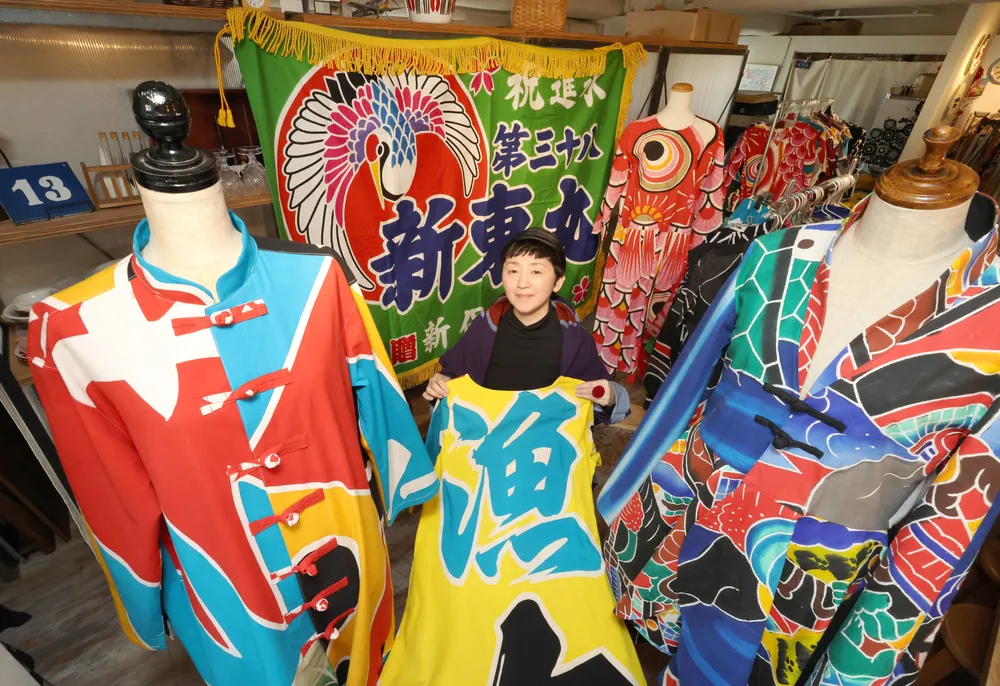
“Celebrating a Great Catch.” The vibrant red, blue, and yellow dress breathes with the skill of the dyeing artisans, once etched onto the celebratory fishing flags that weathered the sea breeze on boats.
Giving new life to used celebratory fishing flags is the Sapporo-based brand “sabumekko,” which sells clothing and bags. The items are handmade by the designer (58)….
sabumekko
“Sabumekko” refers to a traditional Japanese wooden doll from the Tohoku region, often associated with the Aomori Prefecture. Historically, these dolls were carved by fishermen during the winter months as protective charms for safe voyages and bountiful catches. Today, they are recognized as a local folk craft symbolizing good fortune and are sometimes given as gifts for luck and protection.
celebratory fishing flags
“Celebratory fishing flags,” known as **koinobori** in Japan, are traditional carp-shaped windsocks flown annually during Children’s Day (May 5th) to celebrate children’s health and success. Their history dates back to the Edo period (1603-1868), originating from samurai families who displayed warrior flags and later evolved to symbolize strength and perseverance like a carp swimming upstream. Today, they are a colorful national tradition, with each carp often representing a family member.
carp streamers
Carp streamers, known as **koinobori** in Japan, are colorful, wind-sock shaped decorations traditionally flown outdoors to celebrate **Children’s Day (Kodomo no Hi)** on May 5th. Their history dates back to the Edo period (1603-1868), originating from a samurai tradition of flying flags and banners to honor sons and wish for their strength and success, inspired by the Chinese legend of a carp that swims upstream to become a dragon. Today, they symbolize the wish for all children to grow up healthy, determined, and able to overcome life’s obstacles.
Sapporo
Sapporo is the capital city of Hokkaido, Japan, founded officially in 1868 during the Meiji era as part of a planned development of Japan’s northern frontier. It is now internationally famous for hosting the 1972 Winter Olympics and its annual Sapporo Snow Festival, which began in 1950. The city’s modern grid layout and beer-brewing history, starting with the Sapporo Brewery in 1876, reflect its deliberate establishment and Western influences.