The 13th Hakone Ekiden after 41 years: A 65-year-old University of Tokyo professor becomes the “water station uncle.”
The final stages of the 9th leg (23.1 km) were approaching.
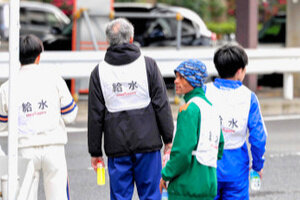
Just before the 15 km mark after receiving the sash at the Totsuka relay point. Among the student volunteers waiting to hand water to the passing runners was one man with graying hair.
Hideo Hatta (66). A sports physiologist and professor (now emeritus) known for his research on lactic acid.
His figure, raising both hands to cheer on the runners, was broadcast on television and became a topic on social media. He came to be called the “Water Uncle.”
Why was he chosen to be a “water handler”?
“Please Hand Me Water” An Unexpected Request
It began in early December of the previous year.
At Hatta’s laboratory on the University of Tokyo’s Komaba campus, a graduate student (at the time), Hiroaki Furukawa (30), came to visit.
Furukawa had been selected as a member of the “Kanto Student Union Team,” composed of runners from teams that did not qualify for the main Hakone Ekiden race. He had been assigned to run the 9th leg and came that day to report to Hatta, who was also the track and field club director.
“I’ve been chosen to run. And so, I’d like to ask you to hand me water.”
Hatta was taken aback.
A water handler is a team-assigned crew member who hands a water bottle to a runner on the course.
Until then, while there had been University of Tokyo runners on the union team, the water handlers had always been University of Tokyo students.
Furthermore, it required running alongside an athlete maintaining a pace of around 18 seconds per 100 meters. Although Hatta was a University of Tokyo track and field club alumnus and had been a hurdler and decathlete in his student days, he was 65 years old at the time.
Lacking confidence, Hatta said,
“I might not be able to run.”
Nevertheless, Furukawa insisted.
“I will stop to receive it…”
Totsuka relay point
The Totsuka relay point was a key station on the historic Tōkaidō road during Japan’s Edo period (1603-1868), located in present-day Yokohama. It served as a vital rest stop for travelers and officials, providing stables, lodgings, and a place to change horses between Edo (Tokyo) and Kyoto. While the original structures are gone, the area’s name and some historical markers preserve its legacy as part of Japan’s extensive pre-modern transportation network.
Hakone Ekiden
The Hakone Ekiden is a famous annual university relay race in Japan, held each January, where teams run from Tokyo to Hakone and back over two days. Established in 1920, it was inspired by the Olympic marathon and was created to foster endurance and teamwork in student athletes. The race is a major national television event, deeply embedded in Japanese New Year tradition and university sports culture.
University of Tokyo
The University of Tokyo, founded in 1877 as Japan’s first modern national university, was established during the Meiji era to advance Western knowledge and technology. It has since grown into the nation’s most prestigious academic institution, known for its significant contributions to research and for educating many of Japan’s leading figures in politics, science, and industry. Its historic main campus in Hongō features the iconic Akamon (Red Gate) and Yasuda Auditorium, symbols of its long academic tradition.
Komaba campus
The Komaba campus is the main campus of the University of Tokyo’s College of Arts and Sciences, serving as the center for undergraduate liberal arts education. Historically, the site was originally an army parade ground before being repurposed for the university’s First Higher School and later its general education division after World War II. Today, it is known for its vibrant student life and distinctive red-brick buildings.
Kanto Student Union Team
The Kanto Student Union Team is a fictional organization from the “Pokémon” franchise, specifically representing the student body of the Pokémon Trainer’s School in the Kanto region. It appears primarily in the anime and games as a group of young trainers who compete in academic and Pokémon battle challenges, reflecting the series’ theme of education and camaraderie on the journey to become Pokémon Masters.