The First 5G-A Factory in Hubei’s Automotive Industry Features a Super Brain.
5G-A, short for 5G-Advanced, can be understood as an enhanced version of 5G, serving as an intermediate step in the transition from 5G to 6G. With faster speeds, greater stability, and enhanced capabilities, 5G-A has already demonstrated its value in areas like smart city construction and vehicle networking.
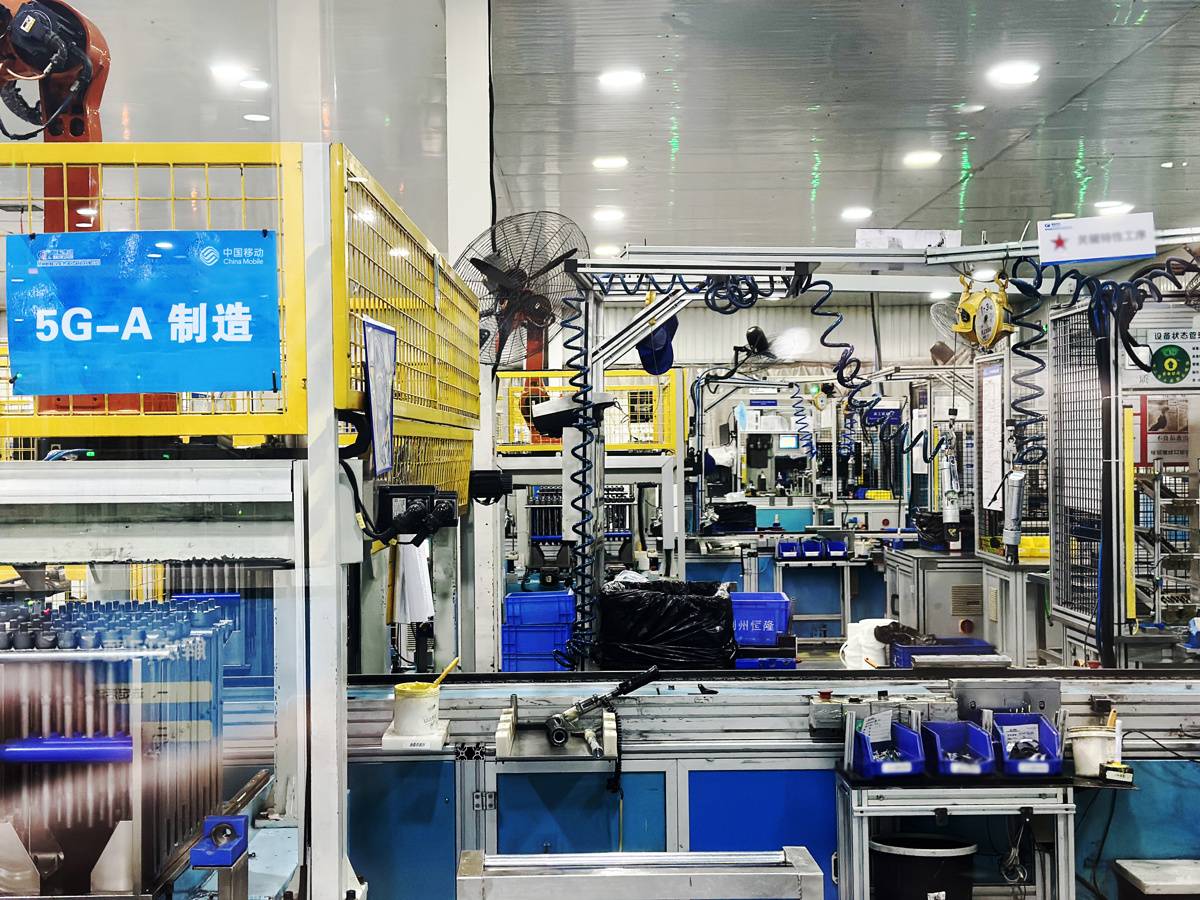
Warehouse No. 2 at the Jingzhou Henglong factory in Shashi District covers an area of 2,700 square meters and can store over 50,000 boxes of automotive steering component parts awaiting assembly. These parts will ultimately become part of the steering systems for well-known domestic and international car brands such as Ford, Volvo, Dongfeng, and FAW.
In such a large warehouse, all handling tasks are performed by just four “robot employees”—AGVs (Automated Guided Vehicles). Their human colleagues, with their hands freed, are only responsible for on-site management and monitoring.
When two vehicles meet, they automatically yield; they locate shelves with precision and autonomously complete picking and placing tasks; they effortlessly lift hundred-kilogram cargo boxes to a height of 4 meters… Why are these little carts so smart?
In the past, AGVs relied on onboard sensors like LiDAR and cameras to perceive their surroundings and navigate using fixed markers like magnetic strips or QR codes pre-installed in the warehouse. Consequently, they could only follow fixed routes. Deployment was troublesome, and changing routes was equally cumbersome.
Now, 5G-A acts as the AGVs’ “cloud super-brain.” The AGVs stream high-definition video from the site to the cloud in real-time. After the cloud brain calculates the optimal route, it transmits the instructions back within milliseconds. When encountering a temporary obstacle, the 5G-A network can complete new path planning within 20 milliseconds, ensuring the AGV’s transport doesn’t stall and its route doesn’t deviate. Even when multiple vehicles operate together, they are guaranteed to avoid collisions.
“These four vehicles can save over a million yuan in costs annually,” explained a technical lead from the planning and logistics department. The AGVs enable on-demand, precise material delivery, unaffected by time or operator skill, operating 24/7 without interruption. Warehouse operational efficiency has increased by over 40% compared to before.
AGVs need to transport goods back and forth, but how do they know where the goods are? On the cargo boxes on the warehouse shelves, there is a label slightly larger than a band-aid. Peeling back the label reveals its secret—an antenna and chip are hidden on the back.
These labels, costing as little as a few dimes, are the “nerve endings” of smart warehousing. They utilize the latest passive IoT technology. “Passive IoT means ‘power-free’ Internet of Things; they operate entirely on ‘borrowed’ energy,” explained a deputy team leader from a 5G IoT project group.
It turns out the warehouse is equipped with numerous 5G-A base stations about the size of a biscuit tin. When these passive tags enter the electromagnetic wave coverage area of a 5G-A base station, their built-in antennas capture these waves. The chip then converts the captured electromagnetic energy into its own power. Once activated, the tag immediately “reflects” its location information back to the warehouse management platform. Even with thousands of tags working simultaneously, anti-collision algorithms prevent chaos.
Leveraging this technology, thousands of pallets, cargo boxes, and tools within the factory are transformed into perceptible, traceable, and interactive smart nodes. Goods with these tags enable unmanned, automated inventory management and precise positioning… Coupled with the efficient data backhaul of the 5G-A network, this enables fully digitalized process
Hubei Jingzhou Henglong Automotive Parts Manufacturing Co., Ltd.
Hubei Jingzhou Henglong Automotive Parts Manufacturing Co., Ltd. is a specialized automotive parts manufacturer based in Jingzhou, Hubei province, China. While specific founding details are not widely published, it operates within China’s major automotive industry region and focuses on producing components such as steering systems, contributing to the local and national supply chain.
Jingzhou Henglong factory
The Jingzhou Henglong factory is a manufacturing facility in Jingzhou, China, primarily known for producing scale model vehicles, especially radio-controlled tanks and military vehicles. While specific details of its corporate history are not widely documented in public cultural archives, it operates as a significant industrial site within the global hobby and toy manufacturing sector.
Shashi District
Shashi District is a historic urban district within Jingzhou City in Hubei Province, China, situated along the Yangtze River. It has a history dating back over 2,700 years and served as a major port and strategic military location during various dynastic periods, including the Three Kingdoms era. Today, it is a key commercial and transportation hub for the region, blending its ancient past with modern development.
Ford
“Ford” most commonly refers to the **Ford Motor Company**, the American multinational automobile manufacturer founded by Henry Ford in 1903. It revolutionized transportation and industry by introducing the moving assembly line for mass production, most famously with the Model T, making cars affordable for the general public. Today, it remains one of the world’s largest and most iconic automotive companies.
Volvo
Volvo is a Swedish automotive manufacturing company, not a specific place or cultural site. Founded in 1927 in Gothenburg, it has a history of pioneering safety innovations, such as the three-point seatbelt, which became its global hallmark. Today, it is known for producing cars, trucks, and buses, with a strong reputation for durability and safety engineering.
Dongfeng
“Dongfeng” (东风) is a common place name in China, often meaning “East Wind,” and does not refer to one specific, universally recognized historical or cultural site. It is most famously associated with the Dongfeng Motor Corporation, a major state-owned automobile manufacturer founded in 1969 in Shiyan, Hubei province, which was originally established as part of China’s “Third Front” industrial development strategy. Therefore, its primary historical significance lies in its role in China’s modern industrial and automotive history rather than in ancient culture.
FAW
“FAW” refers to First Automobile Works (中国第一汽车集团), a historic Chinese state-owned automotive manufacturing company founded in 1953 in Changchun. It was China’s first modern automobile factory, established with Soviet assistance, and produced the country’s first domestically made truck, the Jiefang CA10, symbolizing the nation’s early industrial development. Today, FAW Group remains one of China’s largest vehicle manufacturers, producing a wide range of passenger and commercial vehicles.