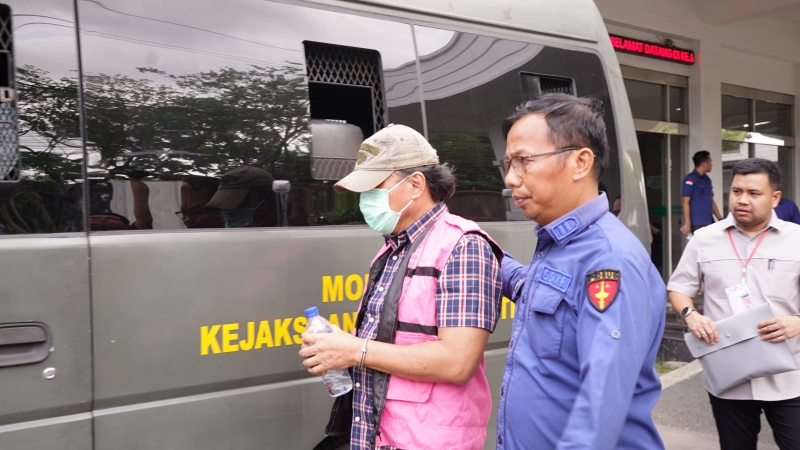
Investigators from the Special Crimes Unit of the North Sumatra High Prosecutor’s Office have named a new suspect in the alleged corruption case concerning Non-Tax State Revenue at Belawan Port. The suspect is Rivolino (61), the former Head of the Belawan Harbor Master and Port Authority Office for the period from October 2023 to October 2024.
The suspect was named after investigators found at least two sufficient pieces of evidence related to alleged irregularities in the management of pilotage and ship delay services.
It was explained that according to regulations, the obligation to use tug pilotage services falls under the authority of the port authority. If such services are not available, their implementation can be delegated to a qualified port business entity, as regulated by Minister of Transportation Regulation Number 57 of 2015.
In practice, the service provision had been delegated to PT Pelindo Regional 1 Belawan. However, discrepancies were found in the data of ships required to use tug pilotage services, specifically ships with a tonnage above 500 GT.
“Based on data from Sailing Approval Letters for 2023 to 2024, there were ships that should have fallen into the mandatory pilotage category but were not recorded in the reconciliation data signed by the suspect along with three other suspects,” the statement said.
As a result of these actions, the state is suspected to have suffered losses reaching billions of rupiah from the Non-Tax State Revenue sector. Investigators are currently deepening the probe and coordinating with related institutions to calculate the exact loss value.
For his actions, the suspect is charged under Article 2 paragraph (1) subsidiary to Article 3 in conjunction with Article 18 of Law Number 31 of 1999 as amended by Law Number 20 of 2001 concerning the Eradication of Criminal Acts of Corruption, as well as provisions in the latest Criminal Code.
Rivolino has been detained for the next 20 days at the Class IA Tanjung Gusta Detention Center in Medan, effective from March 26, based on a detention order signed by the Head of the North Sumatra High Prosecutor’s Office.
Previously, investigators had already detained three other suspects, namely WH, MLA, and SHS, who are also related officials within the Belawan KSOP environment in the same case.
The North Sumatra High Prosecutor’s Office emphasized it will continue to develop this case and does not rule out the possibility of new suspects if involvement of other parties is found.
North Sumatra High Prosecutor’s Office
The North Sumatra High Prosecutor’s Office is a key Indonesian law enforcement institution located in Medan, responsible for prosecuting criminal cases and supervising lower prosecutor’s offices within the province. Historically, Indonesia’s prosecutor’s office system, known as the **Kejaksaan Agung**, was formally established after independence, with regional high offices like this one created to uphold state law across the archipelago. It operates under the national framework to ensure legal enforcement and justice in North Sumatra.
Belawan Port
Belawan Port is a major seaport located in Medan, Indonesia, serving as the primary international gateway for North Sumatra. Historically, it was developed by the Dutch colonial government in the late 19th century to export the region’s key commodities, such as rubber, palm oil, and tobacco. Today, it remains a vital economic hub for trade and logistics in the western Indonesian archipelago.
Belawan Harbor Master and Port Authority Office
The Belawan Harbor Master and Port Authority Office is the administrative center for Belawan Port, the main international seaport of Medan and North Sumatra, Indonesia. Established during the Dutch colonial era in the late 19th century, the port was developed to export the region’s key commodities, such as tobacco and rubber, and the office has since overseen its evolution into a major hub for container and bulk cargo.
PT Pelindo Regional 1 Belawan
PT Pelindo Regional 1 Belawan is the regional branch of Indonesia’s state-owned port operator, Pelindo, responsible for managing the Port of Belawan in North Sumatra. Historically, Belawan has been a crucial maritime gateway since the colonial era, serving as the main port for the city of Medan and the export of key regional commodities like palm oil, rubber, and coffee. Today, it remains a vital hub for national and international trade in the western Indonesian archipelago.
Class IA Tanjung Gusta Detention Center
The Class IA Tanjung Gusta Detention Center is a high-security prison located in Medan, North Sumatra, Indonesia. Historically, it was originally built by the Dutch colonial government in the 1920s. It is known for holding high-profile inmates and has faced criticism over the years for issues of overcrowding and prison conditions.
Medan
Medan is the capital and largest city of Indonesia’s North Sumatra province, historically a key trading hub due to its strategic location on the Strait of Malacca. Its modern development was significantly shaped by the 19th-century Dutch colonial plantation industry, particularly for tobacco, which led to the construction of landmarks like the grand Maimun Palace, the former sultan’s residence. Today, it is a bustling commercial center known for its diverse cultural mix of Malay, Batak, Chinese, and Indian influences.
KSOP Belawan
KSOP Belawan is the port authority office for the Port of Belawan, the main international seaport serving Medan and North Sumatra, Indonesia. Historically, the port was developed in the late 19th century under Dutch colonial rule to export the region’s key commodities, such as rubber, palm oil, and tobacco. Today, KSOP (Kantor Syahbandar dan Otoritas Pelabuhan) manages maritime safety, security, and commercial activities at this vital economic gateway.
Minister of Transportation Regulation Number 57 of 2015
“Minister of Transportation Regulation Number 57 of 2015” is not a physical place or cultural site; it is a legal document issued by the Indonesian government. This regulation specifically governs the technical requirements and operational standards for railway crossings in Indonesia, aiming to improve safety and standardization across the national railway network.