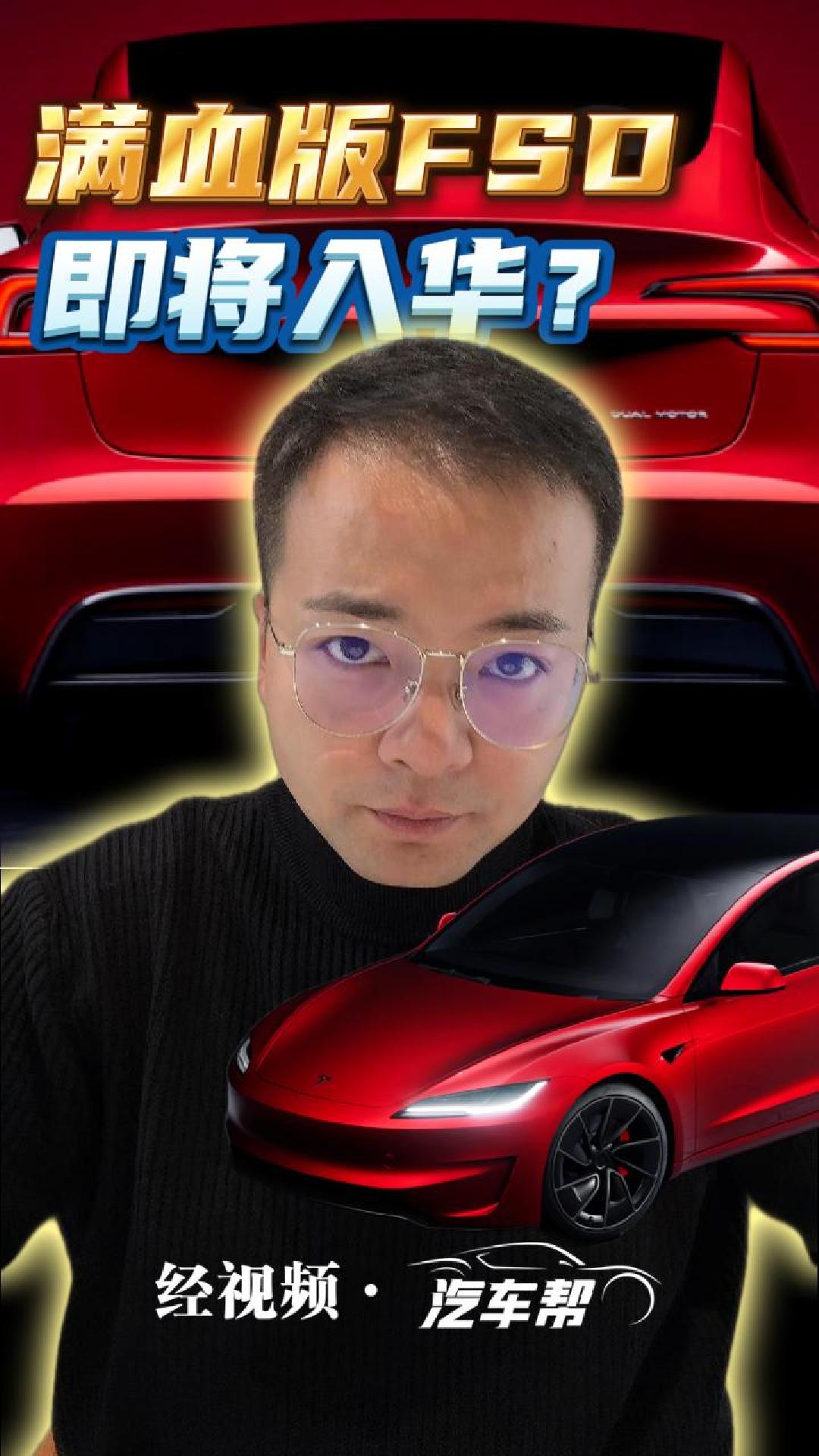
Musk stated at the Davos Forum that the full-featured version of FSD could enter China as early as February; combined with Tesla’s official confirmation earlier that starting February 14th, FSD will no longer be available for a one-time purchase, shifting to a subscription-only model. How true is this news? If the current neutered version of FSD, which can run red lights and go the wrong way, is really replaced by the full-featured version in the future, will it create a major stir like the localization did initially? First, according to a report on January 23rd, Musk clarified on January 22nd local time that the supervised version of FSD is expected to gain approval in Europe next month, with China’s approval process roughly following a similar timeline. This is not sudden; last November he predicted approval in China around February or March of this year, and now the implementation schedule has become clearer. The probability of the full-featured version entering China is not low, with two key hurdles to clear: Policy-wise, Tesla’s Shanghai data center has achieved full local data storage, meeting compliance requirements; on the chip front, according to reports, the U.S. eased restrictions in January, paving the way for Nvidia’s H200 exports to China, aiding algorithm iteration. Technically, it needs adaptation to Chinese scenarios like cutting in line and temporary traffic signals. It’s pointed out that FSD iterates 2-3 times per month, optimized with local data, with a high hope for rollout in the first quarter. This already puts pressure on domestic automakers. The subscription model offers more flexibility for car owners: the original one-time purchase was 64,000 yuan, with the monthly fee expected to be 499-699 yuan. If just trying it out, the subscription is more cost-effective; for long-term use over 8 years, the one-time purchase is cheaper. This model also presents a challenge for domestic automakers. In the current third-party smart driving market, according to statistics, Huawei’s Qiankun smart driving holds a 53.7% market share by unified technical standards, while Xpeng and BYD rely on low-cost one-time purchases or standard inclusions to capture market share. Tesla’s subscription model will disrupt the existing balance. In the short term, domestic automakers will find it difficult to adopt a pure subscription model and will likely maintain a parallel approach of both purchase and subscription while accelerating technological iteration. He Xiaopeng has already made a bet to compete with FSD, indicating that industry competition will intensify comprehensively. In summary, the entry of the full-featured version into China is highly probable. The subscription model will force industry transformation. Domestic smart driving needs breakthroughs in both localization and business models. Competition in the sector will become more intense.
Davos Forum
The Davos Forum, officially known as the World Economic Forum (WEF), is an annual meeting held in Davos, Switzerland, that brings together global political, business, and cultural leaders to discuss pressing international issues. Founded in 1971 by German economist Klaus Schwab, it began as a conference on European business management but has since evolved into a major platform for shaping global, regional, and industry agendas. Today, it is widely recognized as a symbol of elite globalization and a key venue for public-private dialogue on economic, environmental, and social challenges.
Tesla
“Tesla” refers to the Serbian-American inventor and engineer Nikola Tesla (1856–1943), whose pioneering work in electricity and electromagnetism revolutionized modern power and communication systems. While not a physical site, his legacy is honored through institutions like the Nikola Tesla Museum in Belgrade, which preserves his personal items and inventions, celebrating his contributions to alternating current (AC) power and numerous technological innovations.
Nvidia
Nvidia is an American technology company founded in 1993, best known for designing powerful graphics processing units (GPUs) for gaming and professional markets. Its history is marked by pioneering the modern GPU, which later became essential for accelerated computing, artificial intelligence, and data science, transforming it into a global leader in semiconductor design.
Huawei
Huawei is a Chinese multinational technology corporation founded in 1987 by Ren Zhengfei. It has grown from a small telecom equipment reseller into one of the world’s leading providers of telecommunications equipment, smartphones, and consumer electronics. While not a traditional cultural site, it represents a significant part of modern China’s technological and economic history.
Xpeng
“Xpeng” refers to Xpeng Motors, a Chinese electric vehicle manufacturer founded in 2014 in Guangzhou. It is known for its focus on smart, AI-assisted driving technology and has grown to become one of China’s leading EV brands, competing globally with innovations in autonomous driving and connectivity.
BYD
“BYD” refers to BYD Company Ltd., a major Chinese multinational corporation founded in 1995 in Shenzhen. Originally a battery manufacturer, it has grown into a global leader in electric vehicles (EVs) and rechargeable batteries, playing a significant role in the global shift toward sustainable transportation. While not a traditional cultural site, it represents a key part of modern China’s technological and industrial history.
He Xiaopeng
“He Xiaopeng” does not refer to a specific place or cultural site. It is the name of a prominent contemporary Chinese businessman, currently the CEO of the electric vehicle company Xpeng. Therefore, it is not possible to provide a historical summary of a location by this name.
Shanghai data center
The Shanghai Data Center is a modern technological infrastructure hub, not a historical cultural site, that supports the city’s digital economy and cloud computing services. Its development reflects Shanghai’s rapid growth as a global financial and tech center in the 21st century, aligning with national initiatives like “Digital China.” While it lacks a long history, it represents the contemporary era of information technology and urban innovation.