Despite all the astonishing scientific progress in the world, nature still hides many secrets yet to be uncovered. In a quiet farm in the Austrian town of Carinthia, chance led to the discovery of an unusual aspect of behavior in a cow named “Veronica,” an incident that prompted scientists and specialists to reconsider the concept of animal intelligence, particularly in cattle.
The farmer owns the cow Veronica and has treated her as a pet since her birth, caring for her with special attention, pampering her, and providing her with the best types of food and comfort, so she lives a luxurious life away from the usual pressures of farm life.
Over time, a bond of familiarity developed between them, allowing him to notice the finest details of her daily behavior.
The Story of Cow Veronica
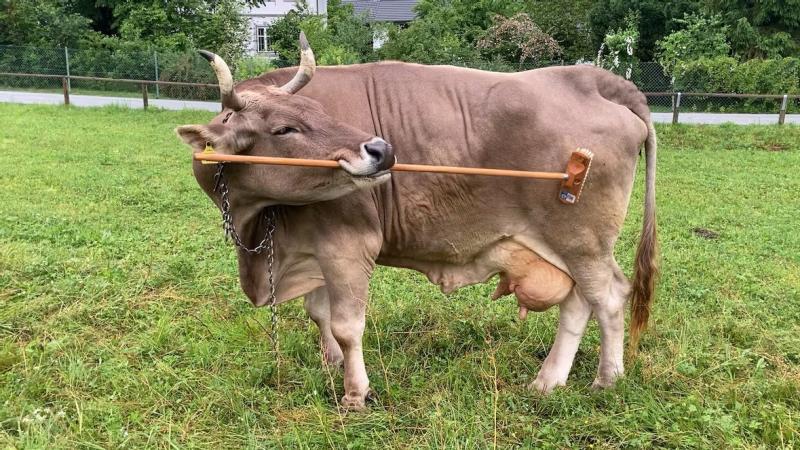
One day, it caught the farmer’s attention that Veronica plays with sticks and sometimes uses them to scratch her back and belly.
At first, he thought it was just random movements or unconscious actions, but he decided to observe her closely. As the scene repeated, he discovered that what she was doing was not spontaneous, but rather intentional and deliberate behavior.
It didn’t stop there. The farmer also noticed that Veronica possesses a remarkable ability to distinguish the voices of his family members individually and responds to their calls by quickly approaching them.
Veronica’s story spread quickly among local farmers, then its echoes reached scientific bodies specializing in animal behavior studies in the capital, Vienna, before media began to spotlight it.
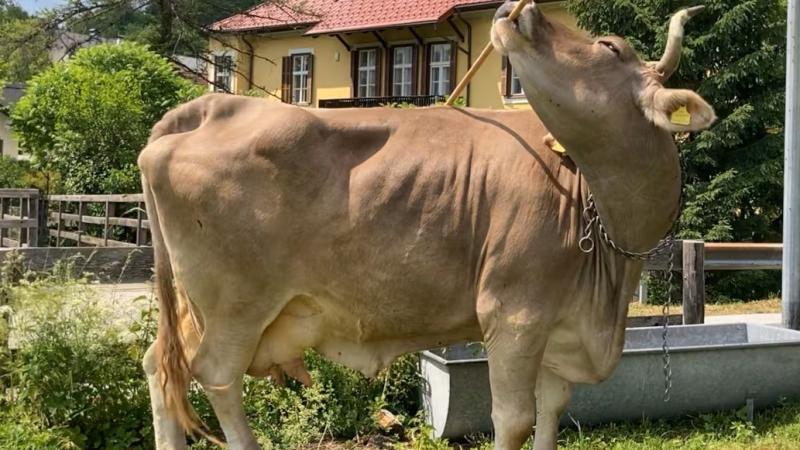
An extensive report on the story revealed that a mission of veterinarians went to the farm to conduct scientific tests aimed at verifying the truth of what was being circulated about this exceptional cow.
According to the report, Veronica underwent a series of field experiments that proved she is capable of skillfully using a broomstick depending on the intended purpose. If the stick was placed at an unsuitable angle, she would first use her tongue to readjust it, then secure it with her teeth and use it in a way that served her goal.
The report quoted the supervising veterinarian of the experiments as saying: “I sometimes think about how many lessons humans could learn from animals: patience, calmness, contentment, and kindness.”
After the success of these tests, scientists emphasized that the cow’s use of tools in multiple ways is rare behavior previously recorded only in humans and some primates, such as chimpanzees, which prompted them to radically reconsider the stereotype about cattle intelligence.
Although Veronica’s story represents a special case of a cow from the “Swiss Brown” breed, other scientific studies have confirmed that cows in general possess advanced cognitive and social abilities that far exceed the traditional view of them as simple animals. They enjoy long-term memory that enables them to remember food locations, perceive dangers, and recognize human and animal faces for many years.
They also show clear emotional responses, jumping when happy, making sounds to communicate with each other, and each cow possesses a unique “vocal fingerprint” through which it expresses its state and feelings.
On social media, the story sparked a wide debate.
One person wrote: “We had our cow who used to do such things, even unfastening her chain with her mouth. To the extent that when she needed something, like water, she would shake her head towards the water, so we knew she wanted it. Cows are sensitive, intelligent, and conscious creatures.”
Another said: “I can’t believe everyone is acting as if this is the first time a cow has picked something up to scratch itself with. I grew up raising cattle, so it’s not that strange.”
A content creator wrote: “If you are impressed by this cow’s intelligence, you should know that farm animals feel joy, boredom, fear, and pain just like you. If you are aware of that and still enjoy consuming animal products, you are a hypocrite. If you are unaware of that and still enjoy consuming animal products, you are a harmful person.”
Another person said: “After thousands of years from now,