Over the past year, global trade uncertainty has increased, yet China’s port throughput has grown against the trend.
In the first 11 months of the year, China’s ports handled 16.75 billion tons of cargo, a year-on-year increase of 4.4%. Correspondingly, China’s trade has maintained strong resilience amidst global economic fluctuations. In the first 11 months, China’s goods trade exports reached 24.46 trillion yuan, up 6.2% year-on-year.
Looking at the full year, major ports also delivered satisfactory results. Key hubs like Shanghai Port and Ningbo-Zhoushan Port remained among the world’s top ports, with Ningbo-Zhoushan Port becoming the world’s first port to exceed 1.4 billion tons in annual cargo throughput, and Shanghai Port’s container throughput ranking first globally for the sixteenth consecutive year. Emerging ports like Yangpu Port and Beibu Gulf Port showed outstanding growth momentum. In the year, Yangpu Port’s container throughput surged by 65% year-on-year, while Beibu Gulf Port entered the ranks of ports handling over 10 million TEUs.
Why has China’s port throughput been able to grow against the trend? On one hand, against the backdrop of slowing global trade growth and increasing geopolitical disruptions, the competitiveness of Chinese ports within the global shipping system has continued to improve. On the other hand, the commencement of operations under the Hainan Free Trade Port’s closed-off system, along with the intensive implementation of smart shipping and green shipping policies, is reshaping the port development environment from institutional and technological perspectives.
An expert noted that the stable growth in China’s port cargo and container volumes under unstable external conditions actually indicates the stable growth of China’s economic scale and international trade volume. Simultaneously, the capabilities of Chinese ports are transforming and upgrading, extending beyond traditional loading and unloading to become supply chain hubs, taking on more roles in logistics, distribution, and upstream-downstream coordination.
“Over the past year, the resilience of China’s ports has improved significantly. The stability and changes in total cargo throughput actually reflect adjustments to regional shipping route layouts and changes in the geopolitical landscape. The layout of shipping routes from Chinese ports to regions like Southeast Asia, Africa, and Latin America has shown a clear growth trend, driven behind the scenes by geopolitical shifts and the promotion of regional trade integration,” the expert said.
Throughput Reaches New Highs
Whether for major hub ports or emerging ports, it was a year of continuously breaking records for China’s major ports.
On December 30, a ceremony was held at the Beibu Gulf Shipping Center to mark Beibu Gulf Port’s container throughput surpassing 10 million TEUs, signifying its entry into the ranks of mega-ports handling over ten million containers.
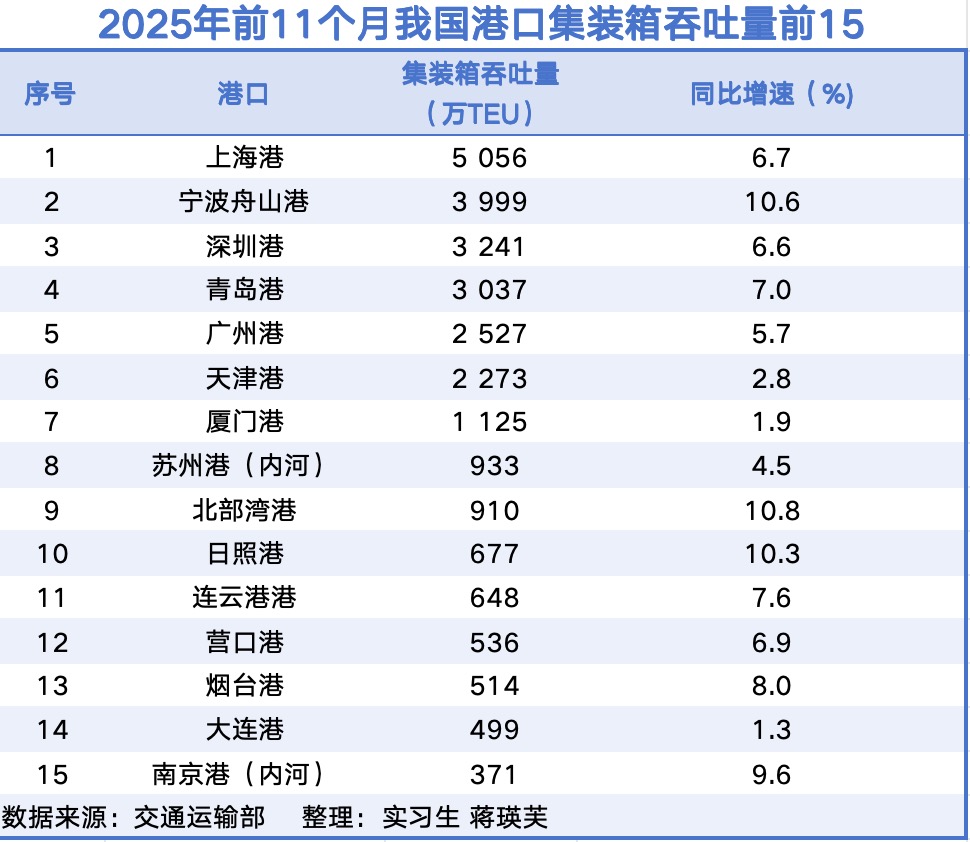
On the eastern coast, the Shanghai International Shipping Center also witnessed a historic moment. The port’s container throughput exceeded 55.06 million TEUs, setting another historical record and securing the top global position for the sixteenth consecutive year. During the same period, Ningbo-Zhoushan Port’s annual container throughput surpassed 40 million TEUs for the first time.
With the formal commencement of the Hainan Free Trade Port’s closed-off operations, the potential of Yangpu Port is being unleashed. The port’s container throughput reached 3.3 million TEUs, a 65% year-on-year increase, with its function as an international shipping hub continuously strengthening.
Looking at northern Chinese ports, Shandong Ports handled over 1.9 billion tons of cargo and over 47 million TEUs of containers. Among them, Qingdao Port, Rizhao Port, and Yantai Port saw their container throughput in the first 11 months grow by 7%, 10.3%, and 8% year-on-year, respectively.
An industry executive pointed out that against the backdrop of frequent changes in Sino-US tariff policies, China’s foreign trade overall still achieved steady growth. At the same time, China’s share of global container exports continued to rise, increasing from 34% in 2019 to 38%, fully demonstrating the competitiveness of Chinese manufacturing and technology, as well as the resilience of Chinese enterprises.
The executive stated that as the “going global” model shifts from the highly concentrated “Made in China, Sold Globally” to a more dispersed “Chinese Enterprises Manufacturing and Selling Globally,” a broader supply chain exodus is accelerating. Globalization is continuing and deepening in another form, with Chinese enterprises continuing to play a pivotal role.
<p