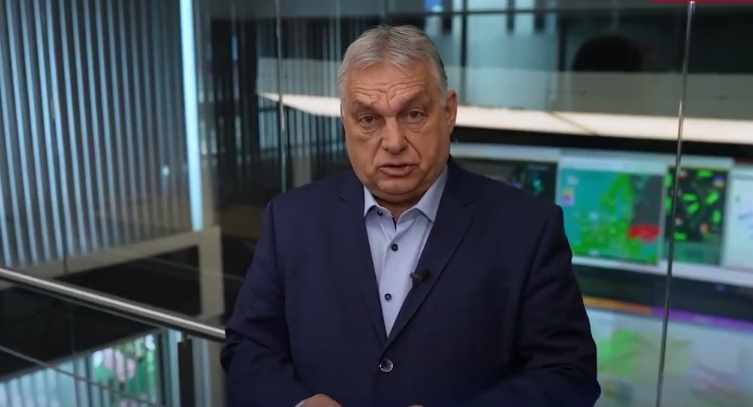
On February 22, local time, the Prime Minister of Hungary stated on social media that in response to the suspension of transit through the “Friendship” oil pipeline by Ukraine, Hungary will take all necessary measures to ensure energy supply security and will implement three countermeasures against Ukraine until crude oil transportation is restored.
The stated countermeasures include: halting diesel supplies to Ukraine; refusing to provide any military loans to Ukraine; and not supporting new EU sanctions against Russia, with a clear statement that Hungary will veto the 20th sanctions package.
It was emphasized that energy security is a matter of fundamental national interest, and any action endangering Hungary’s energy supply will be met with a firm response. Hungary will prioritize safeguarding its own economic and social stability and will take further action if necessary.
The transportation of Russian oil to Europe via the Ukrainian section of the “Friendship” pipeline has been suspended since January 27. Hungary and Slovakia have expressed dissatisfaction and placed the blame on the Ukrainian side.
The “Friendship” oil pipeline is a major pipeline system transporting Russian crude oil to Central and Eastern Europe. Its starting point is in Russia’s Samara Oblast in the southwest, with a northern branch running through Belarus to Poland and Germany, and a southern branch running through Ukraine to the Czech Republic, Slovakia, and Hungary.
Hungary
Hungary is a landlocked Central European nation with a rich history dating back over a millennium, founded by the Magyars in the late 9th century. Its cultural identity is deeply shaped by its unique language, thermal spa traditions, and a legacy as both a powerful medieval kingdom and a later part of the Austro-Hungarian Empire. Notable cultural sites include the stunning Parliament Building in Budapest and the historic Castle District, which showcase its architectural heritage from Gothic to Art Nouveau.
Ukraine
Ukraine is a large Eastern European nation with a rich history dating back to the medieval state of Kyivan Rus, which is considered a foundational cradle of East Slavic civilization. It has endured centuries of foreign rule and conflict, most recently gaining independence from the Soviet Union in 1991 and currently defending its sovereignty against a full-scale Russian invasion that began in 2022. Culturally, it is renowned for its Orthodox Christian heritage, Cossack traditions, vibrant folk art, and significant contributions to literature and music.
Russia
Russia is a vast transcontinental nation with a rich and complex history spanning over a millennium, from the medieval Kievan Rus’ state to the Tsardom of Russia, the Russian Empire, the Soviet Union, and the modern Russian Federation. Its cultural heritage is exemplified by iconic sites like the Kremlin and Red Square in Moscow, the Hermitage Museum in Saint Petersburg, and a profound legacy in literature, music, and ballet.
EU
The European Union (EU) is a political and economic union of 27 European countries, founded after World War II to foster peace and economic cooperation. Its origins trace to the 1951 European Coal and Steel Community, which evolved through key treaties into a single market with shared policies and a common currency, the euro, used by 20 member states. Today, it operates as a major global entity based on the values of democracy, human rights, and the rule of law.
Friendship oil pipeline
The Friendship oil pipeline is a major network of crude oil pipelines built between 1959 and 1964 to transport Soviet oil to Eastern Bloc allies. It remains one of the world’s longest pipeline systems, stretching from Russia through Belarus, Ukraine, Hungary, Slovakia, the Czech Republic, Poland, and Germany. Its construction was a key economic and political project of the Cold War, symbolizing energy interdependence within the former Eastern Bloc.
Slovakia
Slovakia is a landlocked Central European country with a rich history shaped by its time as part of the Great Moravian Empire, the Kingdom of Hungary, and later Czechoslovakia, from which it peacefully became independent in 1993. Culturally, it is renowned for its numerous medieval castles, such as Spiš Castle, vibrant folk traditions, and the stunning mountainous landscapes of the High Tatras. Its capital, Bratislava, sits along the Danube River and features a well-preserved historic core alongside modern developments.
Poland
Poland is a Central European nation with a rich and complex history, marked by its establishment as a unified Christian kingdom in 1025, its golden age in the 16th-17th centuries as the Polish-Lithuanian Commonwealth, and its later partitions and struggles for sovereignty in the 20th century. Culturally, it is renowned for its medieval architecture, contributions to music and science, and resilient national identity, with sites like Kraków’s historic centre and the Auschwitz-Birkenau memorial serving as profound historical touchstones.
Germany
Germany is a country in Central Europe with a rich and complex history, shaped by the Holy Roman Empire, the Protestant Reformation, and its unification in 1871. Its 20th-century history was defined by two World Wars, the division during the Cold War, and its peaceful reunification in 1990. Today, it is known for its influential cultural contributions in philosophy, music, and science, as well as landmarks like the Brandenburg Gate and Cologne Cathedral.