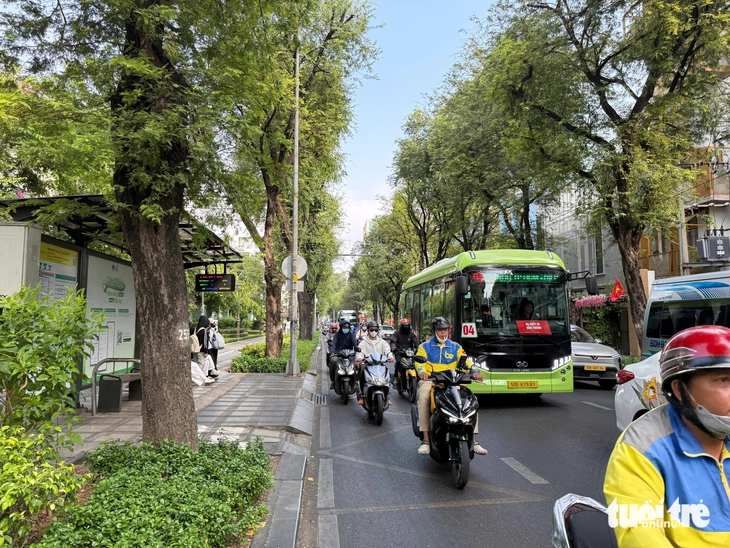
Ho Chi Minh City People’s Committee registers with City Council to build resolution for free bus service, expected to pass in April.
The Ho Chi Minh City People’s Committee has submitted to the City Council Standing Committee a registration to draft a resolution supporting users of public passenger transport by bus (free bus service) following a simplified order and procedure.
The estimated cost for free tickets for users of public passenger transport by bus is approximately 930 billion VND (for the remaining 8 months of 2026).
135 bus routes will apply. This includes 109 subsidized bus routes with an estimated cost of about 627 billion VND, which is the portion covering the ticket price for citizens.
The cost for implementing free tickets on 26 non-subsidized bus routes is approximately 303 billion VND (based on the current DO fuel price of 40,820 VND/liter). Both will use budget funds.
The condition for ensuring the implementation of the document after it is passed is the allocation of the city’s budget expenditure estimates to carry out the support.
The policies, once passed, are expected not to create additional administrative procedures during implementation.
Inspection and supervision will be carried out through the electronic ticketing system. The expected time for submitting the resolution for passage is within April.
Previously, the proposal for free buses was prepared promptly following the directive opinion of the Ho Chi Minh City Party Committee Secretary at the 5th Conference of the City Party Committee, term 2025-2030.
The drafting of the resolution proposal is also based on Directive No. 23 of the Secretariat on strengthening Party leadership over ensuring traffic order and safety in the new situation.
It states: “Strengthen the management of transport activities, prioritize investment in developing public passenger transport, transition to green transport vehicles linked with a roadmap to gradually limit personal vehicles in major urban areas.”
And Resolution No. 25 of the Ho Chi Minh City People’s Council on strengthening public passenger transport combined with controlling the use of personal motor vehicles in traffic: “The state budget plays a leading role (including infrastructure investment and operational exploitation) to ensure the sustainable development of the public transport system.”
Furthermore, Road Law No. 35 issued by the National Assembly in 2024 also stipulates: “Provincial-level People’s Councils, based on local resources, decide on interest rate support for loans from credit institutions for bus vehicle investment projects, investment in infrastructure construction serving public passenger transport by bus; support operating costs for public passenger transport by bus; support for users of public passenger transport by bus services through policies of free or reduced tickets.”
In addition, many other regulations are also favorable for drafting a resolution on free buses for all citizens in Ho Chi Minh City.
Therefore, the Ho Chi Minh City People’s Council has the authority to decide on budget expenditure regimes for specific local tasks outside the regimes, standards, and expenditure norms issued by the Government, the Prime Minister, and the Minister of Finance.
The Ho Chi Minh City Department of Construction has developed 3 implementation plans for free buses. How will they be detailed, and which plan is best for citizens and management agencies?
Ho Chi Minh City People’s Committee
The Ho Chi Minh City People’s Committee Building is the city’s seat of government, a striking French colonial-era landmark originally completed in 1908 as the Hôtel de Ville (City Hall). It was designed by French architect Paul Gardès and today serves as the administrative headquarters, remaining a prominent symbol of the city’s history and a popular tourist attraction for its elegant yellow façade and night-time illumination.
Ho Chi Minh City Council Standing Committee
The Ho Chi Minh City Council Standing Committee is the permanent executive body of the Ho Chi Minh City People’s Council, operating under Vietnam’s political system. It is responsible for overseeing the city’s administration and implementing resolutions when the full People’s Council is not in session. Historically, such committees were established as part of the unified governmental structure following the reunification of Vietnam in 1975.
Ho Chi Minh City Party Committee
The Ho Chi Minh City Party Committee is the leading local organ of the Communist Party of Vietnam in the city, historically established to guide its political and administrative direction following national reunification in 1975. It operates from the former Gia Long Palace, a French colonial-era building that later served as the Independence Palace of the U.S.-backed Republic of Vietnam. The committee’s work is central to implementing national policies and overseeing the development of Vietnam’s largest economic and cultural hub.
Secretariat
The Secretariat refers to the Secretariat Building in New Delhi, India, a central part of the British-era administrative complex designed by Sir Edwin Lutyens. Completed in the early 1930s, it served as the office for the Imperial government and now houses key ministries of the Government of India. Its grand architecture and location along the Rajpath symbolize the historical transition from colonial rule to Indian democracy.
Ho Chi Minh City People’s Council
The Ho Chi Minh City People’s Council is the local legislative body and highest state authority in Ho Chi Minh City, Vietnam. It was established following the reunification of Vietnam in 1975, succeeding the administrative council of the former Saigon government. The Council is responsible for making decisions on local policies, budgets, and socio-economic development plans for the city.
National Assembly
The National Assembly is the legislative body of France, first established during the French Revolution in 1789 when the Third Estate broke away to draft a constitution. It represents the principle of popular sovereignty and has evolved through various republics and empires, with its current form and modern home, the Palais Bourbon in Paris, being central to the Fifth Republic established in 1958.
Government
“Government” as a concept refers to the system or group of people governing an organized community, often a state. Historically, its forms have evolved from ancient monarchies and city-states to modern democracies, republics, and other systems, with the core function of creating and enforcing laws. Notable physical sites include parliamentary buildings like the UK’s Palace of Westminster or the U.S. Capitol, which often symbolize a nation’s political history and governance.
Prime Minister
“Prime Minister” is not a specific place or cultural site, but a political office. The role of a head of government, often called Prime Minister, originated in the United Kingdom in the 18th century, with Sir Robert Walpole widely considered the first. The title and parliamentary system have since been adopted by many countries around the world.