Why does the Nozomi train stop at Shin-Yokohama Station?
When traveling west from Tokyo Station on the Tokaido Shinkansen, trains make stops at Shinagawa Station and then Shin-Yokohama Station.
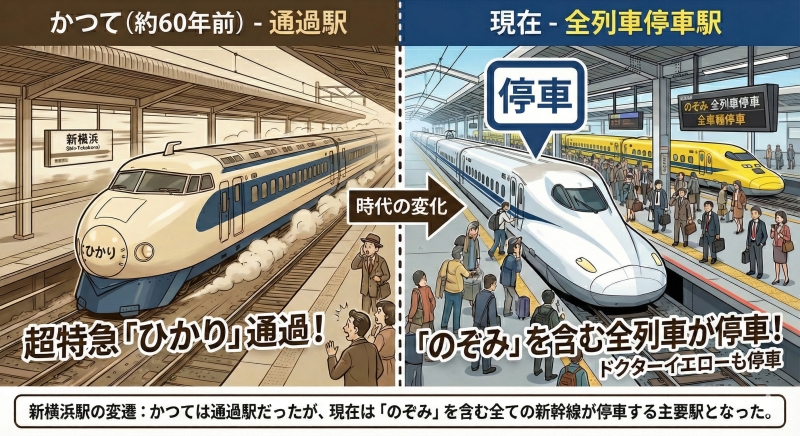
Currently, all trains without exception, including the fastest category “Nozomi,” stop at this station. (Even the Doctor Yellow inspection train stops at Shin-Yokohama Station.)
For many users, this scene is so natural that there may be no room for doubt.
However, if we turn back the clock about 60 years, a completely different landscape unfolds.
Shin-Yokohama was once a station that the Shinkansen’s elite trains, “Hikari” and “Nozomi,” would pass through at full speed without a second glance.
Why did a station built in a rural area with nothing transform into a major terminal boasting one of Japan’s highest passenger numbers?
Hidden within its dramatic growth trajectory are the struggles of railway engineers and the inevitable drama born from urban growth.
1. Construction in a Predestined “Rural Area”
The Tokaido Shinkansen opened in 1964.
The biggest challenge facing the then Japanese National Railways was how to connect Tokyo and Osaka at high speed.
Laying the “straight tracks” necessary for high-speed operation through the already overcrowded urban area around Yokohama Station was physically and financially impossible.
Therefore, the engineers chose a route that made a wide detour around Yokohama’s urban area, cutting through the inland region.
The spot chosen was the intersection with the Yokohama Line.
This was the area around Shinohara-cho, Kohoku Ward at the time.
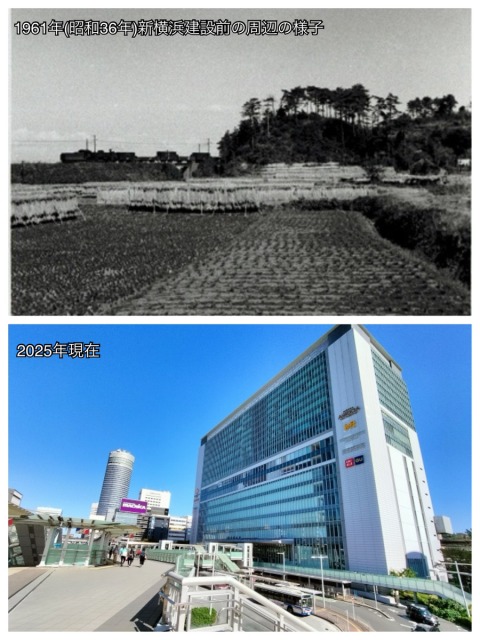
Looking at aerial photographs from the opening period, the scene is shocking.
Surrounding the station were not buildings or hotels, but only fields, farmland, and woodlands.
Above: The surrounding area before the construction of Shin-Yokohama Station (1961).
It is reminiscent of the Hokkaido Shinkansen’s Shin-Hakodate-Hokuto Station when it first opened, standing in the middle of wilderness.
A place bearing the name “Yokohama” yet far removed from the bustling city center.
That was the starting point for Shin-Yokohama.
Naturally, its status at the time of opening was not high.
Only the all-stations “Kodama” service stopped there.
The “Hikari” trains rushing between Tokyo and Osaka would pass by this small station, kicking up dust.
2. Urban Expansion and the Decision for “Hikari” to Stop
However, the establishment of the station decisively changed the fate of the land.
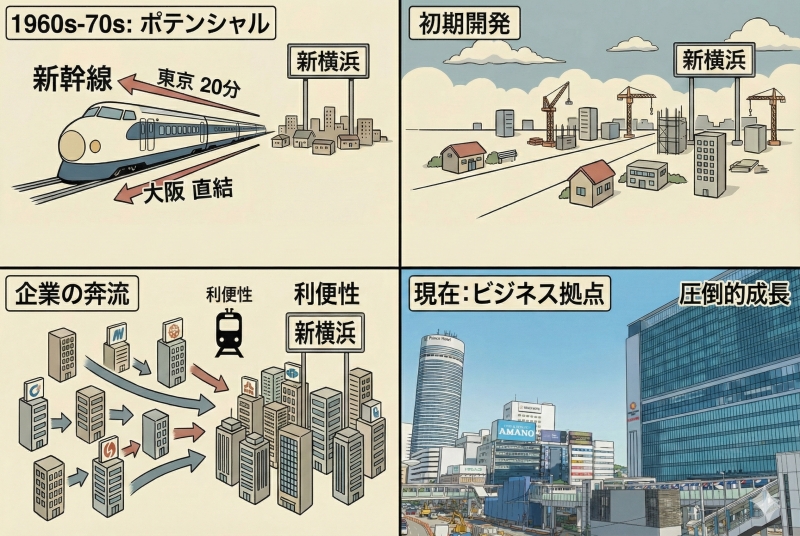
The overwhelming potential of being “less than 20 minutes to Tokyo and directly connected to Osaka” resonated with urban expansion during the period of high economic growth.
The initially sparse development around the station eventually turned into a torrent.
Companies that noticed the convenience of the Shinkansen began relocating their headquarters and offices one after another.
Simultaneously, residential development progressed as a Tokyo bedroom town, leading to the emergence of “Shinkansen commuters” who lived around Shin-Yokohama and commuted via the Shinkansen.
In 1985, the Yokohama Municipal Subway Blue Line was extended, establishing a connection with central Yokohama.
Faced with the rapid increase in businessmen and residents using the station, the National Railways had no choice but to act.
Finally, some “Hikari” trains began stopping at Shin-Yokohama Station.
This was the moment the station was upgraded from a mere “local stop” to an “intercity transport hub.”
3. The Paradigm Shift of All “Nozomi” Trains Stopping
<p
Tokyo Station
Tokyo Station is a major railway hub in Japan’s capital, first opened in 1914. Its iconic red-brick Marunouchi Building, designed by Kingo Tatsuno, survived World War II bombings and was meticulously restored to its original 1914 appearance in 2012. Today, it serves as a vital transportation center and a historic landmark symbolizing Tokyo’s blend of tradition and modernity.
Shinagawa Station
Shinagawa Station is a major railway hub in Tokyo, Japan, originally opening in 1872 as one of the country’s first train stations. It was significantly redeveloped in the early 2000s, becoming a key stop on the Tokaido Shinkansen (bullet train) line and a modern gateway to the city.
Shin-Yokohama Station
Shin-Yokohama Station is a major railway hub in Yokohama, Japan, primarily serving as the eastern terminus for the Tokaido Shinkansen (bullet train) line. It opened in 1964 to coincide with the Tokyo Olympics, strategically connecting Tokyo with the Kansai region and catalyzing development in the surrounding area. Today, it is also a key station for local commuter lines and is directly connected to the large Shin-Yokohama Ramen Museum, a popular cultural attraction.
Tokaido Shinkansen
The Tokaido Shinkansen is Japan’s pioneering high-speed railway line, inaugurated in 1964 just before the Tokyo Olympics. It connects Tokyo and Osaka, revolutionizing domestic travel with its speed and reliability, and remains one of the world’s busiest and most iconic bullet train routes.
Yokohama Station
Yokohama Station is a major railway hub in Kanagawa Prefecture, Japan, serving as the primary gateway to the city of Yokohama. It first opened in 1872 as part of Japan’s first railway line between Shinbashi and Yokohama, playing a pivotal role in the country’s modernization. Today, it is one of the busiest stations in the world, surrounded by vast commercial and business districts that have developed around its transport networks.
Yokohama Line
The Yokohama Line is a railway line in Japan’s Kanagawa Prefecture, operated by JR East, connecting Higashi-Kanagawa Station in Yokohama to Hachiōji Station in Tokyo. It opened in 1908, primarily to transport freight between the major port of Yokohama and industrial areas inland, later becoming vital for passenger commuter traffic in the growing Tokyo-Yokohama metropolitan region. Today, it is a key commuter route integrated into the Greater Tokyo rail network.
Hokkaido Shinkansen
The Hokkaido Shinkansen is a high-speed railway line in Japan that connects the island of Hokkaido with the main island of Honshu via the undersea Seikan Tunnel. Its first segment, from Shin-Aomori to Shin-Hakodate-Hokuto, opened in 2016, marking the extension of the national Shinkansen network to Japan’s northernmost major island. This project realized a long-held goal of linking Hokkaido by bullet train, improving transportation and economic integration, with a further extension to Sapporo scheduled for completion around 2030.
Shin-Hakodate-Hokuto Station
Shin-Hakodate-Hokuto Station is a major railway station located in Hokuto, Hokkaido, Japan, which opened in 2016 as the northern terminus of the Hokkaido Shinkansen line. It was built to connect the island of Hokkaido via high-speed rail to the main island of Honshu through the Seikan Tunnel, significantly reducing travel time from Tokyo to Hakodate. The station serves as a crucial transport hub, facilitating transfers between the Shinkansen and conventional rail lines to central Hakodate and other parts of Hokkaido.