New train cars for the Hakone Tozan Railway after 14 years, “4000 series” to be introduced around summer 2028.
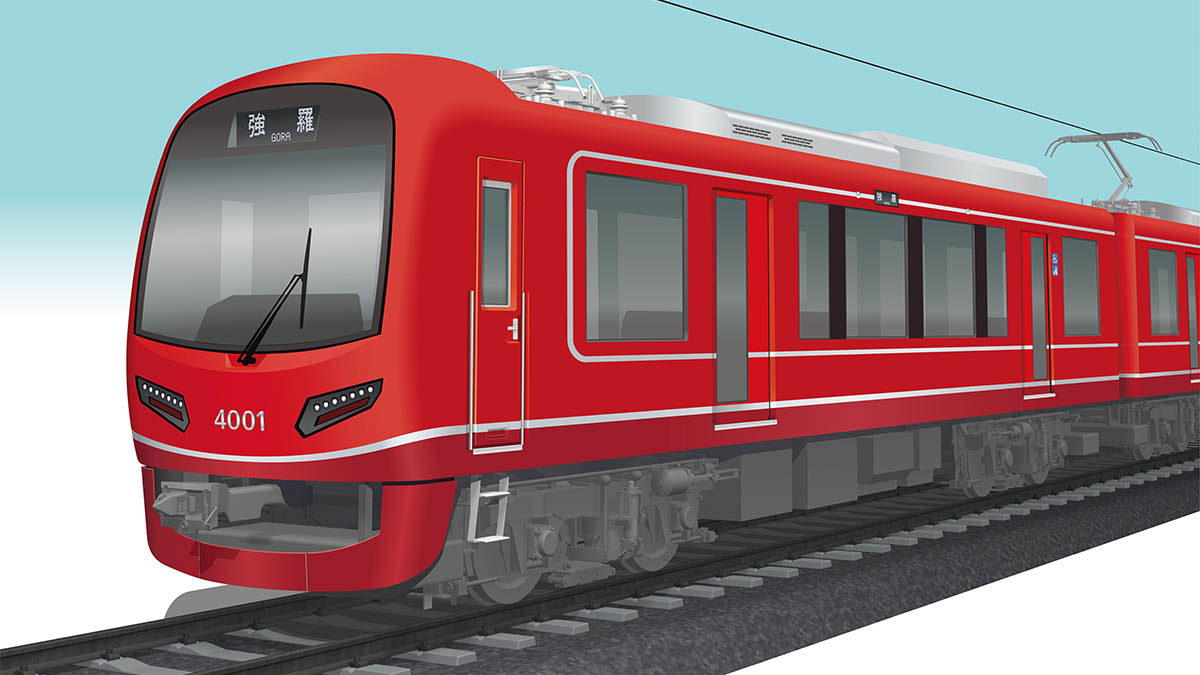
Exterior image of the new “4000 series” train to be introduced on the Hakone Tozan Railway (provided by Odakyu Hakone)
Odakyu Hakone announced that it will introduce a new train model, the “4000 series,” on the Hakone Tozan Railway, which connects the mountainous section between Hakone-Yumoto and Gora, around the summer of 2028. This is the first new model in 14 years. Its exterior features a rounded, friendly design, and the windows have been enlarged to allow passengers to better enjoy the scenery.
Interior image of the new “4000 series” train to be introduced on the Hakone Tozan Railway (provided by Odakyu Hakone)
The train’s body color is primarily red, similar to the “Allegra” train introduced in 2014. It will feature both box seats and longitudinal seats, with some seats slightly angled toward the windows. The interior incorporates designs inspired by the traditional craft “Hakone Yosegi Zaiku” (Hakone marquetry), and space will be provided for storing large luggage.
This model will succeed the 100 series (scheduled for retirement in January 2028), which is the oldest regularly operating conventional railway vehicle in Japan. It is said to reduce power consumption by approximately 45%.
Interior image of the new “4000 series” train to be introduced on the Hakone Tozan Railway (provided by Odakyu Hakone)
The concept and design of the new train were devised by a team of 13 company employees. The person in charge stated, “We hope passengers can relax leisurely while looking out the window and enjoy their journey through Hakone.”
Since November, red 1000 series Odakyu Electric Railway trains, matching the color of the Allegra, have been operating on the Odawara to Hakone-Yumoto section.
Hakone Tozan Railway
The Hakone Tozan Railway is Japan’s oldest mountain railway, opening in 1919 to connect the hot spring resort town of Hakone with the main Odawara Station. It is famous for its steep gradients, scenic switchback sections, and beautiful seasonal views, particularly of hydrangeas in summer, making it both a vital transport link and a popular tourist attraction.
Hakone-Yumoto
Hakone-Yumoto is a historic hot spring town located at the entrance to the Hakone region in Kanagawa Prefecture, Japan. It has been a popular onsen destination for centuries, famously used by travelers along the Tokaido road during the Edo period (1603-1868) to rest and bathe. Today, it remains a major gateway to Hakone’s natural and cultural attractions, offering numerous traditional ryokan inns and public bathhouses.
Gora
“Gora” is a historic village located in the Sharr Mountains of Kosovo, traditionally known as a center for Gorani people who speak a distinct South Slavic dialect. Historically, it was part of the Ottoman Empire and later Yugoslavia, with its culture shaped by a blend of Balkan and Islamic influences. Today, it is noted for its preserved customs, traditional architecture, and its location near the popular Brezovica ski resort.
Allegra
“Allegra” is not a widely recognized specific place or cultural site. It is most commonly known as a feminine given name of Italian origin meaning “joyful” or “lively.” Without a specific geographic or cultural context (like a town, building, or event), there is no notable history to summarize.
Hakone Yosegi Zaiku
Hakone Yosegi Zaiku is a traditional Japanese woodcraft that originated in the town of Hakone during the late Edo period (early 19th century). It is renowned for its intricate geometric patterns, created by carefully assembling and planing different colored natural woods without using any dyes. This delicate marquetry technique was historically used to make puzzle boxes and decorative items, becoming a celebrated local art form and a popular souvenir from the Hakone region.
100 series
The “100 series” refers to the first production models of Japan’s Shinkansen high-speed trains, which debuted in 1964 for the Tokyo Olympics. It was famous for its distinctive streamlined nose and green-and-white livery, revolutionizing rail travel by connecting Tokyo and Osaka at unprecedented speeds. It remained in regular service until 1999, becoming an iconic symbol of Japan’s post-war technological advancement and economic resurgence.
Odakyu Electric Railway
The Odakyu Electric Railway is a major private railway company in Japan, founded in 1923 to connect Tokyo with the southwestern suburbs and the scenic Hakone region. It is historically significant for launching the iconic “Romancecar” limited express services in 1957, which set speed records and revolutionized comfortable, direct travel from Shinjuku to popular tourist destinations like Hakone and Enoshima.
Odawara
Odawara is a coastal city in Kanagawa Prefecture, Japan, most famous for Odawara Castle. The castle served as the formidable stronghold of the Later Hōjō clan during the Sengoku period (15th-16th centuries) and was a key strategic point controlling the approach to Edo (modern Tokyo). Though the current structure is a 1960s reconstruction, the site remains a major historical landmark and symbol of the city.