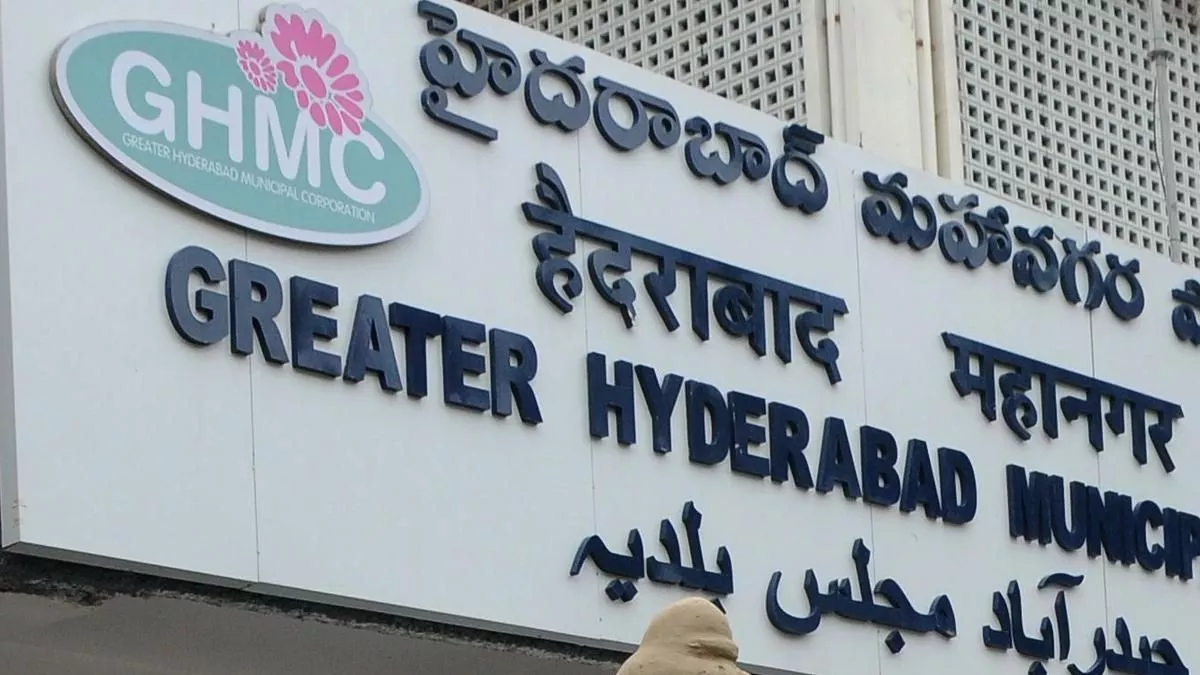
Hyderabad: The Greater Hyderabad Municipal Corporation has issued uniform guidelines for the process of issuing Occupancy Certificates for buildings constructed according to approved plans that do not fall under the high-rise category. These guidelines are specifically for building owners who have not obtained certificates despite the validity period of their building permit having expired.
The GHMC Commissioner, in a circular, stated that these guidelines will apply to approved buildings where construction was completed according to sanctioned plans, but the Occupancy Certificate was not obtained within the stipulated validity period. The lack of an Occupancy Certificate was causing difficulties for building owners in obtaining services from water and electricity agencies. Problems were also arising in securing bank loans. These guidelines have been issued with this in mind.
Fee on total built-up area for applications after two years
The GHMC Commissioner explained that under the new process, if an application for an OC is made within two years of the building permit’s expiry date, it will be settled by collecting the pending building permit fee and other applicable charges such as for link roads and as per CRMP Rule 26. If the application for an OC is submitted after two years, all fees applicable to the total built-up area as of the application date will be levied.
In both cases, the OC will be issued only if deviations in construction are within permissible limits. This allows a maximum deviation of up to 10 percent in mandatory setbacks, while the front setback is excluded from this relaxation. The GHMC clarified that these guidelines will apply only to non-high-rise buildings.
Urge to avail OTS benefit
The Greater Hyderabad Municipal Corporation has called for availing the benefit of the One Time Settlement scheme for property tax arrears. Under this, a 90 percent rebate is being offered on the accumulated interest on the outstanding amount. According to GHMC officials, property owners can settle pending arrears through a lump sum payment. For this, they only need to pay the principal tax amount along with just 10 percent of the accumulated interest, while the remaining 90 percent interest will be waived. This will reduce the financial burden on taxpayers and promote voluntary compliance.
Citizens have been urged to avail this limited-time opportunity and contribute to the city’s development. Under the OTS, payments can be made conveniently through the MyGHMC mobile app, Mee-Seva centers, GHMC Citizen Service Centers, and other online payment modes.
GHMC
“GHMC” typically refers to the **Greater Hyderabad Municipal Corporation**, the civic body that governs the city of Hyderabad, India. It was formed in 2007 by merging the Municipal Corporation of Hyderabad with 12 surrounding municipalities to manage the rapid expansion of the Hyderabad metropolitan area. Its history is tied to the modern administrative evolution of the city, focusing on urban planning and municipal services for one of India’s major tech hubs.
Greater Hyderabad Municipal Corporation
The Greater Hyderabad Municipal Corporation (GHMC) is the civic body responsible for the administration and infrastructure of Hyderabad, India. It was formed in 2007 by merging the Municipal Corporation of Hyderabad with 12 surrounding municipalities, aiming to better manage the rapid growth of the metropolitan area. Its history is tied to the expansion of the historic city, originally established in the 16th century by the Qutb Shahi dynasty.
Hyderabad
Hyderabad is a historic city in southern India, founded in 1591 by Muhammad Quli Qutb Shah. It is renowned for landmarks like the Charminar and Golconda Fort, which reflect its rich legacy as the capital of the Qutb Shahi dynasty and later the Nizams of Hyderabad. Today, it is a major technology hub often called “Cyberabad,” blending its regal past with rapid modern development.
CRMP Rule 26
“CRMP Rule 26” is not a place or cultural site. It is a procedural rule within the **Comprehensive Rules on Motorcycle Patrol (CRMP)** of the Philippine National Police (PNP), which outlines guidelines for the proper conduct and operations of motorcycle-riding police units. As a regulation, it does not have a historical background like a physical location, but it is part of ongoing efforts to standardize law enforcement procedures.
One Time Settlement scheme
The One Time Settlement (OTS) scheme is not a physical place or cultural site, but a financial and administrative process. It is a debt relief mechanism offered by banks and financial institutions, allowing borrowers to settle outstanding loans by paying a reduced lump sum amount. Such schemes have been implemented historically in various countries, often during economic distress, to help clear non-performing assets from the financial system and provide relief to distressed borrowers.
MyGHMC mobile app
The MyGHMC mobile app is a digital service platform launched by the Greater Hyderabad Municipal Corporation (GHMC) in India, designed to streamline citizen engagement with urban services. It allows residents to report civic issues like garbage collection or potholes, pay property taxes and utility bills, and access municipal information. While the app itself doesn’t have a deep historical background, it represents a modern technological initiative by the GHMC, evolving from earlier manual and web-based systems to improve governance and public service delivery in the Hyderabad metropolitan region.
Mee-Seva centers
Mee-Seva centers are government-run service kiosks in the Indian state of Telangana, established to provide citizens with easy access to various public services and certificates. They were launched to digitize and streamline bureaucratic processes, reducing corruption and saving time by offering a single-window system for over 100 services, from birth certificates to utility bill payments.
GHMC Citizen Service Centers
GHMC Citizen Service Centers are public service facilities established by the Greater Hyderabad Municipal Corporation in Telangana, India, to provide a centralized and streamlined interface for citizens to access municipal services. They were created to improve governance and reduce bureaucratic delays by offering services like property tax payments, birth/death certificates, and building permits under one roof. Their history is part of a broader modern e-governance initiative in India to make civic administration more transparent, efficient, and citizen-friendly.