Beam Installation, Closure, and Trial Operation! Key High-Speed Rail Projects in China Accelerate Progress
Three major high-speed rail projects in China have recently achieved significant milestones, marking important progress for the “Eight Vertical and Eight Horizontal” high-speed rail network. The Fujian section of the Zhangzhou-Shantou High-Speed Rail officially began beam installation operations, while the main bridge of the Qujiang Grand Bridge on the Chengdu-Dazhou-Wanzhou High-Speed Rail achieved millimeter-level precision closure. Meanwhile, the Guangzhou-Zhanjiang High-Speed Rail has officially entered the trial operation phase. Upon completion and opening, these projects will inject strong momentum for personnel exchanges, economic cooperation, and regional coordinated development along their routes.
Zhangzhou-Shantou High-Speed Rail Fujian Section Begins Beam Installation
The Fujian section of the Zhangzhou-Shantou High-Speed Rail, connecting Zhangzhou in Fujian and Shantou in Guangdong, has commenced beam installation. The main line of the Zhangzhou-Shantou High-Speed Rail spans approximately 175 kilometers with a design speed of 350 km/h, scheduled for completion and opening in 2028. Once operational, it will enable direct connectivity between Zhangzhou and Shantou, further improving the regional rapid rail network.
The Zhangzhou-Shantou High-Speed Rail is an important component of the coastal corridor in China’s “Eight Vertical and Eight Horizontal” high-speed rail network. After completion and opening, it will connect with the Fuzhou-Xiamen High-Speed Rail and Shantou-Shanwei High-Speed Rail, becoming a crucial link between cities in the southeastern coastal region and the Yangtze River Delta and Greater Bay Area. This will significantly facilitate travel for residents along the route and promote communication and cooperation between Fujian and Guangdong provinces.
Chengdu-Dazhou-Wanzhou High-Speed Rail Qujiang Grand Bridge Main Bridge Officially Closed
The Chengdu-Dazhou-Wanzhou High-Speed Rail, a major project in the “14th Five-Year Plan,” is an important component of the Yangtze River corridor in China’s “Eight Vertical and Eight Horizontal” high-speed rail network. The route starts from Tianfu Station in Chengdu, Sichuan Province, passing through Ziyang, Suining, Nanchong, and Dazhou in Sichuan Province, as well as Kaizhou District and Wanzhou District in Chongqing, finally connecting to the existing Zhengzhou-Chongqing High-Speed Rail at Wanzhou North Station. Upon completion, it will form a convenient passenger transport corridor directly connecting Chengdu with the Central Plains region and the Beijing-Tianjin-Hebei area.
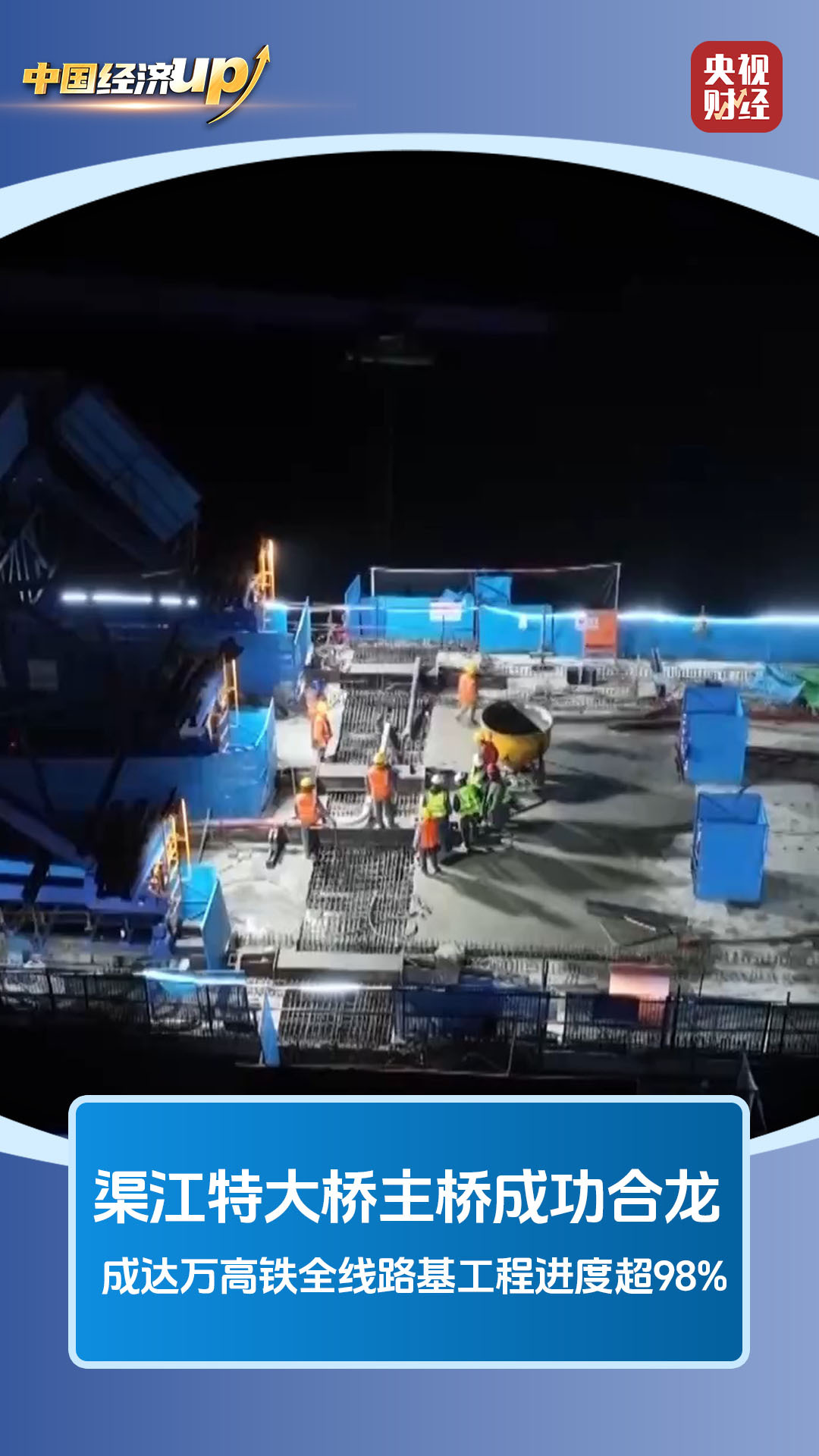
The main bridge of the Dazhou Qujiang Grand Bridge, a controlling project of the Chengdu-Dazhou-Wanzhou High-Speed Rail, has been officially closed. The main bridge spans 557.5 meters, currently the world’s longest-span double-track high-speed rail prestressed concrete low-pylon cable-stayed bridge. To achieve high-precision closure, the construction team selected nighttime hours with “low temperature and small temperature variations” for the closure operation, effectively reducing structural deformation caused by temperature changes. This allowed them to control the bridge’s precision within “millimeter-level” range, achieving high-quality closure.
As a key project for transportation infrastructure connectivity in the Chengdu-Chongqing economic circle, the Chengdu-Dazhou-Wanzhou High-Speed Rail has two important characteristics: although this route doesn’t directly reach Chongqing’s central urban area, its terminal in Wanzhou serves as a transportation corridor connecting the Ba-Shu region with the Central Plains hinterland; its starting station, Tianfu Station in Chengdu, will become a hub for China’s high-speed rail network extending westward in the future, enhancing the significance of the Chengdu-Dazhou-Wanzhou High-Speed Rail within China’s future high-speed rail network.
As of now, the subgrade engineering for the entire Chengdu-Dazhou-Wanzhou line has completed over 98% of total progress, with current final construction efforts concentrated on the “4 bridges and 4 tunnels.”
Guangzhou-Zhanjiang High-Speed Rail Ent