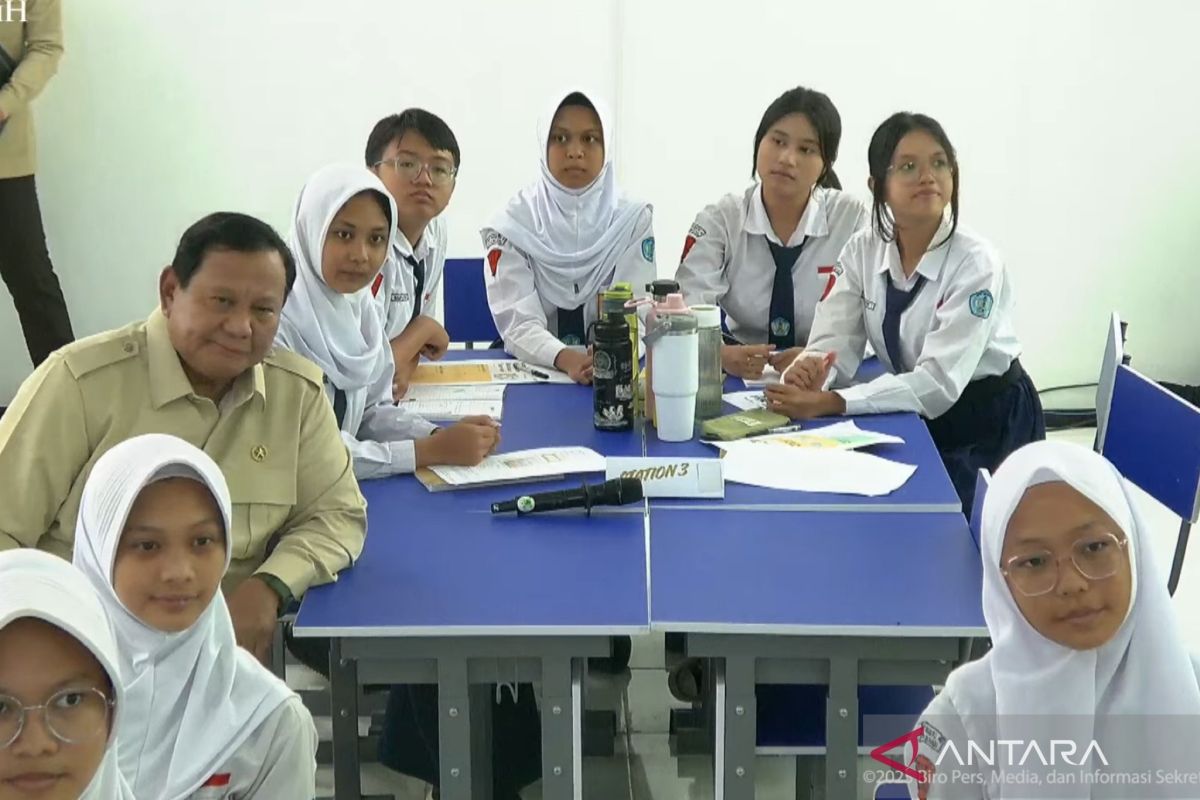
President Prabowo Subianto visited several classrooms at Public Junior High School 4 in Bekasi City, West Java, to directly observe the use of government-provided interactive flat panels, or smartboards, in teaching and learning.
In a video streamed live, Prabowo and the Primary and Secondary Education Minister joined pupils who were learning about acidic substances on the smartboard in a classroom.
Despite the president’s presence, the learning session proceeded smoothly, with neither the pupils nor their teacher appearing pressured. Prabowo and the minister also applauded several students who were invited to share their understanding of the topic under discussion.
The head of state then proceeded to another classroom, where he once again sat among pupils as he observed a teacher explaining the lunar cycle using the smartboard, which appeared to boost students’ interest in the lesson.
After the demonstration, Prabowo took the time to converse with the teacher and greet the pupils one by one. His interactions with pupils and instructors were part of his primary agenda at the school: inaugurating the use of smartboards in schools across the country.
Also present during the visit were the Coordinating Minister for Human Development and Culture, the Communication and Digital Affairs Minister, the Minister of State Secretariat, the Government Communication Agency Head, and the West Java Governor.
Prabowo has ordered the distribution of smartboards to schools nationwide under a presidential instruction that mandates the revitalization of educational institutions, the development of model schools, and the acceleration of digitalization in the education sector.
This year, the government has set a target to distribute roughly 288 thousand smartboards. So far, it has shipped 215,572 units, with 172,550 already reaching designated schools, while the remaining units are expected to arrive by December 2025.
The smartboards are designed to facilitate real-time remote learning, allowing instructors and pupils to engage in more collaborative interactions, improving the one-way learning experience offered by conventional smart TVs.