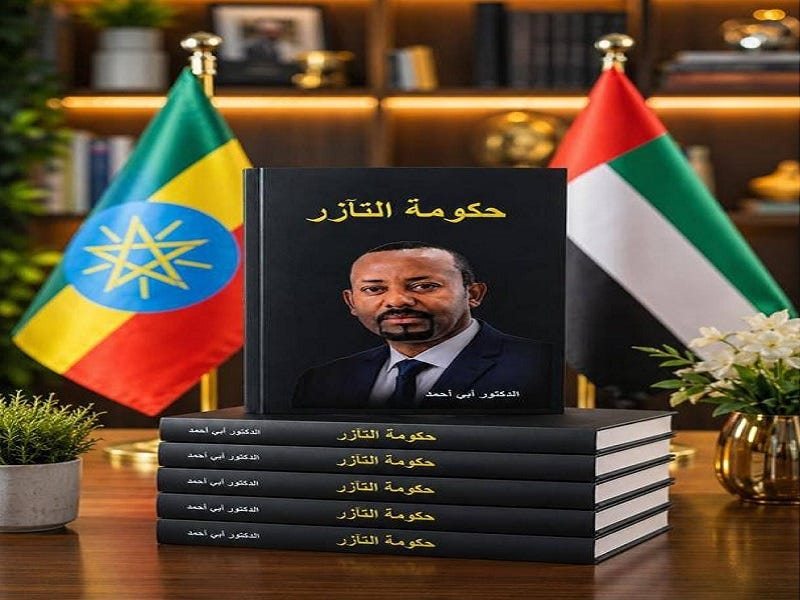
The concept of “Medemer,” which translates to “synergy,” was described as a socio-political and economic philosophy aimed at preserving national unity and promoting comprehensive development among the various components of Ethiopian society.
The remarks came following the official launch of the Arabic version of the book “Medemer” in the UAE capital, Abu Dhabi, on Thursday, a step considered an important milestone in strengthening cultural and diplomatic ties between Ethiopia and the Arab world.
The launch event, organized by the Ethiopian Embassy in the United Arab Emirates, was attended by officials, diplomats, academics, and members of the Ethiopian community, including Sheikh Shakhboot bin Nahyan Al Nahyan and the Ethiopian Ambassador to the UAE, Jamal Bakr.
According to the analysis, the recent conflict in the Gulf region — described as the “Third Gulf War” — has reshaped regional balances on both sides of the strategic waterway through which a significant portion of global oil supplies pass.
Although the conflict has not been officially declared over, it was noted that the Pakistan-mediated ceasefire has held longer than many observers expected, creating cautious optimism about the region’s stability and opening the door for post-war recovery efforts.
“In this complex regional climate, characterized by tension between Iran and the Gulf states, as well as disparities within the Gulf system itself, the Arabic translation of the book Medemer comes at a highly significant time,” the analysis stated.
It emphasized that launching the Arabic version in the UAE was not a random step, explaining that Abu Dhabi is one of Ethiopia’s most prominent strategic partners.
It also highlighted the close relations Ethiopia has with both Saudi Arabia and Iran, suggesting that making the book available in Arabic could prompt decision-makers and intellectual elites in both countries to take an interest in the ideas of “Medemer.”
While ruling out Ethiopia playing a direct mediation role between Iran and the Gulf states or between Saudi Arabia and the UAE, the analysis suggested that the principles of “Medemer” could contribute to encouraging regional cooperation.
“Realistically, Ethiopia will not mediate between Iran and the Gulf monarchies, but the teachings of Medemer could contribute to the post-war phase by encouraging dialogue on regional non-aggression agreements, leading to a broader framework for collective security,” it stated.
The analysis acknowledged ongoing internal challenges in Ethiopia, including unresolved ethnic and regional tensions, but considered that the progress made under the “Medemer” philosophy proves the possibility of addressing even the most complex conflicts.
“If the federal government and groups that have been in conflict with it for years can move toward reconciliation, then the Gulf states are also capable of building peace based on shared economic and security interests,” it added.
In conclusion, the analysis cautioned against overestimating the immediate impact of the “Medemer” philosophy on Gulf politics, but stressed that the Arabic translation of the book could play an important role in enhancing regional dialogue.
“Through ongoing diplomatic and intellectual engagement, Ethiopia can help introduce regional leaders to the fundamental principles of the Medemer philosophy, which could ultimately contribute to lasting peace and shared development in the region,” it stated.
Abu Dhabi
Abu Dhabi is the capital of the United Arab Emirates, located on an island in the Persian Gulf. Its history dates back to the 18th century when it was a small fishing and pearling village, before transforming into a global hub of wealth and culture following the discovery of oil in the 1950s. Today, it is known for its modern architecture, luxury attractions, and landmarks like the Sheikh Zayed Grand Mosque.
United Arab Emirates
The United Arab Emirates (UAE) is a federation of seven emirates, including Dubai and Abu Dhabi, formed in 1971 after the British withdrawal from the Persian Gulf. Historically a region of pearl diving, fishing, and desert trade, its modern transformation began with the discovery of oil in the 1950s, fueling rapid development into a global hub for business, tourism, and luxury. Today, the UAE is known for its futuristic skyline, cultural heritage sites like Al Ain, and its role as a major international crossroads.
Ethiopian Embassy in the United Arab Emirates
The Ethiopian Embassy in the United Arab Emirates, located in Abu Dhabi, serves as the primary diplomatic mission representing Ethiopia’s interests in the UAE. Established to strengthen bilateral relations, it has played a key role in fostering economic cooperation, cultural exchange, and consular services for the large Ethiopian diaspora in the region. The embassy reflects the growing ties between the two nations, which have deepened significantly in recent decades through trade, investment, and mutual development initiatives.
Gulf region
The Gulf region, centered around the Persian Gulf, has a rich history as a crossroads of trade and civilization, with ancient ports like Dilmun (modern-day Bahrain) thriving over 4,000 years ago. In the 20th century, the discovery of oil transformed the area into a global energy hub, leading to the rapid modernization of countries like Saudi Arabia, the UAE, and Qatar. Today, the region blends its deep cultural heritage with futuristic cities, serving as a vital center for commerce, tourism, and diplomacy.
Third Gulf War
The “Third Gulf War” is not a recognized historical conflict but is sometimes used informally to refer to the 2003 invasion of Iraq led by the United States and its allies. This war aimed to overthrow Saddam Hussein’s regime, citing allegations of weapons of mass destruction, though no such weapons were found. The conflict led to a prolonged occupation, widespread instability, and sectarian violence that reshaped the Middle East.
Pakistan
Pakistan is a South Asian country with a rich history that includes being part of the ancient Indus Valley Civilization and later a crossroads for various empires, such as the Mughal and British. It was created in 1947 as a homeland for Muslims of the Indian subcontinent, following the partition of British India. Today, Pakistan is known for its diverse cultures, languages, and landmarks like the Badshahi Mosque and Mohenjo-Daro.
Iran
Iran, historically known as Persia, is a country in Western Asia with a rich cultural heritage spanning over 2,500 years. It was home to ancient empires like the Achaemenid, Parthian, and Sassanid, and later became a center of Islamic art, science, and literature. Today, Iran is renowned for its stunning architectural sites such as Persepolis and Isfahan’s Naqsh-e Jahan Square, as well as its deep traditions in poetry, carpet weaving, and cuisine.
Saudi Arabia
Saudi Arabia is a vast desert kingdom on the Arabian Peninsula, known as the birthplace of Islam and home to its two holiest cities, Mecca and Medina. Founded in 1932 by King Abdulaziz Al Saud, the country united various tribal regions and has since transformed from a largely nomadic society into a global oil powerhouse. Today, it balances its deep religious traditions with ambitious modernization efforts under Vision 2030, aiming to diversify its economy and open up to tourism.