Women of Lake Victoria break taboos and take up fishing.
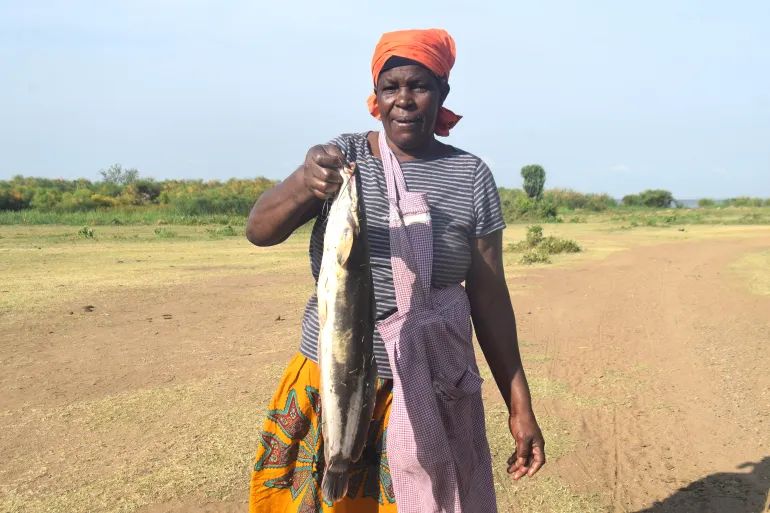
Rhoda Onguti Aketch still remembers the whispers that followed her steps to the lake shore one morning in 2002. She was 39, a mother of seven, and about to break one of the oldest social taboos in the villages around Lake Victoria: a woman setting foot on a fishing boat.
Aketch, now in her sixties, says the people in her village whispered that a woman going to the lake with men would inevitably lead to sexual relationships. But she insisted, and when people realized she came to learn and nothing else, they “fell silent,” as she puts it.
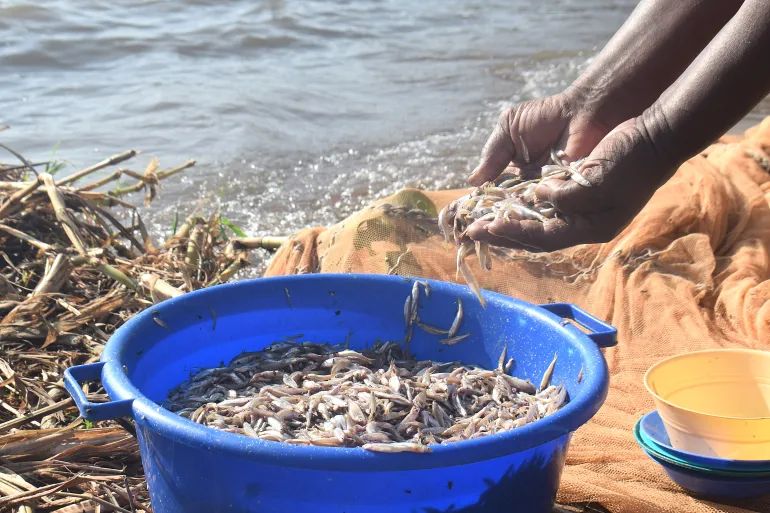
In Kaguil village, part of the Semi sub-county in Kisumu County, western Kenya, fishing was exclusively a male profession for decades, while women’s roles were limited to buying and selling fish in markets. But this strict division began to crack under economic pressures, now compounded by the threat of climate change that is depleting the lake’s fish stocks.
A taboo rooted in tradition
William Okido, a 57-year-old elder from Kaguil village, explains that traditions were stricter when it came to menstruation. It was believed that a woman in that condition entering the lake would “scare the fish and cause losses for fishermen.” Restrictions were not limited to women; even men were forbidden from sleeping with their wives on the night before fishing, as it was thought to reduce their catch.
Before 2002, Aketch was a fish seller like other village women, buying men’s catch to resell in markets. But her income shrank under the weight of costs for fish, firewood, cooking oil, and transport. In 2001, women from neighboring Homa Bay County came to Kaguil and did what was considered impossible: fishing in the lake. That was the inspiring moment for Aketch, who hired two young men from the village to teach her the trade. She endured warnings from locals and pressed on because her family depended on her.
Aketch spent 16 years alone among male fishermen before Faith Owuor Angauo, a mother of four then aged 37, joined her in 2018. Angauo had worked for years as a fish seller in Luanda market. She says her husband initially refused, fearing the reaction of the fishing community, but later allowed her to join Rhoda.
In 2020, Dorcas Oyu, then 22 and a mother of three, joined after her fisherman husband dropped his initial refusal due to the need for extra income. By 2022, the image of a female fisherman had become familiar, so much so that Janet Nduye (42) faced no objections when she joined, because the community “had gotten used to seeing Rhoda and Faith fishing.”
Wilson Ongulo, a fisheries officer in Semi sub-county, revealed the real driver behind the shift: on good days, boat owners on Kaguil beach earn between 6,000 and 8,000 Kenyan shillings ($46–$62), crew members get 500 to 800 shillings ($3.88–$6.20), and traders earn 1,000 shillings ($7.75). This exceeds the 500 shillings women used to earn daily from reselling fish.
Okido admitted the social barrier has effectively fallen, saying “economic hardships are driving women to break the taboo.” Fisherman Delmas Onyango (35) confirms that most of his colleagues now support women’s decisions.
<img alt="Birds gather as a woman washes fish to sell on the shores of Lake Victoria, in Kisumu, western Kenya Saturday, Aug. 13, 2022. Vote-tallying in Kenya's close presidential election isn't moving fast enough, the electoral commission chair said Friday. (AP Photo/Brian Inganga)" data-recalc-dims="1" src="https://asiacity.news/wp-content/uploads/2026/04/ap_69e75e4a2d25a-177
Lake Victoria
Lake Victoria, the largest lake in Africa and the world’s largest tropical lake, spans Uganda, Kenya, and Tanzania. It was first documented by European explorer John Hanning Speke in 1858, who identified it as the primary source of the Nile River. The lake has long supported local communities through fishing and trade, and its shores are dotted with significant historical and cultural sites.
Kaguil village
Kaguil Village is a historic settlement located in the Zanskar region of Ladakh, India, known for its ancient Buddhist monastery, Karsha Gompa, which dates back to the 10th century. The village has long served as a cultural and religious center, with the monastery being one of the largest and most important in Zanskar, housing numerous monks and valuable artifacts. Its remote, high-altitude setting has preserved traditional Tibetan Buddhist practices and a unique way of life for centuries.
Semi sub-county
Semi sub-county is an administrative division located in Nandi County, Kenya, known for its rich cultural heritage tied to the Nandi community. Historically, the area has been part of the larger Nandi region, which played a significant role in Kenya’s pre-colonial and colonial resistance movements. Today, it is recognized for its agricultural activities, particularly tea and maize farming, as well as its scenic landscapes.
Kisumu County
Kisumu County, located in western Kenya along the shores of Lake Victoria, is a major economic and cultural hub in the region. Historically, it grew from a small fishing village into a key port town during the colonial era, serving as a vital railway terminus for the Uganda Railway. Today, it is known for its vibrant markets, the nearby Impala Sanctuary, and its role as a center for trade and tourism around Africa’s largest freshwater lake.
Kenya
Kenya, located in East Africa, is renowned for its rich cultural heritage and stunning landscapes, including savannas and the Great Rift Valley. Historically, it was home to early human ancestors, as evidenced by fossils found in the Turkana Basin, and later became a British colony until gaining independence in 1963. Today, it is celebrated for its diverse wildlife, national parks, and vibrant traditions of over 40 ethnic groups.
Homa Bay County
Homa Bay County is located in southwestern Kenya, along the shores of Lake Victoria. Historically, the area is known for being home to the Luo community and contains significant archaeological sites, including early human fossil discoveries at Kanam and Kanjera. The county is also notable for Rusinga Island, where the fossil of Proconsul africanus, an early ancestor of apes and humans, was discovered in 1948.
Luanda market
The Luanda Market, also known as the Roque Santeiro Market until its closure, was one of the largest and most famous open-air markets in Angola’s capital. Historically, it emerged informally during the Angolan Civil War as a hub for smuggled and scarce goods, reflecting the resilience of local traders. Though it was demolished in 2010 for urban redevelopment, it remains a symbol of Luanda’s vibrant, chaotic informal economy and cultural life.
Kaguil beach
Kaguil Beach is a scenic coastal destination located in the municipality of Bani, Pangasinan, Philippines. Its history is tied to the local fishing communities and the area’s development as a quiet, off-the-beaten-path tourist spot, known for its fine gray sand and clear waters. The beach remains a relatively unspoiled natural attraction, offering visitors a peaceful escape away from more crowded resorts.