TANGERANG – Amid rising public skepticism towards the government’s financial management, particularly regarding the transparency and professionalism of budget use, the Tangerang City Government has chosen to address these doubts with concrete action.
Dismissing residents’ doubts about the tax money they have paid, the Tangerang City Government is committed to making tax management more accountable and ensuring the results are truly felt by the community.
“Public trust is the key. Taxes must not just end up as numbers in financial reports; they must return to the community in the form of better public services and tangible development,” was stated.
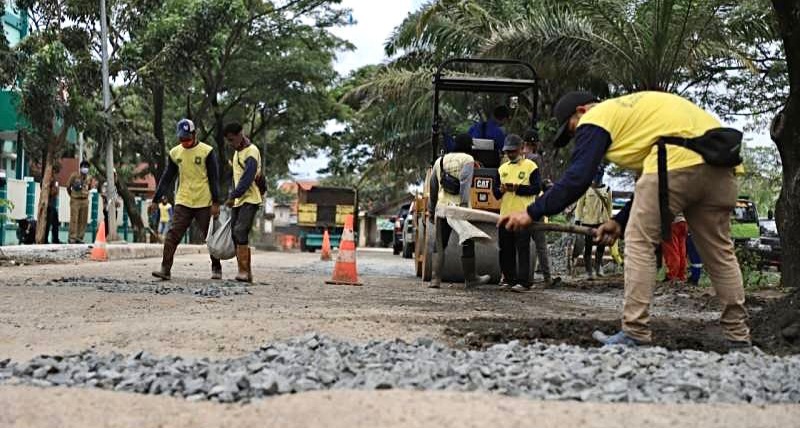
It was explained that local tax revenue is used directly for basic infrastructure development, improving the quality of education and health services, enhancing residential environments, and strengthening public administrative services.
Throughout 2025, the Tangerang City Government has not only focused on increasing local tax revenue but has also proven that every rupiah of tax paid by residents truly returns in the form of better public services and city development whose benefits are directly felt.
Through the transformation of managing the Land and Building Rights Acquisition Fee (BPHTB) and the Rural and Urban Land and Building Tax (PBB-P2), the Tangerang City Government has implemented policies that are simpler, more transparent, and considerate of the community’s economic capacity.
Tax as an Investment for City Progress
Simplifying procedures, providing open information, and offering tax relief have become the main strategies to restore public trust while fostering awareness that tax is not merely an obligation but a joint investment for the city’s progress.
This approach has shown significant results. Throughout 2025, PBB-P2 revenue increased by approximately 4 (four) percent, with realization reaching Rp592 billion from 428,660 transactions.
Meanwhile, BPHTB revenue also grew by about 3 percent, with realization of Rp651 billion from 13,309 transactions. This achievement is an indicator that public trust can be built through fair policies, professional services, and clear, measurable use of tax funds.
This commitment is strengthened by the Tangerang City Regional Revenue Agency (Bapenda) through a comprehensive overhaul of the tax service system and culture. It was conveyed that public trust can only be built with professional, open, and easily accessible service.
“We understand that some people are reluctant to pay taxes due to bad experiences or distrust. Therefore, we focus on ensuring the process is clear, fast, and transparent. The public must know what they are paying for and how their taxes are used,” was stated.
The innovations “Bangga Bayar Pajak” (Bang Baja) and “Online Bapenda Juara” (Nong Dara) are concrete proof of the Tangerang City Government’s efforts to bring tax services closer to the community. Bang Baja prioritizes an educational and outreach approach, so residents do not feel forced but are invited to understand the role of taxes in development.
Digital-Based Tax Services Minimize Potential for Misconduct
Meanwhile, Nong Dara provides transparent and accountable digital-based tax services, ranging from information and calculation to online tax payments. This innovation provides process certainty while minimizing the potential for misconduct.
These policy and service changes are starting to be felt by the community. Bagus, a resident of Cimone Subdistrict, stated that the process for handling BPHTB is now much clearer and more humane. “Now the process is transparent and there are relief options. So, there’s more trust that taxes are indeed managed well,” he said.
Suhartini, a resident of Karawaci, also felt something similar. “It’s more open now and less complicated. We now know what the taxes are for,” she said.
With this policy direction, the management of BPHTB and PBB-P2 in Tangerang City is believed to grow even stronger, in line with the renewed public trust that taxes truly serve as an instrument for shared prosperity.