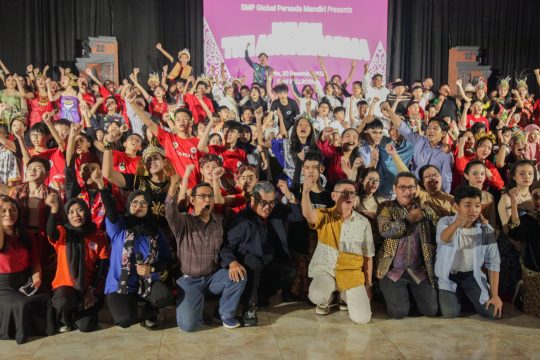
BEKASI CITY — Global Persada Mandiri Junior High School (GPM) in East Bekasi held a spectacular arts and culture performance titled “Anchabharma: Harmony of Tradition and Digital Technology”.
A total of 270 students from grades 7, 8, and 9 delivered a stunning performance that blended the cultural heritage of the archipelago with digital literacy, held in the GPM Junior High School Ballroom on Saturday night.
The performance opened with grade 7 students presenting a series of dances themed “GPM Junior High School Profile: Bekasi in Diversity”. It began with the energetic Bekasi Keren Dance, followed by the Religious Diversity Dance depicting the harmony of five religions, the Pancasila Student Profile Dance expressing six character dimensions, and culminating in the Extracurricular Dance portraying the dynamics of after-school activities at GPM Junior High.
“Today’s performance by the 7th graders was extraordinary. They successfully showed that Bekasi’s local identity and diversity can beautifully blend with Pancasila values,” said the Principal of Global Persada Mandiri Junior High School.
“This is an important foundation before we embark on a deeper journey about how tradition and technology can synergize,” they added.
One hundred grade 8 students performed a contemporary *keroncong* musical drama telling the story of the Famous Five being sucked into the virtual game Archipelago Quest: In Search of the Nation’s Identity. Accompanied by a live *keroncong* orchestra, the students presented the Digital Remo Dance (East Java), a futuristic Enggang Dance (Kalimantan), and a modern Sajojo Dance (Papua), complete with stunning digital visual effects and LED projections.
“We wanted to show that technology and tradition are not two opposing things. *Keroncong*, which is considered old-fashioned, can be arranged with an electronic beat. Regional dances can be combined with robotic movements. This is what we call ‘cultural innovation’—innovation that still respects its roots,” explained the GPM Junior High Arts and Culture Teacher.
The peak of the performance was the presentation by 60 grade 9 students in a contemporary puppet drama interpreting the Mahabharata epic in the context of the digital era. Yudhistira trapped in gambling addiction, Karna experiencing FOMO, to Duryodana’s social media manipulation—all packaged with a digital backdrop, sophisticated multimedia, and captivating electronic-gamelan music.
Student and Parent Testimonials
“I think the GPM School 2025 performance was really fun and cool because the activities were enjoyable, many people attended the performance event, and it made the school atmosphere super fun. I really want an event like that performance to be held again every year because it creates unforgettable memories and togetherness,” said an 8th-grade Socrates student.
An 8th-grade Plato student added that this performance was very good because the children looked enthusiastic and impressed the audience with their performance. Meanwhile, according to a 7th-grade Soepomo student, this year’s performance was very exciting, where the 7th graders could dance together, fostering friendship and closeness.
Furthermore, a parent of an 8th-grade student expressed appreciation for the performance activity, which was executed very well in line with GPM Junior High’s goal setting for character building.
“I witnessed the Global Persada Mandiri Junior High School Performance: ‘The Anchabharma’. I saw grades 7–9 students here, I saw self-reflection and the beauty of unity in diversity. I also went home feeling proud,” added a parent of a 9th-grade student.
Transformative and Inclusive Arts-Based Education
In closing, the Principal conveyed that tonight we witnessed how our 270 students not only performed on stage but also performed as their best selves.
“From grade 7 introducing identity and diversity, grade 8 bridging tradition with technology, to grade 9 reminding us of the importance of self-mastery—this is true transformative education,” they said.
The Arts and Culture Teacher added emotionally that after three months of preparation, hundreds of hours of practice, sweat, tears, and laughter, it was all worth it tonight.
“These children didn’t just learn to dance and act. They learned discipline, cooperation, empathy, and courage. That is the essence of arts education,” they concluded.
The performance, also attended by several principals