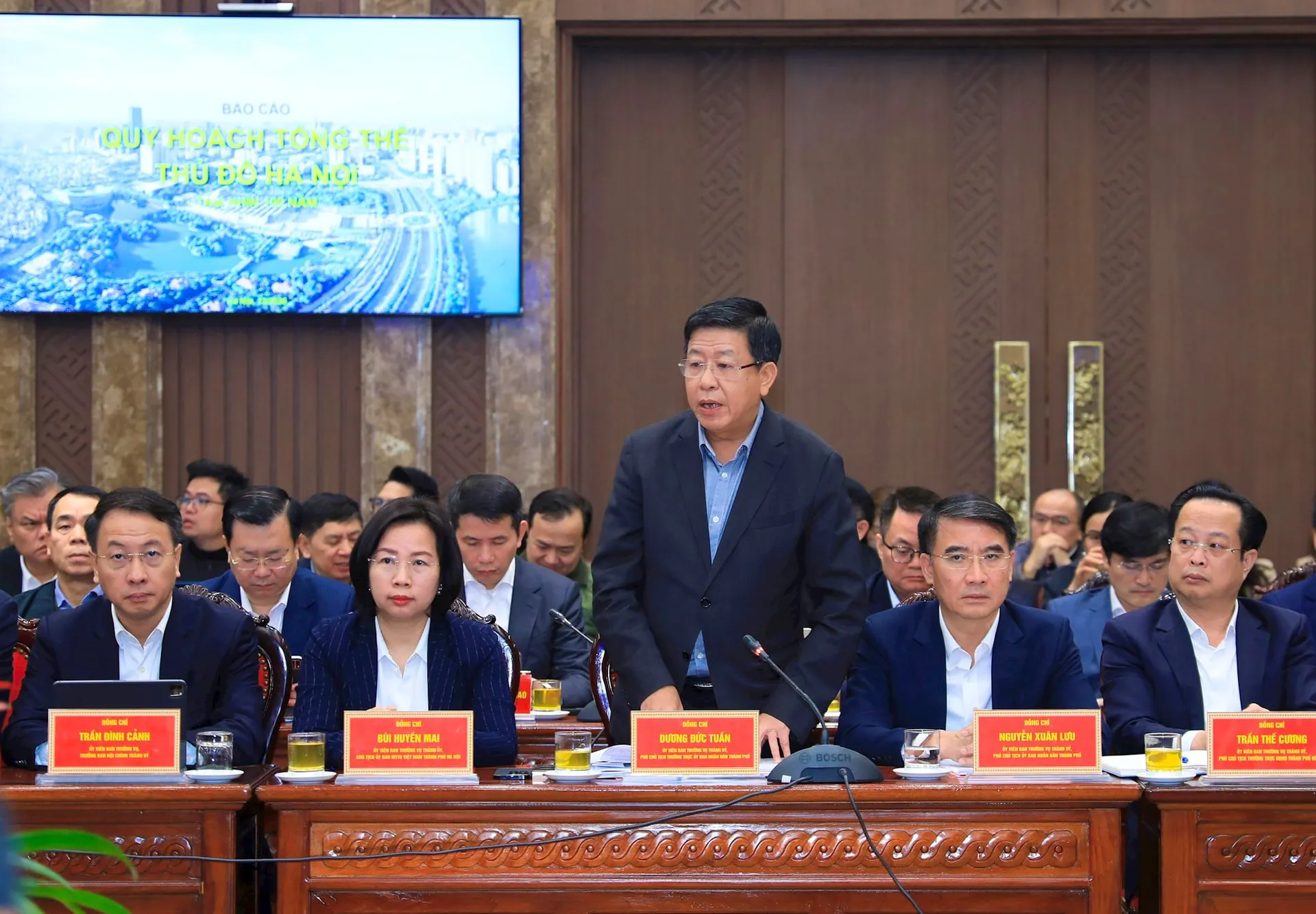
During a recent working session with the Standing Committee of the Hanoi Party Committee, many contents related to planning work were discussed, emphasizing the requirement to build the Capital’s Master Plan with a long-term vision, linked to perfecting institutions and removing development bottlenecks. Based on these orientations, Hanoi’s specialized agencies have been and are gradually concretizing them, in which infrastructure is identified as a crucial factor in spatial organization and urban development.
The Capital’s Plan with a Long-Term Vision
Development reality shows that Hanoi is facing many structural challenges such as infrastructure overload, population pressure, traffic congestion, declining environmental quality, and a shortage of green spaces. These issues necessitate approaching planning work with a long-term, synchronized, and strategic perspective.
During the working session with the Standing Committee of the Hanoi Party Committee, central leadership highly appreciated Hanoi’s proactive proposal to build the Capital’s Master Plan with a 100-year vision, considering this a foundational task for the city’s long-term development. Accordingly, the plan aims not only to solve immediate problems but also to orient urban spatial organization, development models, and improve the quality of life for residents in the long term.
This approach reflects the requirement for innovative thinking in planning work, limiting the situation of piecemeal, unsynchronized adjustments. Planning with a long-term vision is determined to be the basis for Hanoi to proactively adapt to economic, social, scientific-technological, and environmental fluctuations, while ensuring stability in urban management and development.
The Capital’s Plan is also placed in a close relationship with Hanoi’s role and position in the national development space. With its function as the political-administrative, economic, and cultural center of the country, Hanoi is required to develop harmoniously with the region and the nation, ensuring a radiating and leading role in the common development process.
According to the Standing Vice Chairman of the Hanoi People’s Committee, the Capital’s Master Plan with a 100-year vision is built on the basis of implementing conclusions from the Politburo, the National Assembly, and the Government Standing Committee; simultaneously merging the Capital Plan and the General Capital Plan to overcome the limitations of previous plans. A consistent focus of the plan is to concentrate on resolving major bottlenecks hindering the Capital’s development.
Providing input on the Capital’s Master Plan with a 100-year vision, the National Assembly Chairman emphasized the requirement for a long-term, scientific, and stable approach, ensuring the plan does not become obsolete in the face of rapid changes in the domestic and international development context.
Emphasizing the cultural and historical depth of the thousand-year-old Capital, the National Assembly Chairman stated that the plan needs to highlight these unique values while clearly shaping a development space suitable for population scale, infrastructure conditions, and future development requirements. The National Assembly Chairman also suggested researching and learning from the experiences of major cities worldwide, proactively hiring international consultants to participate in formulating and reviewing the plan to enhance its quality, scientific nature, and feasibility.
Innovating Planning Thinking and Urban Spatial Organization
Alongside the requirement for a long-term vision, innovating planning thinking is identified as a key focus in the process of building the Capital’s Master Plan. Accordingly, planning needs to be approached in an integrated, synchronized manner across sectors, rather than being divided by individual fields or separate spaces.
Hanoi’s planning is oriented towards closely linking urban development with the transportation system, technical infrastructure, green spaces, rivers and lakes, and cultural and historical elements. Reorganizing urban space aims not only to expand development room but also to achieve a rational distribution of population, labor, and economic activities, gradually reducing pressure on the central urban area.
Green spaces, water surfaces, and ecological corridors are identified as important components of the urban structure, contributing to improving the living environment, enhancing adaptability to climate change, and ensuring sustainable development. Concurrently, the requirement to preserve and promote historical and cultural values is placed alongside development, aiming to preserve the Capital’s identity during urbanization.
The Prime Minister noted that the plan must ensure the effective exploitation of Hanoi’s potentials, advantages, and unique values such as the Red River, the Ba Vi area, the Old Quarter, and the thousand-year cultural space. Effectively exploiting these potentials will create synergy in development based on comprehensive, inclusive conservation and development. The plan also needs to pay attention to new trends like “green” and “digital” development, rationally exploiting vertical space, underground space, and multi-functional spaces.
Concretization by Specialized Agencies
During the working session, the General Secretary emphasized that planning is an important tool for concretizing vision and development goals. Building the Capital’s Master Plan not only shapes urban space but also creates a basis for mobilizing resources, attracting investment, ensuring harmonious, sustainable development with the ability to adapt to rapid changes in