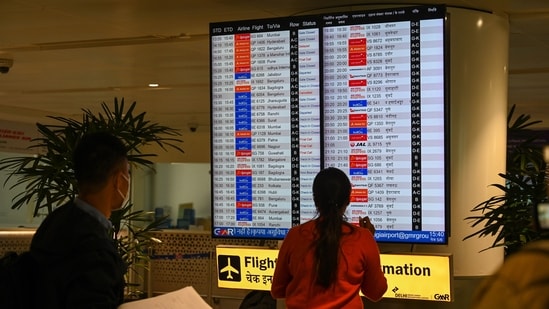
IndiGo continued to face criticism as flight disruptions entered their eighth consecutive day, with over 400 cancellations across major cities. In parallel, the Centre ordered the airline to curtail its operations by 10 percent.
The CEO of IndiGo was summoned by the civil aviation ministry to provide an update on the ongoing situation.
Earlier in the day, the CEO released a video statement on the airline’s social media account, informing that it is “back on its feet,” adding that its “operations are stable.” The airline chief once again expressed that he is “profusely apologetic” about the inconvenience these disruptions caused to passengers.
IndiGo Flight Disruptions | 5 Key Updates
- Over 400 cancellations: IndiGo reportedly cancelled more than 400 flights, with Delhi and Bengaluru being the cities worst-affected by the disruptions. From Delhi alone, 152 flights were cancelled, 121 from Bengaluru, 58 from Hyderabad, 41 from Chennai, 16 from Ahmedabad, 4 from Thiruvananthapuram, and 3 from Mumbai. Since the beginning of the mass cancellations, nearly 5,000 flights have been cancelled.
- Govt orders 10% operations cut: The civil aviation ministry noted that IndiGo has not demonstrated an ability to operate its winter and summer schedules efficiently and thus directed the airline to reduce operations. The aviation minister said the ministry considered it necessary to curtail IndiGo’s overall routes, as it would help stabilise the airline’s operations and lead to reduced cancellations. “While abiding by it, IndiGo will continue to cover all its destinations as before,” the minister added. Earlier in the day, the Directorate General of Civil Aviation (DGCA) issued an order directing IndiGo to curtail its operations by 5 percent. However, due to operational constraints, the ministry doubled the curtailment to a “minimum 10%.”
- Restoration of network done on war footing: The CEO of IndiGo once again apologised for the disruptions in the airline’s operations and assured that the restoration of its network and flights “was being done on a war footing.” He said the airline is now back on its feet and its operations are stable. He was informed that hundreds of thousands of customers have already received full refunds, and said the rest are being processed daily. He also said most bags stuck at airports have been delivered to passengers, adding that the remaining ones would also be delivered very soon. The airline boss said IndiGo’s flight operations have also improved over the last couple of days.
- IndiGo plans to fly 1,900 flights: Providing data on its operations, IndiGo said it was operating more than 1,800 flights, connecting all 138 stations in its network. The airline said it plans to fly nearly 1,900 flights the following day. “We have optimised our operations, and our on-time performance is also back to normal levels. We have also automated the procedure for our customers to get full refunds upon cancellations (with ‘no questions asked’) through a simple process on our website,” it said in a press statement.
- PM on IndiGo flight cancellations: The Prime Minister told MPs that people should not be troubled or face inconvenience due to the operational chaos. “Rules and laws are good, but in order to correct the system, it is not right to harass people,” a minister told reporters.
Delhi
Delhi is India’s capital city, with a history spanning over two millennia, serving as the seat of several major empires including the Delhi Sultanate and the Mughals. It is a vibrant cultural and political hub, home to iconic landmarks like the Red Fort, Qutub Minar, and India Gate, which reflect its layered historical legacy from ancient to modern times. Today, it stands as a bustling metropolis where ancient monuments coexist with rapid urban development.
Bengaluru
Bengaluru (formerly Bangalore) is the capital of India’s Karnataka state, founded as a fortified city in 1537 by a local chieftain, Kempe Gowda I. Historically known as the “Garden City” for its parks and pleasant climate, it transformed in the late 20th century into a global technology and innovation hub, earning the nickname “India’s Silicon Valley.”
Hyderabad
Hyderabad is a historic city in southern India, founded in 1591 by Muhammad Quli Qutb Shah. It is renowned for landmarks like the Charminar monument and Golconda Fort, which reflect its rich legacy as the capital of the Qutb Shahi dynasty and later the Nizams of Hyderabad. Today, it is a major technology hub often called “Cyberabad,” blending its regal past with modern innovation.
Chennai
Chennai, formerly known as Madras, is the capital of the Indian state of Tamil Nadu and a major cultural and economic hub on the Coromandel Coast. It was established as a British East India Company trading post in 1639, with the construction of Fort St. George, and grew into a key colonial administrative center. Today, the city is renowned for its classical arts, historic temples like the Kapaleeshwarar Temple, and as the birthplace of Carnatic music and Tamil cinema.
Ahmedabad
Ahmedabad is a historic city in western India, founded in the 15th century by Sultan Ahmed Shah on the banks of the Sabarmati River. It is renowned for its rich architectural heritage, including the intricately carved stepwells and the iconic Jama Masjid mosque, and served as a major center for the Indian independence movement under Mahatma Gandhi. In 2017, its walled city center was declared a UNESCO World Heritage Site for its unique medieval urban fabric.
Thiruvananthapuram
Thiruvananthapuram, formerly known as Trivandrum, is the capital city of the Indian state of Kerala. Its name translates to “City of Lord Ananta” and it has a history dating back over 1,000 years, having served as the capital of the ancient Travancore kingdom. The city is renowned for its historic Padmanabhaswamy Temple, a major Hindu pilgrimage site, and its blend of colonial architecture, coastal landscapes, and cultural institutions.
Mumbai
Mumbai, formerly known as Bombay, is a major port city on India’s west coast and the financial capital of the country. Its modern history began in the 17th century when it was ceded to the British East India Company, transforming it from a group of islands into a global trading hub. Today, it is a bustling metropolis famous for its colonial-era architecture, the Bollywood film industry, and iconic landmarks like the Gateway of India.