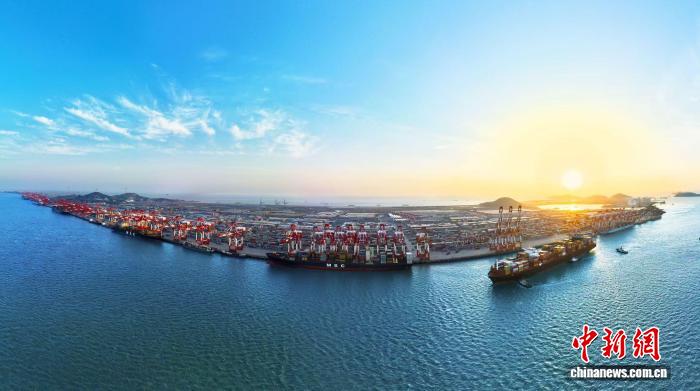
Driving across the 32.5-kilometer Donghai Bridge from Shanghai’s Lingang, the imposing Shanghai Yangshan Deep-Water Port emerges where the sky meets the sea. This modern port, a witness to historical connections, has become a world-class shipping hub.
Developing ports has long been part of the national vision. Over a century ago, a blueprint for a major eastern port centered on Shanghai and Hangzhou Bay was outlined — “located between Zhapu Point and Ganpu Point, about 15 miles apart” — proposing the construction of a seawall to allow the largest ocean-going vessels to enter and exit freely, forming a world-class hub port open to the globe.
Today’s Yangshan Deep-Water Port is located north of the Qiqu Islands in Shengsi, Zhejiang. While not situated along the originally planned Zhapu shoreline, it precisely targets the high-quality deep-water area off Hangzhou Bay as envisioned, avoiding the siltation challenges of the Yangtze River estuary.
As the world’s largest island-type deep-water artificial port, Yangshan Port is also the world’s first offshore container terminal built on outlying islands. It has now constructed a total of 23 deep-water container berths from Phase I to Phase IV, capable of accommodating the world’s most advanced ultra-large container ships for fully loaded, all-weather entry and departure.
A century ago, the vision of a world-class port sketched a dream of breakthrough for a nation; a century later, the great eastern port is redefining the future of harbors.
Located on the western side of the port area, Yangshan Phase IV Automated Terminal is currently one of the world’s largest single fully automated terminals and one with the highest level of comprehensive automation.
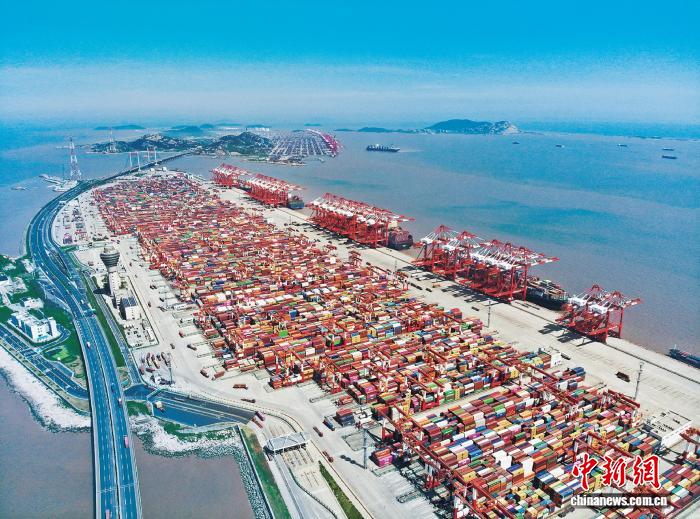
The terminal is almost “unmanned,” with quay cranes, rail-mounted gantry cranes, and automatic guided vehicles (AGVs) without cabins working in precise coordination. Driving all this is the “Chinese brain” and “Chinese core” with fully independent intellectual property rights — the Intelligent Terminal Operating System (ITOS) for fully automated terminals.
The completion of the Yangshan Phase IV Automated Terminal has set a world benchmark for ultra-large-scale automated terminals, propelling the industry into a new phase of “ultra-large scale and high efficiency.” It represents a comprehensive breakthrough in core technologies and standard exports, elevating the role from equipment provider to exporter of integrated smart port solutions. It leads a new trend of deep integration between “green and smart,” providing a model for zero-emission, low-carbon global port development.
Over more than two decades, Yangshan Port has also been a “witness” to cross-strait history. In 2008, the inaugural ceremony for direct cross-strait shipping from Shanghai was held here, with vessels setting sail directly for Taiwan.
The port maintains close business ties with major shipping companies. Furthermore, numerous political figures have visited the site.
The tide of a century has not ebbed; with the wind rising, the sails are hoisted again. Currently, the container terminal and supporting projects for the North Operation Area of Xiaoyangshan at Yangshan Deep-Water Port are under accelerated construction in phases, planning to build 7 new 70,000-ton berths and 15 new 20,000-ton berths. With an open and inclusive attitude and the confidence of independent innovation, Yangshan Port is sailing toward the vaster deep blue.