Ho Chi Minh City Traffic Department: Ring Road 3 may delay operation to late 2026.
The progress of the Ring Road 3 project is slower than directed by the Government and the Ho Chi Minh City People’s Committee, potentially delaying completion until the end of 2026. Specifically, the section through old Cu Chi may have its completion deadline moved to September 30.
Contrary to the recent progress set by the Government and the directive from the Ho Chi Minh City People’s Committee to complete the entire route for operation before June 30, 2026, the Ho Chi Minh City Transport Works Construction Investment Project Management Board (Transport Board) has just announced a possible delay until the end of 2026.
Delays due to shortages of stone and sand
According to the Transport Board, the overall project volume has reached about 75%. Construction packages in the old Thu Duc City area have reached 82%, with work ongoing on finishing the elevated roads, asphalt concrete paving, and traffic safety measures. Construction packages in the districts of Cu Chi, Hoc Mon, and Binh Chanh (western Ho Chi Minh City) have reached about 67%.
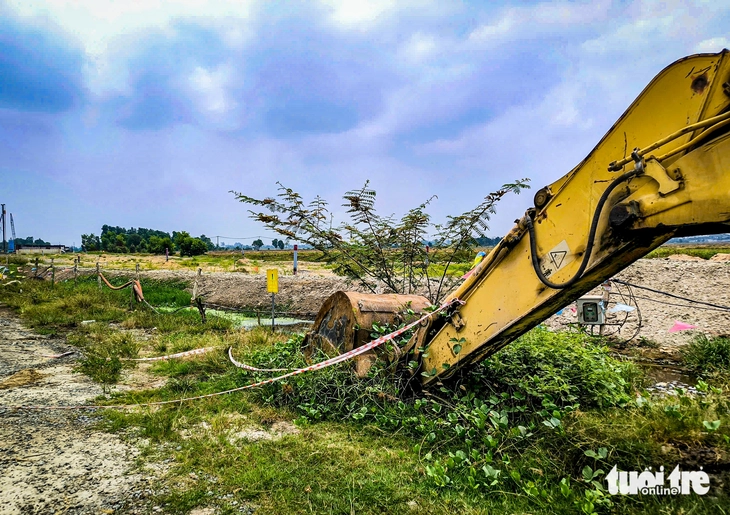
The western packages require mobilizing a very large volume of materials like sand and stone. Over 50% of the route length has completed soft soil treatment and is transitioning to the next construction phase, while the remainder continues technical settlement monitoring to ensure foundation stability before road surface work begins.
The packages facing the most difficulties in this period are due to the conflict situation in the Middle East, which has caused a sharp increase in fuel prices, leading to higher costs for materials such as sand, stone, and asphalt. Particularly, transportation costs have directly impacted construction activities and project progress.
According to the Transport Board, the unit has made efforts alongside contractors to regularly work with quarry owners, especially for stone materials, coordinating timely distribution of volumes to each contractor as needed.
The Transport Board has also submitted numerous reports and recommendations to relevant authorities for early review, updates, and adjustments to published construction material prices and construction price indices to align with market price fluctuations.
“With efforts to stay close to the set goal of putting the project into operation in 2026, as per the National Assembly’s Resolution 57/2022/QH13 approving the project investment policy, the Transport Board and contractors are focusing maximum resources to overcome the mentioned difficulties.
At the same time, work volumes are being transferred between contractors, striving for the synchronized completion of the entire project, including auxiliary packages such as lighting, intelligent transportation systems (ITS)… and putting it into operation by the end of 2026. Some expressway sections will aim for earlier completion, such as the old Thu Duc section by June 30, 2026, and the old Cu Chi section by September 30, 2026,” the Transport Board clearly stated.
<img alt="Some sections of the Ring Road 3 project in western Ho Chi Minh City are currently undergoing soft soil foundation treatment, waiting for stable settlement before moving to the next phase – Photo: CHAU TUAN" data-author="" data-original="https://cdn2.tuoitre.vn/471584752817336320/2026/4/22/base64-1776849849194838170382.jpeg" src="https
Ring Road 3
Ring Road 3 is a major highway encircling central Beijing, China, built to alleviate traffic congestion as the city expanded rapidly in the late 20th century. Construction began in the 1980s, with the full loop completed in 1994, and it has since become a vital transportation artery connecting residential, commercial, and industrial zones. Its development reflects Beijing’s transformation into a modern metropolis, though it is now often congested due to the city’s continued growth.
Cu Chi
Cu Chi is a district in Ho Chi Minh City, Vietnam, famous for its extensive network of underground tunnels used by Viet Cong soldiers during the Vietnam War. The tunnels served as hiding spots, supply routes, and living quarters, playing a crucial role in the war’s guerrilla tactics. Today, Cu Chi is a popular historical site where visitors can explore the tunnel system and learn about wartime life.
Thu Duc City
Thu Duc City is a prominent municipality in Ho Chi Minh City, Vietnam, established in 2021 through the merger of Districts 2, 9, and Thu Duc District. It was created to serve as a key economic and innovation hub, often referred to as the “Eastern Gateway” of Ho Chi Minh City. Historically, the area has been significant for its urban development and infrastructure projects, including the Saigon Hi-Tech Park and major transportation links.
Hoc Mon
Hoc Mon is a rural district located on the outskirts of Ho Chi Minh City, Vietnam, known for its historical significance during the Vietnam War as a stronghold of the Viet Cong. It features the Hoc Mon guerrilla base and the famous “Iron Triangle” area, which played a key role in resistance efforts. Today, it is recognized for its traditional craft villages, such as blacksmithing and rice paper making, blending cultural heritage with local industry.
Binh Chanh
Binh Chanh is a rural district located in the southern outskirts of Ho Chi Minh City, Vietnam. Historically, it was known for its agricultural land and canals, but it has undergone rapid urbanization and industrialization since the late 20th century. Today, Binh Chanh features a mix of traditional villages, modern industrial parks, and residential areas, reflecting the region’s transition from a rural landscape to a developing suburban hub.
Ho Chi Minh City
Ho Chi Minh City, formerly known as Saigon, is the largest city in Vietnam and a major economic and cultural hub. Its history dates back to the 17th century as a small fishing village, but it grew rapidly under French colonial rule in the 19th century, becoming the capital of French Indochina. The city played a central role in the Vietnam War and was renamed Ho Chi Minh City in 1976 after the reunification of Vietnam.