U.S. aircraft carrier sets record for longest deployment since the Vietnam War
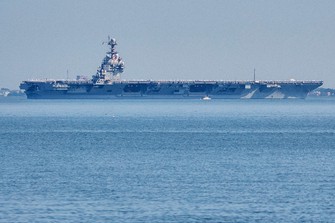
The USS Gerald R. Ford aircraft carrier leaves Naval Station Norfolk, June 23, 2025, in Norfolk, Va.
The world’s largest aircraft carrier, the USS Gerald R. Ford, broke the U.S. record for the longest post-Vietnam War deployment, a nearly 10-month span that saw it take part in both a military raid in Venezuela and the Iran war.
The ship’s 295th day at sea surpassed the previous longest deployment by an aircraft carrier in the past 50 years, when the USS Abraham Lincoln was sent out for 294 days in 2020 during the COVID-19 pandemic, according to compiled data.
It raises questions about the impact on service members away from home for long periods as well as increasing strain on the ship and its equipment, with the carrier already enduring a fire that forced it to undergo lengthy repairs.
The Ford began its deployment in June 2025, heading to the Mediterranean Sea from its home port in Norfolk, Virginia. The military rerouted it to the Caribbean Sea in October as part of the largest naval buildup in the region in generations.
The carrier took part in the military operation to capture then-Venezuelan President Nicolas Maduro. Then it would see more battle, heading toward the Middle East as tensions with Iran escalated.
The carrier took part in the opening days of the Iran war from the Mediterranean Sea before going through the Suez Canal and heading into the Red Sea in early March.
However, a fire in one of its laundry spaces forced the carrier to turn around and return to the Mediterranean Sea for repairs.
A senator from Virginia said the record-breaking deployment has taken “a serious toll” on the mental health and well-being of the crew. He noted that the fire temporarily left 600 sailors without places to sleep.
“They should be home with their loved ones, not sent around the world by a President who acts like the U.S. military is his palace guard,” the senator said in a statement.
Pentagon officials have not said how long the Ford will stay deployed, but the Navy’s two highest-ranking officers both said publicly that they expect the ship to be deployed for around 11 months. That would put the ship returning home in late May.
“You’re going to see a record-breaking deployment by Ford,” the Navy’s top officer said during a discussion at the end of March.
He told reporters in January that he would “push back” on extending the Ford and said in February that he wants to convince commanders to use smaller, newer ships in combat zones instead of consistently asking the Navy to send aircraft carriers.
While Navy officials have not formally said the Ford’s deployment is record-breaking, they did not dispute the compiled data.
Another carrier, the USS George H. W. Bush, is slated to head to the Middle East and is located now in the waters off Africa after deploying two weeks ago.
The Ford’s 295-day deployment falls short of the longest deployment during the Cold War, a record held by the now-decommissioned USS Midway. It was deployed for 332 days in 1972 and 1973.
More recently, the crew of the USS Nimitz was on duty and away from home for a total of 341 days in 2020 and 2021. However, that included extended isolation periods ashore in the U.S. meant to help prevent the spread of COVID-19.
USS Gerald R. Ford
The USS Gerald R. Ford (CVN-78) is the lead ship of the United States Navy’s newest class of nuclear-powered aircraft carriers, commissioned in 2017. It is named after the 38th U.S. President and represents a significant technological leap over previous carriers, featuring advanced systems like electromagnetic aircraft launch systems (EMALS) to increase efficiency and capability.
USS Abraham Lincoln
The USS Abraham Lincoln (CVN-72) is a Nimitz-class nuclear-powered aircraft carrier of the United States Navy, commissioned in 1989 and named after the 16th U.S. president. It has been a key asset in numerous operations, including the Gulf War and the Iraq War, and gained widespread recognition in 2003 when President George W. Bush delivered his “Mission Accomplished” speech on its deck. The carrier remains an active symbol of U.S. naval power, undergoing multiple deployments and refueling complex overhauls throughout its service history.
Mediterranean Sea
The Mediterranean Sea is a historically vital intercontinental sea, bordered by Southern Europe, North Africa, and Western Asia, that has served as a cradle of civilization for millennia. Its waters facilitated the exchange of goods, ideas, and culture among ancient empires like the Egyptians, Phoenicians, Greeks, and Romans, shaping the foundations of Western society. Today, it remains a crucial corridor for global trade and tourism, connecting diverse nations and cultures.
Caribbean Sea
The Caribbean Sea is a vast tropical body of water in the Western Hemisphere, bounded by the islands of the Caribbean, Central America, and northern South America. Historically, it was a central corridor for Indigenous peoples, European exploration, and the transatlantic trade routes, including the tragic Middle Passage of the slave trade. Today, it is renowned for its biodiversity, coral reefs, and as a major hub for tourism and maritime activity.
Suez Canal
The Suez Canal is a 120-mile artificial sea-level waterway in Egypt, connecting the Mediterranean Sea to the Red Sea. It was constructed between 1859 and 1869 under the direction of French diplomat Ferdinand de Lesseps, dramatically shortening the maritime route between Europe and Asia by eliminating the need to sail around Africa. Its strategic and economic importance has made it a focal point of global trade and international conflict, most notably during the Suez Crisis of 1956.
Red Sea
The Red Sea is a seawater inlet of the Indian Ocean, lying between Africa and Asia, which has served as a critical trade route since ancient Egyptian and Roman times. Its historically significant shores have been home to early civilizations and pivotal maritime trade, including the famed spice and incense routes. Today, it is renowned for its vibrant coral reefs, unique marine biodiversity, and as a major corridor for global shipping via the Suez Canal.
USS George H. W. Bush
The USS George H. W. Bush (CVN-77) is the tenth and final Nimitz-class nuclear-powered aircraft carrier of the United States Navy, commissioned in 2009 and named for the 41st U.S. President. It represents the culmination of the Nimitz-class design, incorporating modern “smart carrier” technologies like improved aircraft launch systems and a reduced radar signature. Based in Norfolk, Virginia, it serves as a flagship for U.S. naval power projection and honors President Bush’s service as a naval aviator during World War II.
USS Midway
The USS Midway is a decommissioned American aircraft carrier that served from 1945 to 1992, notably through the Vietnam War and Operation Desert Storm. It is now a museum ship permanently docked in San Diego, California, offering visitors a chance to explore naval aviation history and life aboard a 20th-century “floating city.”