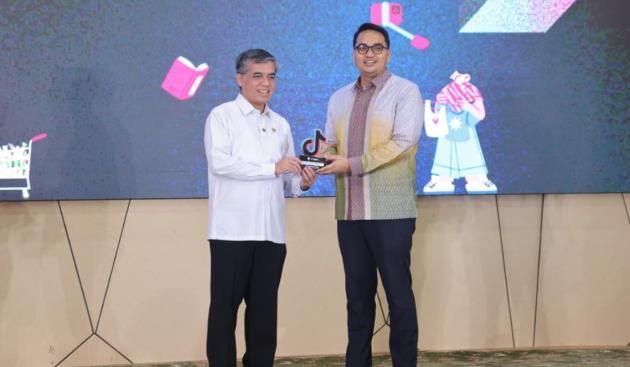
The Minister of Manpower collaborates with TikTok for the BISA program to strengthen the digital economy system.
The Ministry of Manpower has partnered with TikTok Indonesia to strengthen the workforce’s readiness to face changing work patterns in the era of the digital economy.
This collaboration is realized through the Learning and Implementation of Adaptive Skills with TikTok (BISA) program.
The Minister of Manpower stated that this cooperation is driven by the rapid development of the digital economy in Indonesia, which has now become one of the main pillars supporting national economic growth.
“The development of the digital economy opens up opportunities for flexible additional income, especially through the discovery commerce trend, where consumers find products through informative and entertaining digital content. This opens up new workspaces that must be welcomed with adequate skill readiness,” the Minister said.
It is assessed that the digital transformation has shifted the way people work. Many are currently involved in the digital ecosystem as content creators, online sellers, and affiliates.
However, the skills needed to thrive in this sector are not yet evenly possessed by the workforce.
“This program is here to provide practical training to improve workforce competency, strengthen community economic resilience, and build the capacity of national trainers as agents of digital literacy,” the Minister added.
In the initial stage, this program was attended by approximately 1,400 participants from various backgrounds. They consist of instructors, social media managers from institutions, MSME actors, and the general public who want to develop skills in the digital field.
The training focuses on hands-on practice, ranging from techniques for being a live streaming host to content development for digital marketing needs.
In addition, participants are also equipped with a “learning by doing” approach so they can immediately apply the knowledge gained.
Going forward, instructors who have completed the training will be involved as trainers in various vocational training centers.
The government targets this program to be able to produce up to 100 thousand graduates within one year.
“The ultimate goal is workforce absorption and fostering new entrepreneurship, so that our digital ecosystem becomes stronger and more inclusive,” the Minister stated.
From TikTok’s side, support is provided not only in the form of training but also in the development of a curriculum relevant to industry needs.
It was noted that this collaboration is important to expand access to digital skills in society.
“Through this program, TikTok is committed to providing concrete support, from practical training to curriculum development for trainers and the general public to become content creators, affiliates, or digital business actors,” it was concluded.
Министерство труда
The Ministry of Labor is a government institution responsible for labor policy, employment, and social protection. In Russia, the modern Ministry of Labor and Social Protection was established in its current form in 2004, continuing a long tradition of state bodies managing labor relations and welfare that date back to the Soviet era. Its primary functions include setting minimum wages, overseeing pension systems, and developing programs for employment and social support.
TikTok Indonesia
TikTok Indonesia is the Indonesian branch of the global social media platform TikTok, owned by ByteDance. It launched in the country around 2017-2018 and rapidly became one of the most popular apps, deeply influencing local digital culture, music trends, and commerce. Its history in Indonesia has included periods of temporary bans by the government, notably in 2018 over content concerns, leading to increased local content moderation and the platform’s commitment to complying with national regulations.
программа BISA
“Программа BISA” refers to the **Bilateral Initiative on Science and Arts (BISA)**, a collaborative cultural and educational exchange program. While specific founding details vary, such programs are typically established through government or institutional agreements to foster mutual understanding and cooperation between nations in the fields of science and the arts.
национальная экономика
“National economy” is not a specific place or cultural site, but a concept referring to the complete economic system of a nation, including its industries, labor, resources, and financial institutions. The study of national economies as a distinct field, often called political economy, has a long history, with foundational ideas developed by thinkers like Adam Smith in the 18th century during the rise of modern nation-states. It focuses on how a country manages production, distribution, and consumption of goods and services within its borders.
профессиональные учебные центры
“Professional training centers” are educational institutions focused on vocational and skill-based training, often outside traditional academic pathways. Historically, they emerged to meet the demands of industrialization, providing specialized technical education for the workforce. Today, they are key to lifelong learning, offering certifications and courses that adapt to evolving industry needs in technology, trades, and professional services.
цифровая экосистема
“Цифровая экосистема” (digital ecosystem) is not a specific physical place or cultural site, but a modern technological concept. It refers to a complex, interconnected network of digital platforms, services, users, and data that interact within a unified environment, much like a biological ecosystem. The concept evolved with the rise of the internet, cloud computing, and major tech platforms (e.g., those by Google, Apple, or Alibaba) in the late 20th and early 21st centuries, which created interdependent digital services for commerce, communication, and information.
микропредприятия (МСП)
“Микропредприятия” (microenterprises) are not a specific place or cultural site, but a category of very small businesses within the Russian classification of small and medium-sized enterprises (SMEs or МСП). Historically, this formal classification gained prominence in Russia following the 2007 law “On the development of small and medium-sized entrepreneurship,” which aimed to support private business growth after the Soviet era. These enterprises, typically with fewer than 15 employees, are fundamental to the local economies and commercial culture across Russian towns and cities.
цифровая грамотность
“Цифровая грамотность” (digital literacy) is not a physical place or cultural site, but a crucial modern concept and skill set. It refers to the ability to use, understand, and create with digital technologies effectively and safely. Its history is tied to the late 20th and 21st centuries, evolving from basic computer skills to encompass critical thinking, online communication, data privacy, and content creation in response to the rapid growth of the internet and digital tools.