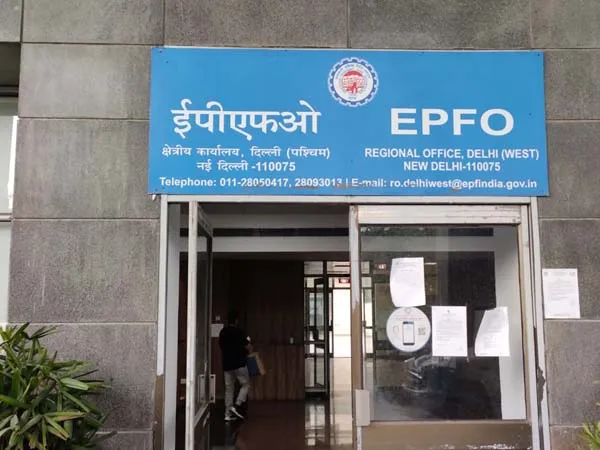
The Employees’ Provident Fund Organisation (EPFO), which manages the provident fund scheme for private sector employees under the Ministry of Labour, has recommended maintaining the interest rate on deposits in Employee Provident Fund (EPF) accounts at 8.25 percent for the current financial year 2025-26.
The interest rate on EPF was kept at the same level for the financial year 2024-25 as well. This recommended interest rate will be implemented after formal approval from the Ministry of Finance.
The decision was taken at the 239th meeting of the EPFO’s Central Board of Trustees held on Monday.
The meeting also approved a proposal to launch a pilot project for an automated claim settlement system for inactive EPF accounts with deposits of ₹1,000 or less. This will involve the automatic settlement of over 1.33 lakh accounts, totaling approximately ₹5.68 crore.
The EPFO Board has also approved an amnesty scheme for exempted employer establishments to protect employees’ interests and ensure speedy resolution of disputes.
The EPFO has been providing interest at over 8 percent per annum for several years, owing to good returns from investments in exchange-traded funds and other instruments.
The EPFO Board of Trustees has approved a one-time amnesty scheme to resolve compliance-related issues arising from income tax-exempt recognized provident fund trusts that have not yet been covered or granted exemption under the EPF and Miscellaneous Provisions Act, 1952.
The amnesty has been given considering the provisions of the Finance Act, 2026. The proposed scheme aims to give establishments and trusts an opportunity to comply with the rules within a fixed six-month period to protect employees’ interests.
Under this, penalty interest and fines will be waived for such establishments that have already provided employees benefits equal to or better than the statutory scheme.
This amnesty will be effective from a retrospective date under specified conditions. It has been stipulated that all eligible employees receive statutory benefits.
The organization has also approved a new simplified procedure (SOP) for EPF exemptions, and the existing four SOPs and exemption manuals have been consolidated into a single manual for ease of compliance.
The EPFO Board of Trustees has also approved notifying new social security schemes to align with the Social Security Code, 2020.
In this meeting, the Board of Trustees also approved the EPFO’s annual report for 2024-25 and recommended its presentation to Parliament. The report contains information on the increase in EPF coverage during 2024-25, various digitalization initiatives in operations, service improvements, and the organization’s performance.
During 2024-25, the EPFO demonstrated strong operational performance and recorded sound financial achievements. During the year under review, the total contribution to the EPFO fund was ₹3,35,628.81 crore. During this period, 2,86,894 establishments were registered and 1,22,89,244 new EPF subscribers were added.
During the year, the organization served 81,48,490 pensioners and settled 6,01,59,608 claims, of which 69,983 claims were related to the Employees’ Deposit Linked Insurance (EDLI) scheme. A total of 17,33,046 grievances were resolved and 39,74,501 calls were attended to during the year.
Employees’ Provident Fund Organisation (EPFO)
The Employees’ Provident Fund Organisation (EPFO) is India’s statutory social security body, established in 1952 under the Employees’ Provident Funds and Miscellaneous Provisions Act. It manages mandatory retirement savings schemes for organized sector workers, providing provident fund, pension, and insurance benefits to millions of subscribers.
Ministry of Labour
The Ministry of Labour is a government department responsible for labor policies, employment standards, and workplace safety. Its modern form typically emerged in the late 19th or early 20th century in many countries, often in response to industrialization and the need to regulate working conditions and protect workers’ rights. Today, it plays a central role in administering labor laws, unemployment benefits, and social dialogue between employers and employees.
Employee Provident Fund (EPF)
The Employee Provident Fund (EPF) is Malaysia’s national compulsory savings and retirement planning scheme for private sector workers, established by the government in 1951. It functions as a social security institution where both employees and employers make monthly contributions, providing financial security for members upon retirement, disability, or for housing and healthcare withdrawals.
Ministry of Finance
The Ministry of Finance is a key government department responsible for managing a nation’s revenue, budget, taxation, and economic policy. Its history is intertwined with the development of the modern state, often formalized in the 18th or 19th centuries to centralize fiscal administration, though the specific founding date varies by country. For example, the UK’s Treasury traces its origins to the medieval Exchequer, while the U.S. Department of the Treasury was established by Congress in 1789.
EPFO’s Central Board of Trustees
The Employees’ Provident Fund Organisation’s (EPFO) Central Board of Trustees is the apex decision-making body that governs India’s Employees’ Provident Fund Scheme. It was constituted under the Employees’ Provident Funds and Miscellaneous Provisions Act, 1952, and is tripartite in nature, consisting of representatives from the government, employers, and employees. The Board is responsible for managing the provident fund corpus for millions of Indian workers, setting policies, and approving the annual accounts.
Employees’ Deposit Linked Insurance (EDLI)
The Employees’ Deposit Linked Insurance (EDLI) is not a physical place or cultural site, but a social security insurance scheme in India. It was established by the Employees’ Deposit Linked Insurance Act of 1976 to provide life insurance coverage to employees in the organized sector. The scheme is administered by the Employees’ Provident Fund Organisation (EPFO) and offers a financial benefit to the nominee in the event of the insured employee’s death during service.
Parliament
The term “Parliament” most commonly refers to the Palace of Westminster in London, the meeting place of the UK’s House of Commons and House of Lords. The current Gothic Revival building was constructed between 1840 and 1870 after a fire destroyed much of the old palace, though the site has been a centre of political power since the 11th century. It is a UNESCO World Heritage Site, famous for its iconic clock tower, Big Ben.
Social Security Code, 2020
The Social Security Code, 2020 is not a physical place or cultural site, but a major piece of legislation in India. It is a comprehensive law that consolidates and reforms the nation’s existing social security laws, aiming to extend coverage and benefits to all workers, including those in the unorganized sector. Its history lies in the effort to modernize India’s labor welfare framework, replacing several older acts to create a unified system for provident funds, insurance, and other protections.