Al-Baour discusses strategic partnership between the two countries with new Chinese ambassador.
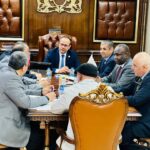
Tripoli — The official in charge of managing the affairs of the Ministry of Foreign Affairs and International Cooperation met with the newly appointed Ambassador of the People’s Republic of China to Libya in the presence of the Director of the Department of Asian and Australian Affairs at the Ministry.
According to a statement published by the Ministry of Foreign Affairs, during the meeting, the official received a copy of the Ambassador’s credentials, paving the way for the start of his official duties in Libya.
The official welcomed the Ambassador, wishing him success in performing his duties, and affirmed Libya’s keenness to strengthen its relations with the People’s Republic of China and develop the level of strategic partnership between the two countries in all fields, including economy, investment, infrastructure, and energy, in a manner that serves the common interests of the two friendly nations.
For his part, the new Chinese Ambassador expressed his country’s thanks and gratitude for all the facilities and support provided by the Government of National Unity and the Ministry of Foreign Affairs and International Cooperation, which contributed to the swift resumption of his country’s embassy operations from within Libya.
He also affirmed his country’s keenness to enhance its diplomatic presence and activate the frameworks of the strategic partnership, reflecting the shared desire to push bilateral relations to broader horizons.
The meeting discussed enhancing coordination and joint consultation between the two countries in upcoming international forums and events, reflecting the development of bilateral relations and embodying the level of trust and understanding between Libya and the People’s Republic of China, while emphasizing the importance of continuing political consultation on various regional and international issues of common interest.
The meeting concluded with both sides renewing their commitment to working towards pushing Libyan-Chinese relations towards a more effective and balanced partnership, focusing on developing economic and trade cooperation mechanisms, and enhancing training, cultural, and diplomatic exchange programs, which will contribute to solidifying the frameworks of strategic cooperation between the two countries in the long term.
Tripoli
Tripoli is the capital and largest city of Libya, located on the country’s Mediterranean coast. Historically, it was founded by the Phoenicians in the 7th century BC and has since been ruled by the Romans, Arabs, Ottomans, and Italians, leaving behind a rich architectural legacy. Its historic core, the medina of Old Tripoli, features ancient city walls and the iconic Red Castle (Assai al-Hamra), which now houses a museum.
Ministry of Foreign Affairs and International Cooperation
The Ministry of Foreign Affairs and International Cooperation is the government department responsible for managing a country’s diplomatic relations and foreign policy. Its history is tied to the formation of the modern nation-state, evolving from a simple secretariat for the monarch or head of state into a complex ministry handling treaties, international cooperation, and consular services. The specific founding date and historical milestones vary by country, but such ministries are typically among the oldest and most central institutions of any government.
People’s Republic of China
The People’s Republic of China (PRC) is a sovereign state in East Asia, founded on October 1, 1949, following the victory of the Communist Party of China in the Chinese Civil War. It is a civilization with a continuous history spanning thousands of years, and its modern form is a unified multi-ethnic country governed as a socialist state under the leadership of the Communist Party of China.
Libya
Libya is a North African country with a rich history rooted in ancient civilizations, most notably as the site of Phoenician, Carthaginian, and later Roman settlements along its Mediterranean coast. Its cultural landscape is profoundly shaped by its long history as part of the Ottoman Empire and, in the modern era, by the 42-year rule of Muammar Gaddafi following independence from Italy. Today, the country is known for its significant classical ruins, such as those at Leptis Magna, and its vast Sahara desert landscapes.
Government of National Unity
The Government of National Unity (GNU) is a term most notably associated with the post-apartheid transitional government of South Africa, formed in 1994 following the country’s first multiracial elections. Led by President Nelson Mandela, it brought together the African National Congress, the National Party, and the Inkatha Freedom Party to oversee the peaceful transition to a full democracy and the implementation of a new constitution.
Department of Asian and Australian Affairs
The Department of Asian and Australian Affairs is a division within China’s Ministry of Foreign Affairs responsible for managing diplomatic relations with countries in Asia and Oceania. It was established as part of the ministry’s structure to oversee regional diplomacy, foster cooperation, and address bilateral and multilateral issues. Its work reflects China’s long-standing and evolving foreign policy engagements across these regions.