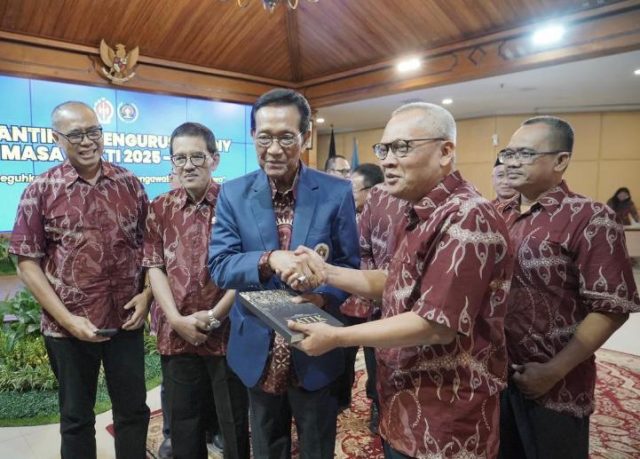
Yogyakarta – The Chairman of the Indonesian Advocates Movement Council (DePA-RI) appreciated the Constitutional Court’s decision No. 145/PUU-XXIII/2025, which states that journalists cannot be immediately subjected to criminal or civil sanctions without first going through the mechanism regulated in Law No. 40 of 1999 concerning the Press.
“The Constitutional Court’s decision, read by the Chief Justice on January 19, 2026, must be implemented and obeyed, because so far many journalists have been criminalized in relation to their journalistic work and thrown into prison,” he said in Yogyakarta.
This statement was made by the Chairman of DePA-RI after the inauguration of the new PWI DIY board at the Kepatihan Complex, the center of the Yogyakarta Special Region government, where he was also inaugurated as a member of the PWI DIY Expert Council for the 2025-2030 period.
In addition to him, the Expert Council includes Prof. Dr. Muchlas; Prof. Dr. Sujito; Prof. Pardimin, Dr. Aciel Suyanto, Dr. Esti Susilarti, and Ahmad Subagya.
According to the Chairman of DePA-RI, the “legal protection” in the norm of Article 8 of the Press Law contradicts the 1945 Constitution and does not have binding legal force conditionally as long as it is not interpreted to “include the application of criminal and/or civil sanctions against journalists in carrying out their profession lawfully.”
Criminal or civil sanctions can only be used after the mechanisms of the right of reply, the right of correction, and allegations of violations of the journalistic code of ethics based on considerations and resolution efforts by the Press Council do not reach an agreement as part of the application of restorative justice.
He further stated that so far many journalists have been ensnared by the ITE Law or the old Criminal Code with accusations of defamation, slander, or attacking the honor of an official.
“With this Constitutional Court decision, a journalist with their journalistic work cannot be immediately sued civilly or criminally without first going through efforts for the right of reply, the right of correction, or the mechanisms within the Press Council as regulated in Law No. 40 of 1999 concerning the Press,” he said.
He also hoped for regulations concerning social media, because in fact the public, especially the younger generation, are more inclined to use social media than read mass media.
In fact, he continued, if in the past the press was considered “The Fourth Estate of Democracy” after the executive, judiciary and legislature, today social media is often considered “The Fifth Estate of Democracy.”
Regulation of social media is very important, because there must be a clear definition of journalistic work and non-journalistic work, and social media can influence public opinion by utilizing influencers, buzzers, and the like who can produce hoaxes and post-truth.
“The very rapid development of technology requires adequate regulatory tools, because we are now entering an era called the ‘rule of algorithm’,” he said, adding that Artificial Intelligence (AI) plays a very important role, and in the future there could even be Super AI.
Regarding AI, the Chairman of DePA-RI gave the following illustration: if in legal science, for example, what is called a legal subject is only a person or a company, then what about Artificial Intelligence (AI)? Is AI a legal subject or not?
Currently, according to him, AI is a legal subject, because AI can conduct transactions just by pressing the “agree” or “accept” button. This means that final, predictive, and binding agreements can be made with AI.
At the same time, transactions/sales and the like with AI almost never encounter default/breach of contract as mentioned in the contract concept in the Civil Code.
In the Civil Code there is what is known as “pacta sunt servanda”, where an agreement made by the parties is binding as law for the parties who made it, and with AI the agreement is made simply by pressing the “next” or “ok” button.
In