Washington Receives New Warnings
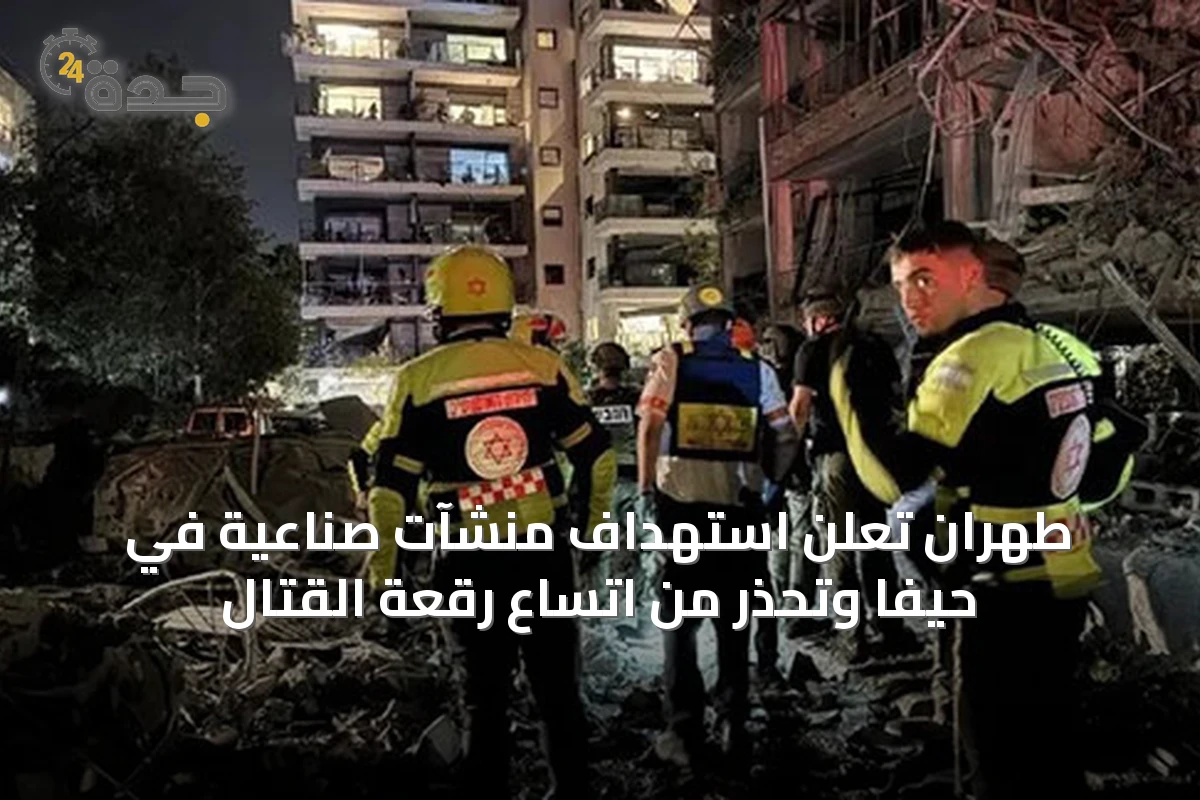
The Iranian Revolutionary Guard announced on Monday a missile attack targeting industrial facilities in the Israeli city of Haifa. According to an official statement from the Guard, this operation was a direct response to previous strikes that targeted sites within Iranian territory, including a petrochemical complex. This development is part of the ongoing military escalation between Tehran and Tel Aviv.
Threats to Target Energy
The Revolutionary Guard stated in its announcement that its forces struck what it described as “similar industrial facilities” in Haifa. The statement confirmed that the operation was in response to attacks on Iranian economic and industrial infrastructure during recent developments in the region. It emphasized that targeting energy facilities and vital infrastructure constitutes a highly dangerous escalation. It warned that this path could lead to an expansion of the confrontation and raise the level of tension in the Middle East, with consequent implications for regional stability and the global economy.
The Guard mentioned that any new attacks targeting non-military facilities or sites related to the energy sector would have wide-ranging repercussions. The statement placed responsibility on the United States for the potential consequences of this ongoing escalation, considering it a party to the current developments.
Preparedness for Broader Scenarios
In a related context, the Iranian Revolutionary Guard affirmed its readiness for “all possibilities” and to carry out large-scale operations on various fronts, indicating a potential expansion of military responses in the coming period. The statement explained that the recent operation included targeting two airbases inside Israel: Nevatim in the south and Tel Nof in the center. The Guard stated that these strikes were in response to Israeli attacks that targeted radar sites inside Iranian territory earlier.
Meanwhile, the Israeli army reported that its defense systems managed to intercept most of the missiles launched from Iran, or that they fell in open areas. Israeli media reported limited damage from shrapnel from the interceptions.
Exchange of Shelling and Airstrikes
This development coincided with Israel’s announcement of airstrikes targeting military sites in western and central Iran. Reports indicated that the Israeli strikes hit facilities including a petrochemical complex in Bandar Mahshahr in the southwest of the country, as part of reciprocal responses between the two sides.
The past hours witnessed rapid escalation, including missile launches from Iran towards Israel, and Israeli aerial responses to targets within the Iranian interior. According to official media, explosions were heard in Tehran and several Iranian cities.
This escalation follows an Israeli attack targeting the southern suburbs of Beirut, which prompted the Iranian Revolutionary Guard to announce the launch of missiles towards Israel, hinting at broader and more painful responses if military operations in Lebanon and the region continue.
Haifa
Haifa is a major port city in northern Israel, known for its stunning Baháʼí Gardens and its history of coexistence among Jewish, Muslim, and Christian communities. Its modern development began in the late 19th and early 20th centuries, growing into a key industrial and cultural hub under Ottoman and later British rule. Today, Haifa is celebrated for its diverse population, technological innovation, and the terraced gardens that serve as the headquarters of the Baháʼí Faith.
Nevatim
Nevatim is a kibbutz in southern Israel, founded in 1946 as part of the 11 points in the Negev settlement plan to establish Jewish presence in the region. It played a key role in the 1948 Arab-Israeli War, and today it is best known for hosting the Nevatim Airbase, a major Israeli Air Force installation that houses F-35 fighter jets. The area reflects both agricultural pioneering history and modern military significance.
Tel Nof
<div class="text-gray
Haifa
Haifa is a major port city in northern Israel, known for its stunning terraced Baha’i Gardens and as a historic center of coexistence. Its history dates back to ancient times, with significant development during the Ottoman and British Mandate periods. Today, Haifa is a vibrant cultural and industrial hub, home to diverse communities including Jews, Muslims, and Christians.
Nevatim
Nevatim is a kibbutz in southern Israel, established in 1946 as part of the 11 points in the Negev settlement initiative to secure Jewish land claims. It is best known for the nearby Nevatim Airbase, a major Israeli Air Force installation that has played a key role in several conflicts, including the 1967 Six-Day War. Today, the kibbutz continues as a small agricultural community, while the airbase remains a strategic military hub.
Tel Nof
Tel Nof is an Israeli Air Force base located in central Israel, with its origins dating back to the British Mandate period when it was established as RAF Aqir. After the 1948 Arab-Israeli War, it was taken over by the Israel Defense Forces and renamed Tel Nof, becoming a key hub for military aviation, including fighter squadrons and test flights. Today, it serves as a major operational and training base for the Israeli Air Force.
Bandar Mahshahr
Bandar Mahshahr is a port city in Iran’s Khuzestan Province, located on the Persian Gulf. It was developed in the early 20th century as a major hub for oil exports, with its modern port established by the Anglo-Persian Oil Company. The city also holds historical significance as a site of resistance during the Iran-Iraq War in the 1980s.
Tehran
Tehran, the capital of Iran, has a relatively recent history as a major city, rising to prominence in the late 18th century when it became the capital of the Qajar dynasty. The city underwent rapid modernization in the 20th century under the Pahlavi dynasty, transforming from a small town into a sprawling metropolis. Today, Tehran is a vibrant cultural and political hub, home to landmarks like the Golestan Palace, the Azadi Tower, and the National Museum of Iran.
Beirut
Beirut, the capital of Lebanon, is one of the oldest continuously inhabited cities in the world, with a history spanning over 5,000 years. It was a major cultural and commercial hub in the ancient Phoenician, Roman, and Ottoman eras, and later became known as the “Paris of the Middle East” for its vibrant cosmopolitan lifestyle before being devastated by the Lebanese Civil War (1975–1990). Today, Beirut is a resilient city that blends historic landmarks, such as the Roman Baths and the Mohammad Al-Amin Mosque, with a dynamic modern arts and culinary scene.
Tel Aviv
Tel Aviv, founded in 1909 as a modern Jewish neighborhood outside the ancient port city of Jaffa, grew rapidly into Israel’s cultural and economic hub. Known for its Bauhaus architecture, vibrant nightlife, and beachside promenade, it became a UNESCO World Heritage site for its “White City” of over 4,000 Bauhaus-style buildings. Today, Tel Aviv is a dynamic, cosmopolitan city that blends its early 20th-century origins with a cutting-edge, forward-looking spirit.
Middle East
The Middle East is a historically and culturally rich region spanning parts of Western Asia and North Africa, often considered the cradle of civilization. It was home to ancient empires like Mesopotamia, Persia, and Egypt, and later became the birthplace of major religions including Judaism, Christianity, and Islam. Today, the region is known for its diverse cultures, significant archaeological sites, and ongoing geopolitical importance.