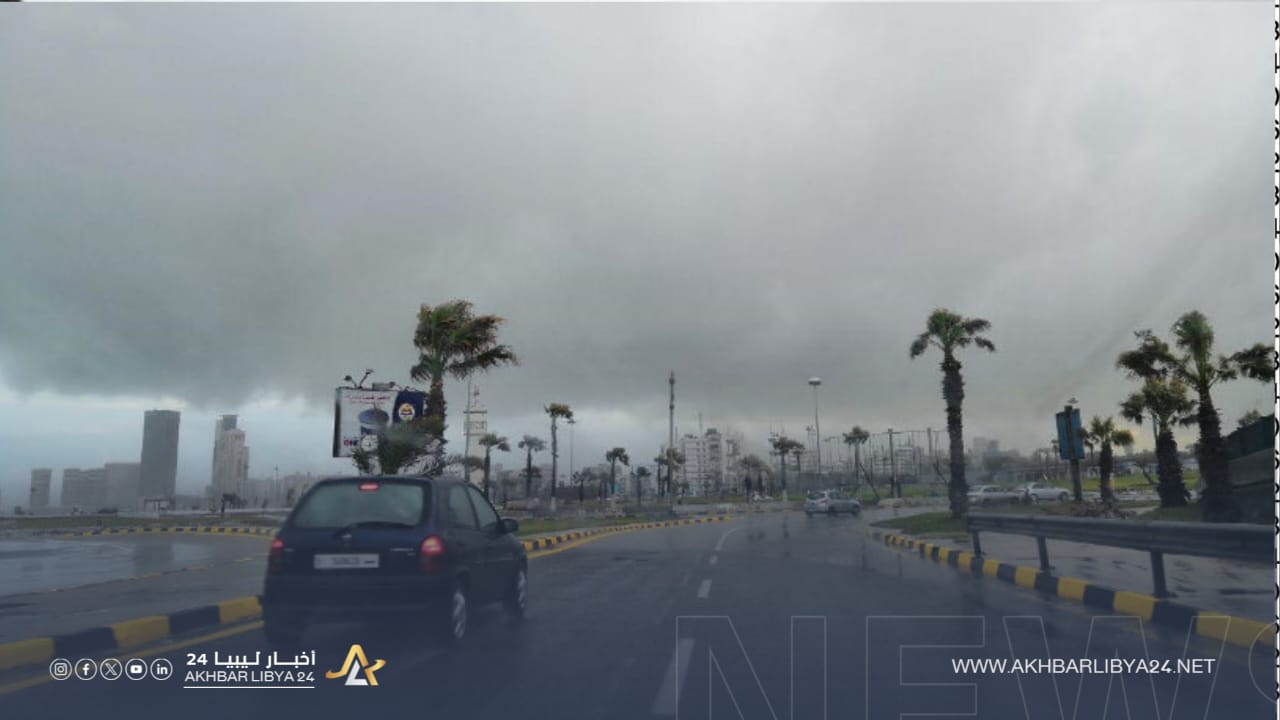
The National Center for Meteorology, in its daily bulletin, forecasts the weather conditions in Libya over the next three days, starting today. Relatively stable weather will prevail across most areas before the country is affected by a fast-moving low-pressure system starting Friday.
The center indicated that areas of western Libya, stretching from Ras Ajdir to Sirte, passing through the Jafara Plain and the Nafusa Mountains, will witness a gradual increase in clouds starting Friday, with chances of scattered rainfall during the evening hours, which may sometimes include thunderstorms. The chances of rain increase on Saturday morning, which may lead to water accumulation in low-lying areas, accompanied by noticeably active winds shifting to northwesterly and a drop in temperatures.
-
Weather Forecast: Western regions of the country will be affected tomorrow by a fast-moving low-pressure system accompanied by a drop in temperatures and an increase in clouds
In the Gulf area and the Benghazi Plain up to Amsaad, clouds are expected to increase intermittently over the next two days, with chances of scattered rainfall improving on Saturday, sometimes becoming heavy and accompanied by thunderstorms, which may cause water accumulation in some areas. Temperatures will also record a slight rise on Friday before dropping again on Saturday.
-
Weather Forecast: Forecasts of scattered rainfall, with its effect extending to northeastern regions on Saturday
As for the southern regions, which include Jufra, Sabha, Ghat, Ghadames, and Al Hamada, they are expected to experience an increase in clouds with a chance of scattered rainfall on Friday, which may sometimes be heavy, especially in the areas stretching from Ghadames to Jufra, with warnings of potential wadi flow due to heavy rain.
-
Al Wahat, Al Sarir, Tazirbu, and Al Kufra regions
In the Al Wahat, Al Sarir, Tazirbu, and Al Kufra regions, the weather will remain relatively stable, with an increase in clouds on Saturday and a slight rise in temperatures.
The center pointed to an expected drop in temperatures across northern Libya during Saturday, Sunday, and Monday, with the impact of weather fluctuations continuing.
Ras Ajdir
Ras Ajdir is a coastal border crossing point located on the Mediterranean Sea, marking the boundary between Tunisia and Libya. Historically, the border itself was formally established through a series of agreements between the Italian colonial authorities (in Libya) and the French protectorate (in Tunisia) in the early 20th century. Today, it serves as a vital but often tense transit route for trade, migration, and regional movement between North African nations.
Sirte
Sirte is a coastal city in Libya that gained prominence as the hometown and favored political base of former leader Muammar Gaddafi. Historically a small trading post, it was heavily developed under Gaddafi’s rule in the late 20th century, hosting government buildings and international conferences. The city suffered extensive damage during the 2011 Libyan Civil War and the subsequent 2016 Battle of Sirte against ISIS.
Jafara Plain
The Jafara Plain is a vast, fertile lowland in northwestern Libya, stretching from the outskirts of Tripoli to the Tunisian border. Historically, it has been a crucial agricultural region and a strategic corridor, with its history deeply tied to the rise of Tripoli as a major city-state and its interactions with various Mediterranean powers, including the Romans and Ottomans. Today, it remains Libya’s most important area for cereal cultivation and olive production.
Nafusa Mountains
The Nafusa Mountains are a rugged range in northwestern Libya, historically inhabited by the indigenous Amazigh (Berber) people. For centuries, the region served as a remote stronghold, preserving its unique language and culture, and its fortified hilltop villages, known as *ghurfas*, are a distinctive architectural feature. During the 2011 Libyan Civil War, the mountains were a significant stronghold for anti-Gaddafi forces.
Benghazi Plain
The Benghazi Plain is a coastal region in eastern Libya, historically significant as part of the ancient Greek colony of Cyrenaica. It was a fertile agricultural area known for its grain and silphium plant, which was highly valued in antiquity. In modern history, the plain and its main city, Benghazi, were pivotal during World War II and the 2011 Libyan Civil War.
Amsaad
“Amsaad” refers to the Amsa-dong Prehistoric Settlement Site, located in Seoul, South Korea. It is a significant archaeological site where the remains of a Neolithic village (c. 6000-5000 years ago) were discovered, providing crucial evidence of early settled life and comb-pattern pottery culture on the Korean Peninsula. Today, it is a park and museum where visitors can see reconstructed pit dwellings and excavated artifacts.
Jufra
Jufra is a historic oasis region in central Libya, located along a traditional Saharan trade route. It is best known for containing the fortified city of Waddan and the ancient rock art sites of the nearby Sahara, which date back thousands of years and depict the region’s greener past. In more recent history, it served as a significant military site during the 2011 Libyan Civil War.
Sabha
Sabha is a major city in southwestern Libya, historically serving as a key oasis and trading hub along the trans-Saharan caravan routes. It is best known for the Sabha Fortress, a distinctive red mud-brick castle that dates back centuries and reflects the region’s Saharan architectural heritage. Today, it remains an important administrative and cultural center for the Fezzan region.