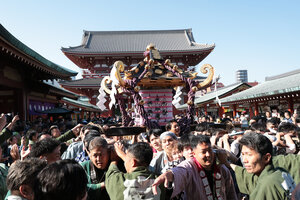
The three-day Tokyo early summer tradition, Asakusa Shrine, on its final day, the 17th, featured the carrying out of three main portable shrines from the shrine grounds in a ceremony called “Miyadashi.”
After a safety prayer festival, at around 7 a.m., a single clap signaled the start, and parishioners vigorously lifted the three portable shrines, from “Ichinomiya” to “Sannomiya.” Under clear skies, they paraded through the shrine grounds shouting “Oisa, Oisa,” then passed through the torii gate and headed into the town. Many spectators lined the streets.
A self-employed visitor, Hiroe Arai (58), said, “I was impressed by last year’s excitement, so I came looking forward to it again this year. I want to come again next year.” Kikujiro Sato (75), a company employee who used to participate as a carrier, nostalgically remarked, “I look forward to it every year, and seeing it reminds me of the urge to carry.” Tsutomu Nomita (70), a company executive from Sakai City, commented, “I came to enjoy the vitality. There are so many spectators, it’s incredibly lively.”
Asakusa Shrine
Asakusa Shrine is a Shinto shrine located in the Asakusa district of Tokyo, Japan, and is one of the city’s most famous religious sites. Originally built in 1649, it was established to honor the three men who founded the nearby Senso-ji temple, and it survived the bombings of World War II, making it a rare example of historic architecture in the area. The shrine is known for its vibrant festivals, particularly the Sanja Matsuri, which celebrates its founders and draws large crowds each year.
Ichinomiya
Ichinomiya refers to shrines that historically held the highest rank in each Japanese province, serving as the most important Shinto sites in their region. The term “Ichinomiya” literally means “first shrine,” and these locations often have deep roots in Japanese mythology and ancient governance, with many dating back over a thousand years. Today, they remain significant cultural and religious landmarks, attracting visitors interested in Japan’s spiritual heritage and history.
Sannomiya
Sannomiya is a bustling commercial and entertainment district in Kobe, Japan, named after the Sannomiya Shrine, which dates back to the 9th century. Historically, it served as a key port area during Kobe’s development in the Meiji era and became a central hub for shopping, dining, and business. Today, it is famous for its vibrant atmosphere, with landmarks like the Sannomiya Shrine and the nearby Motomachi shopping street.
torii gate
A torii gate is a traditional Japanese gate most commonly found at the entrance of Shinto shrines, symbolically marking the transition from the mundane to the sacred. Its origins are ancient, with the earliest records dating back to the 10th century, though the structures likely existed much earlier, possibly inspired by similar gates in other Asian cultures. The iconic vermilion-colored torii, such as the famous floating gate at Itsukushima Shrine, has become a globally recognized symbol of Japan and its spiritual heritage.
Asakusa Shrine
Asakusa Shrine, located in Tokyo, Japan, is a historic Shinto shrine built in 1649 by order of Tokugawa Iemitsu. It honors the three men who founded the nearby Senso-ji Temple after discovering a statue of Kannon in the Sumida River. Unlike many Tokyo sites, the shrine survived World War II bombings and remains a key cultural landmark, especially during its annual Sanja Matsuri festival.
Ichinomiya
Ichinomiya, meaning “first shrine,” refers to the highest-ranking Shinto shrine in a given province in Japan. Historically, each province designated a specific shrine as its ichinomiya, where local lords and samurai would pray for protection and prosperity. Today, these shrines, such as Owari Ichinomiya in Aichi Prefecture, remain important cultural and religious sites, attracting visitors for their historical significance and spiritual atmosphere.
Sannomiya
Sannomiya is the bustling central district of Kobe, Japan, known for its vibrant shopping, dining, and entertainment scene. Historically, it developed after the opening of Kobe Port in the late 19th century, growing into a major commercial hub. The area is also famous for Sannomiya Shrine, which dates back to the 9th century and gives the district its name.
torii gate
A torii gate is a traditional Japanese gate most commonly found at the entrance of Shinto shrines, symbolically marking the transition from the mundane to the sacred. Its origins are ancient, possibly dating back to the 6th century, and the simple two-post design is believed to have been influenced by Asian ceremonial arches. Typically painted vermilion and black, the torii gate represents a boundary where kami (spirits) are welcomed, and it has become an iconic symbol of Japanese culture worldwide.