A retro candy shop in Osaka displays toys and memorabilia from the Showa to Reiwa eras.
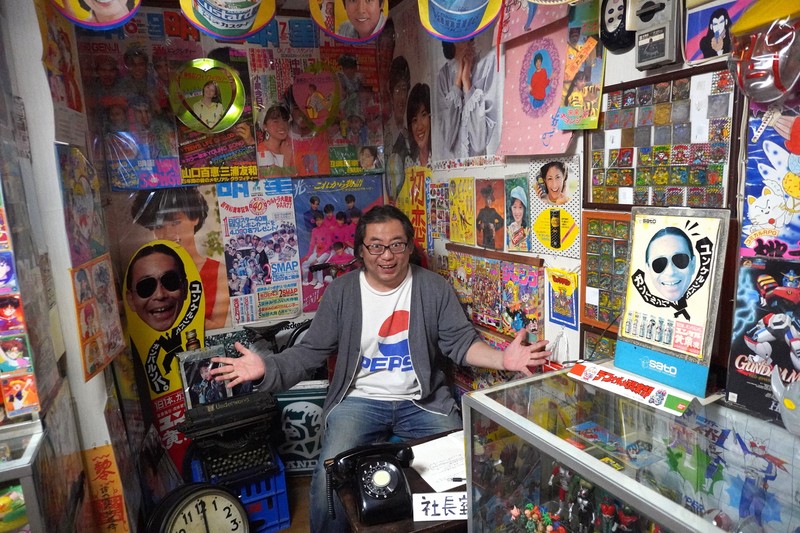
The manager shows off his collection in the “President’s Office” on the second floor of the candy shop in Osaka’s Nishinari Ward on March 31, 2026.
OSAKA — Around 5,000 items including toys and magazines from the Showa, Heisei and Reiwa eras are exhibited on the second floor of a traditional “dagashiya” candy shop in this western Japan city’s Nishinari Ward.
Some people even travel long distances to visit the shop amid the boom of “Showa retro” and “Heisei retro” aesthetics, based on elements of the Showa era (1926-1989) and the Heisei era (1989-2019). The candy shop manager, 44, said, “I hope people from each generation can look at the displays and relive those memorable days from their past.”
Everyday items featuring popular characters are on display in the “President’s Office” on the second floor of the candy shop in Osaka’s Nishinari Ward on March 31, 2026.
Along from the rows of assorted confectionary, up a steep staircase, and through a door marked “President’s Office,” visitors are greeted by nostalgic posters of idols, anime character merchandise and toys. The sight of the tightly packed “treasures” from many different genres filling the roughly 14 to 15 tatami sized room is impressive.
The collection was built over many years by the manager himself. The defining feature, he says, is that it is “broad and shallow.” It includes not only products that were sold commercially, but also promotional signs and flyers. Posters even cover the ceiling, and visitors are free to read the magazines on display.
The manager, who was born and raised in the area, opened the candy shop on May 24, 2014, using what had once been a meat processing facility, aiming to “create a fun shop for children.” The store sells not only sweets, but also items such as Osaka Prefecture’s “takosen” street food snack made with sauce from a local manufacturer and thin “katanuki” candies used in a traditional Japanese festival game where participants carve pre-molded shapes using a toothpick or needle — all popular with kids.
Posters cover the ceiling inside the “President’s Office” on the second floor of the candy shop in Osaka’s Nishinari Ward on March 31, 2026.
Memories passed through items across generations
For many years, the second floor of the shop had been used as a storage space where the manager kept his collection. Wishing for “as many people as possible to see it,” he spent several years preparing the exhibit before opening it on last year’s Showa Day on April 29, which also marked the 100th year of the Showa era. He chose the name “President’s Office” because he wanted it to feel “like visiting a friend’s collection room.”
Among the exhibits are pamphlets from the 1970 Osaka World Exposition and even cigarettes that were sold at the time. The shop is also calling for donations of nostalgic items that people no longer need at home.
Bonus stickers from “Bikkuriman Choco” are on display in the “President’s Office” on the second floor of the candy shop in Osaka’s Nishinari Ward on March 31, 2026.
At first, the exhibit was only open on weekends and holidays, but visitors began coming from places such as Tokyo, so it is now open whenever the shop itself is open. The manager, who continues to run the shop while also working a company job, laughed as he said, “I plan to clean up a little more and expand the display space even further. There’s no finish line.”
He added, “I want people of every generation, from children to the elderly, to be able to enjoy it.”
Admission is 500 yen (around $3) for adults and 300 yen (approx. $2) for children. A special exhibition with the title roughly translating to “The shop’s 12-year history” is being held through May 24. The shop is open from 2 p.m. to 6 p.m. on weekdays and holidays, and from 1 p.m. to 6 p.m. on weekends.
Nishinari
President’s Office
The President’s Office, often located in a nation’s capital, serves as the official workplace and administrative hub for the head of state. Historically, such offices have evolved from simple meeting rooms into complex institutions that symbolize executive power and national governance, with notable examples like the Oval Office in the United States or the Rashtrapati Bhavan in India. These sites frequently hold significant cultural and political importance, hosting diplomatic meetings and key decisions that shape a country’s history.
Showa era
The Showa era refers to the period of Japanese history corresponding to the reign of Emperor Hirohito, from 1926 to 1989. This era witnessed Japan’s militarization and involvement in World War II, followed by its post-war reconstruction and rapid economic growth, transforming the nation into a global industrial power. Culturally, the Showa era is remembered for its blend of traditional values and modernization, from wartime austerity to the vibrant pop culture of the 1960s–80s.
Heisei era
The Heisei era (1989–2019) in Japan began with Emperor Akihito’s ascension following the death of Emperor Hirohito, marking a period of significant economic stagnation known as the “Lost Decade” after the asset bubble burst. It was also a time of natural disasters, including the 1995 Kobe earthquake and the 2011 Tōhoku earthquake and tsunami, which led to the Fukushima nuclear disaster. The era concluded with Emperor Akihito’s abdication, the first in over two centuries, symbolizing a transition toward modernity and reflection on Japan’s post-war identity.
Reiwa era
The Reiwa era is the current imperial era in Japan, which began on May 1, 2019, following the abdication of Emperor Akihito and the ascension of Emperor Naruhito. Its name, meaning “beautiful harmony,” was derived from the Manyoshu, an ancient Japanese poetry anthology, marking the first time an era name was taken from a Japanese classic rather than Chinese sources. The era has been defined by modern challenges and changes, including the COVID-19 pandemic, technological advancements, and a focus on cultural continuity and international cooperation.
Osaka Prefecture
Osaka Prefecture, located in the Kansai region of Japan, is a historic and economic hub that served as a vital center of trade and culture during the Edo period. Its capital, Osaka City, was once known as the “nation’s kitchen” for its role in rice distribution, and it later became a key industrial and commercial powerhouse. Today, the prefecture blends its rich heritage—seen in landmarks like Osaka Castle—with modern innovation and vibrant urban life.
1970 Osaka World Exposition
The 1970 Osaka World Exposition, officially known as Expo ’70, was a major international exhibition held in Suita, Osaka, Japan, from March to September 1970. It was the first world’s fair ever held in Japan and symbolized the country’s post-war economic miracle and technological advancement, attracting over 64 million visitors. The Expo’s theme, “Progress and Harmony for Mankind,” featured iconic structures like the soaring Tower of the Sun by artist Taro Okamoto, and it left a lasting legacy by promoting global cultural exchange and inspiring future large-scale events in Japan.
Showa Day
Showa Day, celebrated on April 29th in Japan, is part of the Golden Week holiday period and honors the birthday of Emperor Hirohito (posthumously known as Emperor Showa), who reigned from 1926 to 1989. Established after his death, the day was originally his birthday and was renamed in 2007 to reflect on the tumultuous Showa era, which included Japan’s militarization, World War II, and subsequent post-war reconstruction. It serves as a time for public reflection on the nation’s history and the importance of peace.
Nishinari Ward
Nishinari Ward is a district in Osaka, Japan, historically known as a working-class area that grew rapidly during the industrialization of the late 19th and early 20th centuries. It is famous for the vibrant, slightly gritty neighborhood of Shinsekai, home to the iconic Tsutenkaku Tower, and for its deep association with kamagasaki, one of Japan’s largest day-laborer communities. Despite challenges such as poverty and aging infrastructure, the ward retains a unique cultural identity, with lively markets, traditional entertainment, and a resilient local spirit.