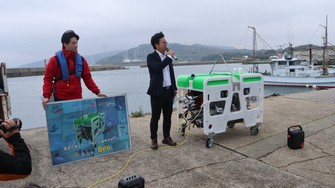
Underwater robot controllable by radio waves developed by Kyushu Institute of Technology.
The new Mega Bee submersible robot is explained before its launch ceremony, at Waita fishing port in the Anya area of Wakamatsu Ward, Kitakyushu, Fukuoka Prefecture, April 10, 2026.
KITAKYUSHU — The Kyushu Institute of Technology here has announced it has developed a new submersible robot that can transmit live video and be remotely operated via radio waves, a breakthrough that could enable inspections of offshore wind power facilities and, in the future, undersea rare earth mining.
The robot was jointly developed by the university’s Center for Social Implementation of Future Robots and its Research Center for Network and Smart Systems. Equipped with a communication device specialized for undersea radio transmission, the robot operates wirelessly yet enables higher-speed, larger-volume data transmission than conventional acoustic communication. This allows operators on land to control it while viewing live video. According to the university, no other underwater robot in the world can be remotely operated through radio communication.
The new Kyushu Institute of Technology Center for Social Implementation of Future Robots’ Mega Bee submersible robot is lowered into the sea, at Waita fishing port in the Anya area of Wakamatsu Ward, Kitakyushu, Fukuoka Prefecture, April 10, 2026.
At a launch ceremony on April 10 at Waita fishing port in the Anya area of Kitakyushu’s Wakamatsu Ward, researchers unveiled the new “Mega Bee” robot, which measures 75 centimeters wide, 88 centimeters high, 130 centimeters long and weighs 300 kilograms, and is equipped with six high-resolution underwater cameras. Although a wired system was used for the demonstration, in a test where wire-shaped antennas were laid across a 25-by-12.5-meter area on the seabed about 10 meters deep, communication and control were confirmed up to 4 meters above the seabed.
Because radio waves attenuate significantly in salt water, the research team achieved high-speed communication by increasing transmission paths for low-frequency radio waves, applying the latest technologies, and designing the robot to avoid generating radio noise.
Yuya Nishida of the Graduate School of Life Science and Systems Engineering, who heads the future robot center, said, “By installing antennas in advance on structures such as offshore wind power facilities, regular inspections can be carried out. We aim for practical application in about five years,” adding, “We hope to promote underwater technology from Kyushu Tech to the world.”
Kyushu Institute of Technology
The Kyushu Institute of Technology (Kyutech) is a prestigious national university in Japan, founded in 1909 as the Meiji College of Technology. Located in Kitakyushu, Fukuoka Prefecture, it was established to support Japan’s rapid industrialization and has since evolved into a leading institution for engineering and technology research. Today, Kyutech is known for its strong focus on innovation, robotics, and international collaboration, particularly in engineering fields.
Waita fishing port
Waita Fishing Port is a historic fishing hub located on the coast of Iwate Prefecture, Japan. It has long been central to the local fishing industry, particularly known for its catch of saury and squid. The port was heavily damaged by the 2011 Tōhoku earthquake and tsunami, but has since been rebuilt and continues to play a vital role in the region’s economy and cultural heritage.
Anya area
The Anya area, located in what is now the Russian Far East, is a historically significant region tied to the indigenous peoples of Siberia, particularly the Evenki and other Tungusic groups. Its history is marked by traditional reindeer herding and hunting, as well as later influences from Russian exploration and settlement during the 17th to 19th centuries. Today, the area is recognized for its cultural heritage and pristine natural landscapes.
Wakamatsu Ward
Wakamatsu Ward is a historic district in Kitakyushu, Japan, known for its role in the Meiji-era industrialization as a key coal shipping port. The area features the iconic Wakamatsu Castle, originally built in the 17th century, and the nearby Mojiko Retro District, which preserves Western-style buildings from the early 1900s. Today, it blends cultural heritage with scenic views of the Kanmon Straits.
Kitakyushu
Kitakyushu is a major industrial city in Fukuoka Prefecture, Japan, formed in 1963 through the merger of five cities. It played a key role in Japan’s modernization as a center of steel production and heavy industry, particularly through the state-run Yawata Steel Works established in 1901. Today, Kitakyushu is known for its successful environmental recovery, including the revitalization of Dokai Bay, and features cultural attractions like Kokura Castle and the historic Mojiko port district.
Fukuoka Prefecture
Fukuoka Prefecture, located on Kyushu Island, is historically significant as the site of Dazaifu, an ancient administrative capital, and as a gateway for cultural exchange with Korea and China. It was a key location during the Mongol invasions of Japan in the 13th century, defended by the famous Kamakura shogunate. Today, it is a vibrant region known for its modern city Fukuoka, traditional festivals like Hakata Gion Yamakasa, and renowned cuisine such as tonkotsu ramen.