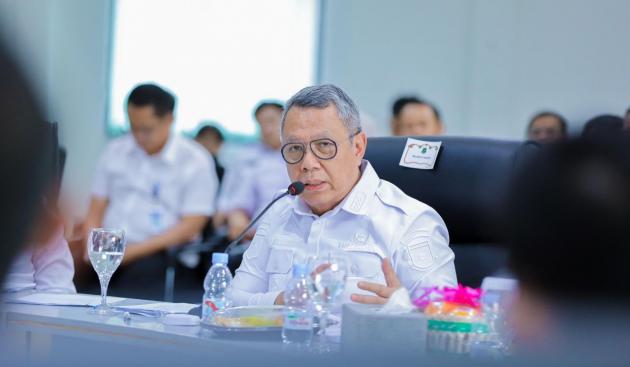
South Tangerang Mayor Benyamin Davnie at a Coordination Meeting for Waste-to-Energy Management (PSEL) in North Serpong.
The South Tangerang City Government (Tangsel) has increased the volume of logistical aid for residents living in the area directly impacted by the Cipeucang Final Disposal Site (TPA).
This decision was made in response to the basic needs of 50 Households (KK) in the region.
Information indicates a significant increase in the distribution of mineral water. Previously, residents received only two gallons per week. Starting this week, the amount has been raised to four gallons per household each week for the next month.
In addition to clean water, food aid in the form of 5 kilograms of rice per household is also being distributed regularly through a synergy between the Tangsel City Government and the National Zakat Agency (Baznas).
South Tangerang Mayor Benyamin Davnie stated that this step is a follow-up to aspirations conveyed directly by the residents.
Via a video call connection, Benyamin instructed the relevant department officials to ensure the distribution of aid is not hindered.
“We have heard the residents’ aspirations. This humanitarian aid is officially extended to ensure basic needs continue to be met,” said Benyamin during a dialogue with residents.
Mobile Health Services
In addition to logistical aid, monitoring the physical condition of residents is also a priority. The Indonesian Red Cross (PMI) of Tangsel City has been deployed to conduct direct mobile health check-ups.
This preventive measure is taken to anticipate the risk of health issues that may arise due to environmental exposure around the TPA area.
The Head of the Tangsel Communication and Information Office (Diskominfo), present directly at the location, emphasized the importance of precise field execution.
“Coordination between institutions is necessary so that technical assistance reaches the hands of those who truly need it,” he said.
The Head of Neighborhood RT 03/04 in Serpong Village confirmed that the additional aid is highly anticipated by her residents.
According to her, the availability of clean water and food is an urgent need for families directly impacted by the waste disposal operations.
“We are grateful the request for additional clean water and rice has been granted. The presence of officers in the field also provides certainty for our residents,” she concluded.
Cipeucang Final Disposal Site
The Cipeucang Final Disposal Site is a large sanitary landfill located in Tangerang, Indonesia, serving as a primary waste management facility for the Jakarta metropolitan area. It was developed to address the region’s critical waste disposal needs, replacing older, less environmentally controlled dumping grounds. The site represents a modern, engineered approach to waste handling in a densely populated region with significant urban waste challenges.
South Tangerang City Government
The South Tangerang City Government is the administrative authority for South Tangerang, a city in Indonesia’s Banten province. It was established following the city’s official formation in 2008, when it was separated and granted autonomy from the larger Tangerang Regency. The government manages the rapid urban development and services for this major residential and economic hub near Jakarta.
National Zakat Agency
The National Zakat Agency is a government body in Indonesia (known as Badan Amil Zakat Nasional or BAZNAS) established in 2001 to manage the collection and distribution of zakat, the obligatory alms-giving in Islam. Its creation formalized and centralized zakat management, aiming to increase transparency, efficiency, and the social impact of zakat funds for poverty alleviation and community welfare programs across the country.
Indonesian Red Cross
The Indonesian Red Cross, known as Palang Merah Indonesia (PMI), was founded on September 17, 1945, shortly after Indonesia’s declaration of independence, to address the humanitarian crises of the revolutionary period. It is the country’s sole national humanitarian organization, operating under the principles of the International Red Cross and Red Crescent Movement to provide disaster response, blood transfusion services, and community health programs.
Tangsel Communication and Information Office
The Tangsel Communication and Information Office (Diskominfo Tangsel) is the official government agency responsible for managing public communication, information technology, and media relations for the city of South Tangerang (Tangerang Selatan) in Indonesia. It was established as part of the city’s administrative infrastructure following South Tangerang’s formation as an independent city separate from Tangerang Regency in 2008. Its primary role is to facilitate transparent information flow between the local government and the public, while also overseeing the city’s digital services and IT development.
Serpong Village
Serpong Village is a modern residential and commercial development located in South Tangerang, Indonesia, part of the Greater Jakarta area. Historically, the area was known for its rural landscapes, but it transformed rapidly in the late 20th and early 21st centuries into a major planned township featuring housing estates, shopping malls, and educational institutions. Today, it is a prominent suburban hub known for its planned communities and green spaces within the metropolitan region.
North Serpong
North Serpong is a district within South Tangerang, Indonesia, primarily known as a modern residential and commercial development area. While the district itself lacks a single prominent historical site, its history is tied to the broader transformation of the Tangerang region from agricultural land into a major suburban hub for Jakarta, a process that accelerated significantly in the late 20th and early 21st centuries.
South Tangerang
South Tangerang is a city within the Greater Jakarta metropolitan area in Indonesia, officially established in 2008 after being separated from the larger Tangerang Regency. Its history is tied to the rapid urban development of Jakarta’s satellite cities, transforming from a region of villages and farmland into a major residential and commercial hub.