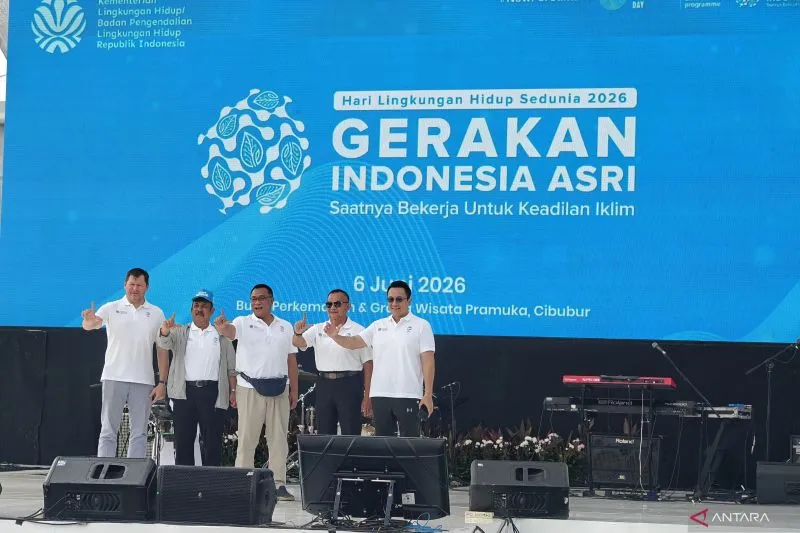
The Ministry of Environment/Environmental Control Agency (BPLH) has officially orchestrated the Gerakan Indonesia Asri movement as a national strategic instrument to mitigate the triple planetary crisis while realizing the principle of climate justice. The Minister of Environment/Head of BPLH, Jumhur Hidayat, emphasized that the draft of this mass movement is a real manifestation of President Prabowo Subianto’s directive to boost collective public involvement from the smallest social units. Speaking at the peak agenda of World Environment Day, titled “Gerakan Indonesia Asri: Time to Work for Climate Justice” at the Cibubur Campground, Jakarta, authorities called for the urgency of ecological repentance not just as discourse, but as a real call to change the pattern of human interaction with nature to reduce the rate of hydrometeorological disasters and meet global targets in the Paris Agreement.
As the largest archipelagic country in the world, Indonesia has very high ecological vulnerability, where more than 90 percent of domestic disasters are hydrometeorological, such as floods, landslides, and droughts. Additionally, more than 60 percent of the national population living in coastal areas is now shadowed by the real risk of sea level rise, extreme weather, and threats to food security. To keep the global temperature rise as close as possible to the 1.5 degrees Celsius limit according to the Paris Agreement, the Indonesian Government has reaffirmed its commitment through the draft Second NDC 2030, targeting emission reductions of 31.89 percent through independent domestic capacity, and 43.2 percent through international support.
In addition to strengthening carbon governance, the Gerakan Indonesia Asri movement focuses on reducing methane gas emissions originating from the national annual waste pile of 51 million tons, where currently 74 percent of it is not yet optimally managed and still accumulates in landfills using the open dumping method. To that end, the ministry has enacted a draft new culture requiring the sorting of organic and inorganic waste directly at the household level, considering that the damaging power of methane gas is 30 times more dangerous than carbon dioxide (CO2) for environmental sustainability and public health. As a law enforcement step in this climate governance, the government is also finalizing a draft Climate Justice Law to guarantee protection rights for customary law communities and local residents so they can absorb the greatest economic benefits from the domestic carbon trading market.
The Chairperson of the Gerakan Indonesia Asri Organizing Committee, Rasio Ridho Sani, reported that this green commitment was rolled out simultaneously both offline and online, involving 10,141 environmental warriors, including Dasawisma cadres, regional cleaning officers from Greater Jakarta, waste picker communities, and the Saka Kalpataru Scouts. The field action in Cibubur was also accompanied by a number of state officials such as the Coordinating Minister for Food Zulkifli Hasan, Minister of National Development Planning/Head of Bappenas Rahmat Pambudy, Deputy Coordinating Minister for Political and Security Affairs Retired Lieutenant General Lodewijk F. Paulus, Deputy Minister of Environment Diaz Hendropriyono, Deputy Minister of Cooperatives Farida Farichah, and the Slovak Ambassador to Indonesia Thomas Ferko. This cross-sector synergy was strengthened by commitments to expand green areas from regional heads, such as the Mayor of Tangerang H. Sahrudin, Acting Mayor of Bekasi Abdul Haris Bobihoe, Deputy Mayor of Bogor Zaenal Muttaqin, and the Mayors of North Jakarta and South Jakarta.
To ensure the program draft permeates down to the grassroots level, the Minister of Environment along with cabinet members held a virtual communication (teleconference) with six governors and the Head of the Nusantara Capital City Authority, followed by the distribution of waste sorting facilities and symbolic tree planting to pursue the national target of two billion trees. This series of environmental restoration orchestration will later be strengthened through the holding of the International Environment Technology and Innovation Expo and Conference on June 11-13, 2026 at the Jakarta International Convention Center. This international agenda is projected to become a platform for the best green technology transfer as well as a stimulus instrument to accelerate the achievement of emission reduction targets towards the grand vision of Golden Indonesia 2045.