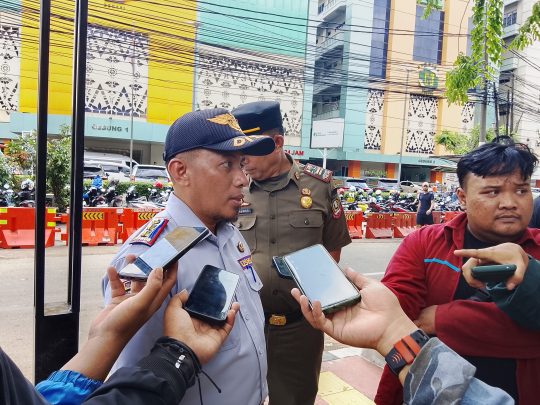
BEKASI CITY – The Bekasi City Transportation Agency has begun cracking down on illegal parking along Kemakmuran Street, with a primary focus on the area in front of Hermina Hospital. This action was taken following numerous public complaints regarding traffic congestion caused by vehicles parked haphazardly in the area.
According to authorities, this crackdown is not only targeting the area in front of Hermina Hospital but also the entire stretch of Kemakmuran Street, which is lined with businesses that have limited parking capacity. Socialization efforts with business operators were conducted the day before, and officers are currently sweeping the area up to the end of the street.
“The main focus is indeed in front of Hermina because it is a priority for leadership. But after this, we will continue to other streets like Rawat Embaga,” stated the Head of the Public Street Lighting Division.
However, limited personnel from the Civil Service Police Unit mean the crackdown is being carried out in stages. Kemakmuran Street is the initial priority, followed by other areas such as Rawat Embaga, the station area, the public hospital, the town square, and Rahmatan Baga.
Regarding the reasons people choose to park on the street, authorities stated that the Hermina Hospital parking lot is actually quite adequate. However, many residents choose to park outside for practical reasons.
“It’s similar to street vendors at Pasar Baru, who prefer to sell in front rather than inside,” they explained.
In terms of fees, official parking inside the Hermina Hospital area costs Rp3,000 for the first hour, with a maximum of Rp5,000. Furthermore, parking inside is considered safer and more comfortable due to the presence of security officers and adequate facilities.
To address the ongoing issue of illegal parking, the government will conduct intensive patrols and monitoring for the next week. “Initially, we will take a persuasive approach. But if they remain defiant, actions such as deflating tires or towing vehicles could be taken,” they emphasized.
The crackdown will also target station areas that remain crowded with illegal parking despite having official management. In this case, the awareness of the management is still considered lacking. The government has conducted socialization efforts to ensure parking managers do not interfere with public facilities.
Kemakmuran Street
Kemakmuran Street is a common name for commercial thoroughfares in many Indonesian cities, often translating to “Prosperity Street.” Historically, these streets were typically established as central market areas during colonial or early post-independence periods, designed to foster local trade and economic activity. Today, they remain vibrant hubs of small businesses, shops, and street vendors, reflecting the enduring entrepreneurial spirit of their communities.
Hermina Hospital
Hermina Hospital is a private hospital network in Indonesia, founded in 1972 by Dr. Satrio Herminanto. It has grown from a single clinic into a nationwide chain, focusing on providing maternal and child health services. Today, it is known as a major healthcare provider with numerous branches across the country, emphasizing modern facilities and family-friendly care.
Rawat Embaga
I am unable to find any verifiable historical or cultural information about a place or site named “Rawat Embaga.” It is possible the name is misspelled, refers to a very localized or lesser-known location, or uses a different common name. To provide an accurate summary, could you please double-check the spelling or provide any additional context, such as the country or region?
the station area
“The station area” typically refers to the district surrounding a major railway station, which historically developed as a commercial and transport hub. For example, areas like Tokyo Station or Grand Central Terminal in New York grew around early 20th-century rail infrastructure, driving urbanization and becoming iconic city centers. Today, such zones often blend historic architecture with modern business, retail, and transit functions.
the public hospital
The public hospital, as a concept, emerged in the Western world during the Enlightenment, with institutions like London’s Royal Hospital of St. Bartholomew (founded 1123) and Paris’s Hôtel-Dieu (founded c. 651) evolving from religious charitable care into secular, state-funded institutions by the 18th and 19th centuries. Its primary purpose shifted from isolating the sick and poor to providing scientific medical treatment accessible to all citizens, regardless of wealth. Today, it remains a cornerstone of public health systems, offering essential and emergency care funded by taxation or social insurance.
the town square
A town square is a central public space found in many communities, historically serving as the commercial, social, and political heart of a town. Traditionally the site of markets, town halls, and public gatherings, its design and functions have evolved, but it remains a key venue for community events and civic life.
Rahmatan Baga
I’m unable to find any verifiable historical or cultural information about a place or site specifically named “Rahmatan Baga.” It’s possible the name may be misspelled, refer to a very localized site, or be part of a longer or different proper name. To provide an accurate summary, could you please double-check the spelling or provide any additional context about its location?
Pasar Baru
Pasar Baru is a historic market district located in Central Jakarta, Indonesia, established by the Dutch colonial government in 1820. Originally designed as a European-style shopping area, it evolved into a vibrant hub known for its textile and garment shops, attracting a diverse mix of communities. Today, it remains a bustling commercial center reflecting Jakarta’s multicultural heritage, particularly through its Chinese, Indian, and Arab merchant influences.