—
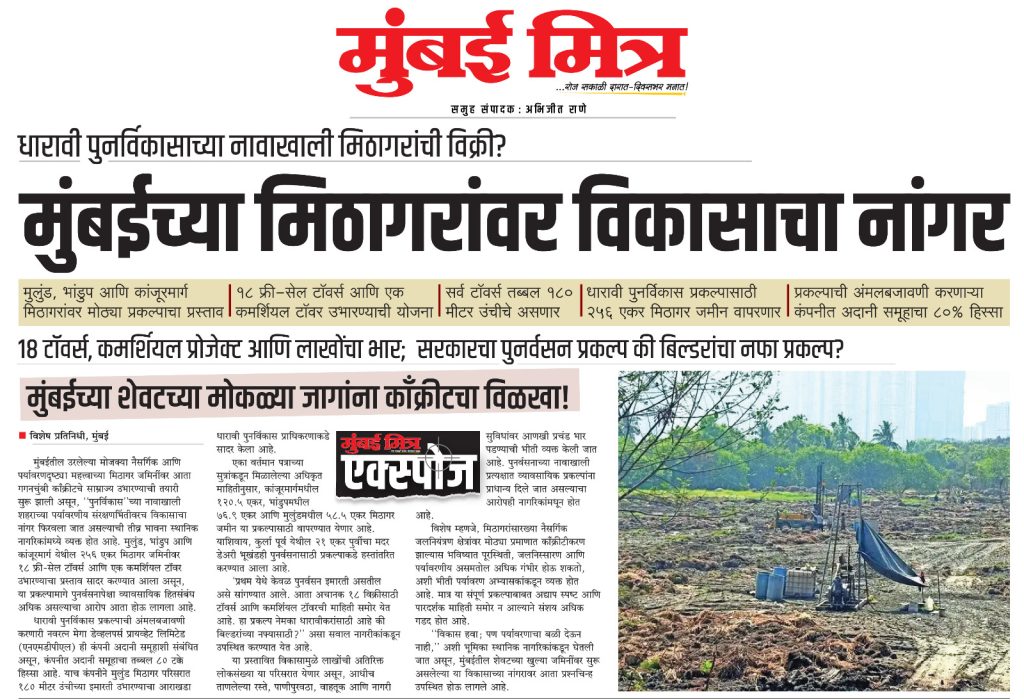
◆ Sale of salt pan lands under the guise of Dharavi redevelopment?
◆ *Development plows through Mumbai’s salt pan lands*
◆ 18 towers, a commercial project, and a burden on millions; a government rehabilitation project or a builder’s profit venture?
◆ Concrete grip tightens on Mumbai’s last open spaces!
====
◆ Proposal for a large project on salt pan lands in Mulund, Bhandup, and Kanjurmarg
◆ Plan to erect 18 free-sale towers and one commercial tower
◆ All towers to be a staggering 180 meters tall
◆ 256 acres of salt pan land to be used for the Dharavi redevelopment project
◆ The Adani Group holds an 80% stake in the company implementing the project
—
Preparations are underway to build a towering concrete empire on the few remaining natural and environmentally significant salt pan lands in Mumbai. Local residents are expressing strong feelings that under the name of “redevelopment,” the plow of development is being driven through the city’s environmental defenses. A proposal has been submitted to build 18 free-sale towers and one commercial tower on 256 acres of salt pan land in Mulund, Bhandup, and Kanjurmarg. Allegations are now emerging that the project is driven more by commercial interests than by rehabilitation.
Navratna Mega Developers Private Limited (NMDPL), the company implementing the Dharavi redevelopment project, is linked to the Adani Group, which holds a massive 80% stake in the company. This same company has submitted a plan to the Dharavi Redevelopment Authority to build structures 180 meters high in the Mulund salt pan area.
According to official information obtained from a source, 120.5 acres in Kanjurmarg, 76.9 acres in Bhandup, and 58.5 acres in Mulund will be used for this project. Additionally, a 21-acre former Mother Dairy plot in Kurla East has also been transferred to the project for rehabilitation.
“Initially, we were told there would only be rehabilitation buildings here. Now, information about 18 towers for sale and a commercial tower suddenly emerges. Is this project really for the people of Dharavi or for builders’ profits?” citizens are questioning.
This proposed development is expected to bring an additional population of millions into the area, raising fears of immense strain on already stressed roads, water supply, transportation, and civic amenities. Citizens are also alleging that commercial projects are being prioritized under the guise of rehabilitation.
Significantly, environmental experts fear that large-scale concretization of natural water regulation areas like salt pans could worsen future flood situations, drainage issues, and environmental imbalance. However, the lack of clear and transparent information about the entire project is deepening the suspicion.
“We want development, but not at the cost of the environment,” is the stance taken by local residents, and question marks are now being raised over this development plowing through Mumbai’s last open lands.