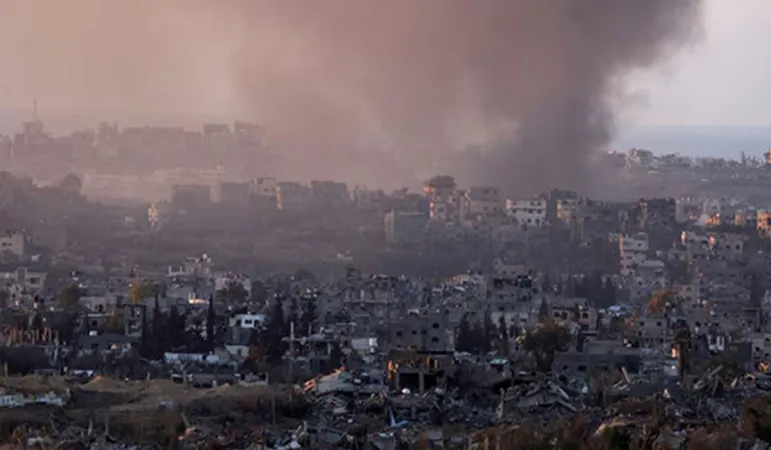
The Israeli military has launched an attack. The air force bombed Hamas weapons depots in the Gaza Strip, causing significant damage.
Israeli military attacked, Hamas positions in Gaza destroyed
The Israeli military launched an attack because a major threat was looming over its soldiers in the border area. According to reports from Tel Aviv, the military has intensified its operations in the Gaza Strip. The Israeli Air Force targeted and completely destroyed three major Hamas weapons storage centers last week. Lethal weapons were hidden in these warehouses to attack the military. Military officials have successfully completed this operation.
After this military operation, tensions have once again escalated across the Middle East.
Hamas weapons depots
According to sources, the Israeli Air Force bombed various areas of the Gaza Strip. Before the Israeli military launched the attack, explosives, rifles, and sniper rifles were stored in these warehouses. Additionally, the military destroyed 10 pickup trucks used for terrorist activities. Military forces conducted precise airstrikes on these centers.
According to reports, a series of explosions occurred at the Hamas weapons depots after the attack. These secondary explosions indicate that a large amount of explosive material was stored there.
These weapons were intended to harm Israeli civilians.
Yellow Line border
This incident comes at a time when there was a tense calm between the two sides at the border. Israeli soldiers are currently serving in an area known as the Yellow Line border. The military made this major decision to remove the threat to its soldiers. With the destruction of the Hamas weapons depots, the terrorists have failed to carry out a major attack.
Specifically, this operation has made the soldiers stationed at the border safer.
When the Israeli military launched the attack, clouds of smoke were seen in the area.
Gaza ceasefire agreement
According to reports, despite the ceasefire in place in the area, terrorist activities continued. Under the terms set by the Gaza ceasefire agreement, Israeli soldiers are only operating within specific designated borders. Israel maintains full military control over the eastern, northern, and southern parts of this line.
Furthermore, under this agreement, Hamas terrorists are strictly forbidden from crossing this security line.
Yet, Hamas fighters were secretly gathering weapons and plotting an attack.
West Asia politics
In the coming times, diplomatic activity may increase internationally following this attack. According to experts monitoring West Asia politics, Israel will further strengthen its security system. The military is adopting a tough stance to enforce the Gaza ceasefire agreement.
Moreover, after the Israeli military launched the attack, military patrolling at the Gaza border has been doubled.
It remains to be seen what stance the UN Peace Committee will adopt on the entire situation going forward.
Although the Israeli military has launched an attack, establishing long-term peace at the Gaza border remains a major challenge. Will there be a new retaliatory strike from Hamas after this military operation? Will the international community find a new mediating path to establish lasting peace in the region?
Gaza Strip
The Gaza Strip is a narrow Palestinian territory along the Mediterranean Sea, bordered by Israel and Egypt. Historically part of the region of Canaan and later controlled by various empires, it came under Ottoman rule before being administered by Britain after World War I. Since the mid-20th century, it has been a focal point of the Israeli-Palestinian conflict, with Hamas taking control in 2007, leading to ongoing blockades and periods of violence.
Tel Aviv
Tel Aviv, founded in 1909 as a Jewish suburb of Jaffa, grew rapidly into a modern city and became the commercial and cultural heart of Israel. It served as the country’s temporary capital from 1948 until 1950, when Jerusalem was officially declared the capital. Today, Tel Aviv is known for its vibrant nightlife, Bauhaus architecture—a UNESCO World Heritage site—and its dynamic startup scene.
Yellow Line border
The “Yellow Line” refers to the demarcation line established in 1975 during the Lebanese Civil War, which separated predominantly Muslim West Beirut from Christian East Beirut. Named for the yellow ochre paint used to mark buildings along the divide, it became a heavily fortified and dangerous checkpoint zone. The line remained a symbol of sectarian division until the war ended in 1990, after which it gradually faded as the city was rebuilt and reunified.
Gaza ceasefire agreement
The “Gaza ceasefire agreement” refers to a temporary halt in hostilities between Israel and militant groups in Gaza, often brokered by international mediators like Egypt, Qatar, and the United Nations. Historically, such agreements have followed intense escalations of conflict, including major wars in 2008–2009, 2014, and 2021, aiming to de-escalate violence and allow for humanitarian aid delivery. These ceasefires are typically fragile, with recurring violations and cycles of violence rooted in the broader Israeli-Palestinian conflict.
West Asia
West Asia is a historically rich and culturally diverse region that served as the cradle of some of the world’s earliest civilizations, including Mesopotamia and the Persian Empire. It has been a crossroads for trade, religion, and conflict, with major contributions to human development such as writing, law, and monotheism. Today, the region encompasses countries like Iran, Iraq, Turkey, and Saudi Arabia, blending ancient heritage with modern significance.
Gaza border
The Gaza border refers to the heavily fortified boundary between the Gaza Strip and Israel, established after the 1948 Arab-Israeli war. Historically, it has been a site of intense conflict and blockade, with Israel controlling most access points since 2007 when Hamas took over Gaza. The area is marked by checkpoints, security barriers, and periodic protests, making it a focal point of the Israeli-Palestinian conflict.
UN Peace Committee
The UN Peace Committee, formally known as the United Nations Peacebuilding Commission, was established in 2005 to help countries transitioning from conflict to lasting peace. It works by bringing together international donors, governments, and UN agencies to coordinate reconstruction and prevent a relapse into violence. Unlike peacekeeping missions, the committee focuses on post-conflict recovery, such as rebuilding institutions and promoting economic stability.
Middle East
The Middle East is a historically and culturally significant region spanning parts of Asia and Africa, often considered the cradle of civilization due to the early development of agriculture, writing, and urban societies in Mesopotamia. It is the birthplace of three major world religions—Judaism, Christianity, and Islam—and has been a crossroads of trade, culture, and conflict for millennia, from the ancient empires of Persia and Rome to the modern nation-states shaped by colonialism and oil wealth. Today, the region remains a dynamic and complex area, known for its rich heritage, diverse populations, and ongoing geopolitical significance.