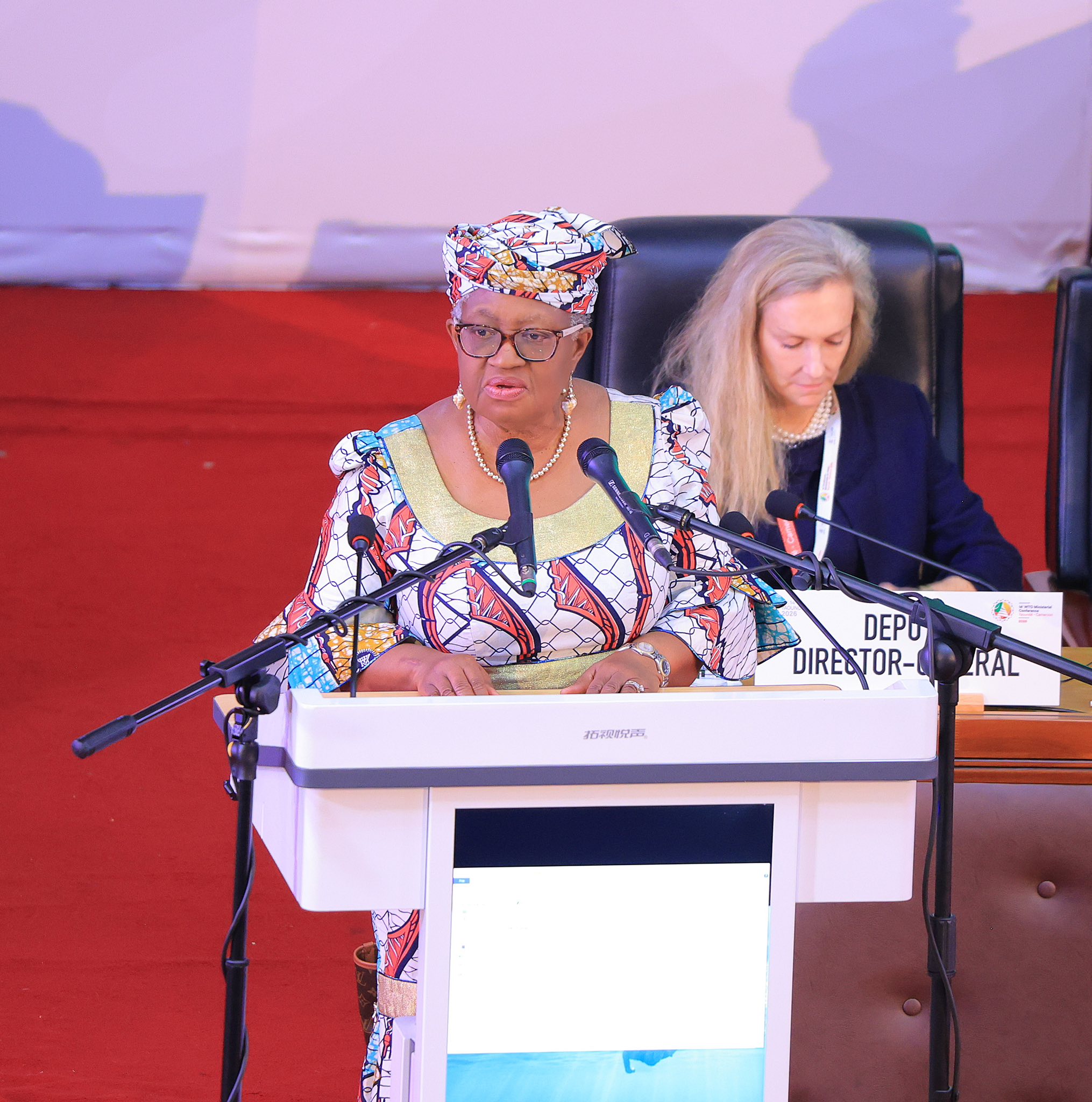
In her address during the recent 14th Ministerial Conference of the World Trade Organization held in Yaoundé, the determination of countries seeking accession despite current global challenges was highlighted.
It was stated: “The process of joining the World Trade Organization is arduous,” praising all advanced accession candidate countries for their demonstrated flexibility, patience, and diligent work.
Special commendation was given to Ethiopia and Uzbekistan, noting that both countries have intensified their efforts and are making notable progress towards joining the organization this year.
Gratitude was also expressed for the support provided by the chairs of the respective working parties on accession, including South Korea and the United Kingdom, for their dedication in guiding this process.
Ethiopia’s accession to the World Trade Organization is viewed as a fundamental step towards enhancing its integration into the global economy, which could contribute to improved trade opportunities, investment flows, and economic reform.
World Trade Organization
The World Trade Organization (WTO) is an international body established in 1995 to regulate and facilitate global trade, succeeding the post-World War II General Agreement on Tariffs and Trade (GATT). Headquartered in Geneva, Switzerland, its primary role is to provide a forum for negotiating trade agreements, settling disputes between member nations, and ensuring trade flows as smoothly and predictably as possible.
Yaoundé
Yaoundé is the capital city of Cameroon, founded in 1888 by German traders as a base for the ivory trade. It later became the administrative center under French colonial rule and has served as the nation’s political and cultural heart since Cameroon’s independence in 1960.
Ethiopia
Ethiopia is a historically rich nation in the Horn of Africa, widely considered one of the oldest sites of human existence and home to the ancient Aksumite Kingdom. It is unique as one of the few African countries to avoid long-term colonization, preserving its ancient Christian heritage and traditions, with landmarks like the rock-hewn churches of Lalibela. Its diverse culture is shaped by numerous ethnic groups, including the Amhara and Oromo, and a legacy of ancient empires.
Uzbekistan
Uzbekistan is a Central Asian country renowned for its pivotal role on the ancient Silk Road, dotted with historic cities like Samarkand, Bukhara, and Khiva. These cities feature stunning Islamic architecture, including turquoise-domed mosques and madrasahs, which flourished under powerful empires such as those of Timur and the Samanids. Today, these sites are UNESCO World Heritage landmarks, preserving the region’s rich history as a major center of trade, science, and culture.
South Korea
South Korea, officially the Republic of Korea, is a country in East Asia located on the southern half of the Korean Peninsula. Its history includes the ancient Three Kingdoms period, the unified Goryeo and Joseon dynasties, and its rapid modernization following the Korean War (1950-1953). Today, it is renowned globally for its dynamic pop culture (K-pop, K-dramas), technological innovation, and historic sites like Gyeongbokgung Palace and the Jongmyo Shrine.
United Kingdom
The United Kingdom is a sovereign nation comprising England, Scotland, Wales, and Northern Ireland, with a history shaped by Celtic, Roman, Anglo-Saxon, and Norman influences. It emerged as a major global power through the British Empire and was central to the Industrial Revolution, leaving a profound legacy in politics, science, and culture. Today, it is a constitutional monarchy and parliamentary democracy, renowned for historic landmarks, world-class museums, and a diverse cultural heritage.