Kenyan President William Ruto concluded a three-day official visit to Italy on Wednesday, during which he met with President Sergio Mattarella and Prime Minister Giorgia Meloni. The visit saw the adoption of a bilateral action plan for 2026-2029 and the signing of eight agreements in the fields of technical education, environment, defense, and scientific research, within the framework of the Italian “Mattei Initiative.”

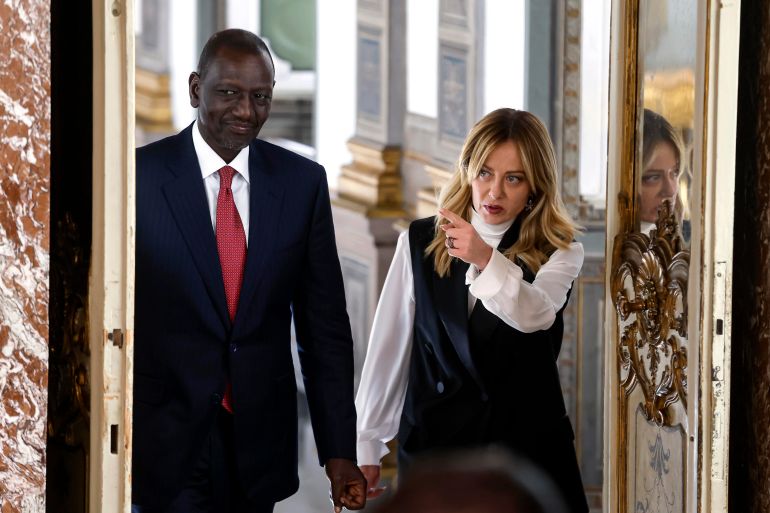
Ruto began his program on Monday by laying a wreath at the Tomb of the Unknown Soldier in Piazza Venezia, then moved to the Quirinal Palace where Mattarella received him for a lunch, before holding bilateral talks with Meloni at Palazzo Chigi.

Action Plan within the “Mattei Initiative”

The two leaders announced an action plan for 2026-2029, falling under the “Mattei Plan for Africa” launched by Meloni in January 2024, which she presents as a framework for partnerships with the African continent in areas of development, addressing migration, and energy security. According to a statement from the Italian Prime Minister’s office, the plan will include periodic consultations between the foreign ministries and regular review of implementation through bilateral mechanisms.

Meloni described Kenya as a “pivotal country” in the initiative and Italy’s “gateway” to East African economies, while Ruto affirmed that his country intends to engage in the digital economy, noting six decades of bilateral relations between the two countries.
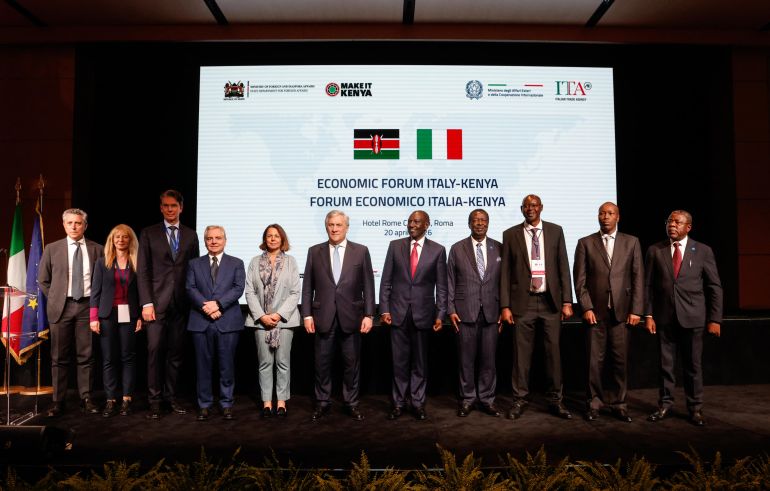
Italy's Minister for Foreign Affairs Antonio Tajani (C-L) and Kenyan President William Ruto (C-R) pose for a family photo with delegations during the Italy–Kenya Business Forum at Hotel Cavalieri Waldorf Astoria, in Rome, Italy, 20 April 2026.

Signed Agreements

The two countries signed eight agreements on the first day of the visit, most notably an agreement to modernize between 60 and 70 technical and vocational training institutions in Kenya, at a cost of approximately $62.7 million, including student and academic exchange programs.

The talks also covered the Arror, Kimwarer, and Itare dam projects in Kenya, which had been stalled due to legal and financial disputes with Italian contractors and were linked to corruption cases during the tenure of former President Uhuru Kenyatta. Ruto announced that the outstanding issues in the Itare dam project had been resolved after an agreement with the Italian company and the withdrawal of international arbitration cases, noting that these dams are part of a government plan to expand irrigated areas to 2.5 million acres within seven years.

The agreements also included a defense cooperation agreement, with the joint statement indicating it would guide training and capacity-building initiatives based on respect for legal frameworks, including maritime security and counter-terrorism.

On the technological front, Meloni announced new branches of the “Blue Raman” submarine fiber optic cable, which connects India to Europe via the Middle East and the Mediterranean, making Kenya one of its stations on the East African coast. She also announced the transformation of the “Luigi Broglio” space center in Malindi into a continental hub for training in space sciences and Earth observation.

The two countries also agreed to link cooperation with the African Continental Free Trade Area (AfCFTA) to support value chains and regional integration. A Kenyan-Italian business forum was held on the sidelines of the visit, focusing on investment in infrastructure, renewable energy, and agro-industries.

On the second day, Ruto met with the President of the Italian Chamber of Deputies, Lorenzo Fontana, and delivered a lecture at the “Luiss Guido Carli” University, pledging to transform Kenya into an advanced economy “within a generation,” before meeting with the Kenyan community living in Italy at events organized by the “Midor” Foundation.

Ruto’s visit to Rome, along with the

Tomb of the Unknown Soldier

The Tomb of the Unknown Soldier is a monument dedicated to unidentified soldiers who died in war, symbolizing national mourning and gratitude. Located in Arlington National Cemetery in the United States, it was established in 1921 after World War I, with an unidentified American soldier interred there. The site is guarded 24/7 by sentinels and serves as a solemn tribute to all unknown service members.

Piazza Venezia

Piazza Venezia is a central square in Rome, Italy, dominated by the monumental Altare della Patria (Altar of the Fatherland), which honors King Victor Emmanuel II. Historically, the square takes its name from the adjacent Palazzo Venezia, a Renaissance palace that served as the headquarters for Benito Mussolini during the Fascist regime. Today, it remains a major traffic hub and a symbol of Italy’s unification and complex 20th-century history.

Quirinal Palace

The Quirinal Palace is a historic building in Rome, Italy, currently serving as the official residence of the President of the Italian Republic. Originally built in the 16th century as a summer papal residence, it later became the home of the King of Italy after the unification of Italy in 1871. The palace is one of the largest in the world and has witnessed centuries of political and cultural history.

Palazzo Chigi

Palazzo Chigi is a historic palace in Rome, Italy, that has served as the official residence of the Prime Minister of Italy since 1961. Originally built in the 16th century for the Aldobrandini family, it was later acquired by the Chigi family in 1659 and underwent significant expansions and renovations. The palace is also notable for housing the famous “Sala del Consiglio” and for being the site where the 1947 Treaty of Paris was signed.

Hotel Cavalieri Waldorf Astoria

The Hotel Cavalieri Waldorf Astoria is a luxury hotel located in Rome, Italy, known for its stunning views of the Vatican and the city. Originally opened in 1963 as the Rome Cavalieri, it was later rebranded as part of the prestigious Waldorf Astoria collection, blending modern elegance with classic Italian hospitality. The hotel features a world-class art collection, a renowned spa, and is situated near the historic Villa Borghese gardens, offering guests a refined retreat in the heart of Rome.

Luigi Broglio space center

The Luigi Broglio Space Center, located near Malindi, Kenya, is an Italian-owned spaceport established in the 1960s under a partnership between Italy and Kenya. It was named after Italian aerospace engineer Luigi Broglio and historically served as a key launch site for the San Marco satellite program, which placed Italy among the first nations to successfully launch and operate its own satellites. Though currently less active, the center remains a symbol of early international space cooperation and continues to host research and tracking activities.

Luiss Guido Carli University

Luiss Guido Carli University is a prestigious private university in Rome, Italy, founded in 1966 by a group of entrepreneurs led by Guido Carli, a former governor of the Bank of Italy. Initially established as a business school, it has since expanded into a comprehensive social sciences university, known for its strong programs in economics, law, and political science. The university is named after Guido Carli in recognition of his contributions to Italian economic policy and European integration.