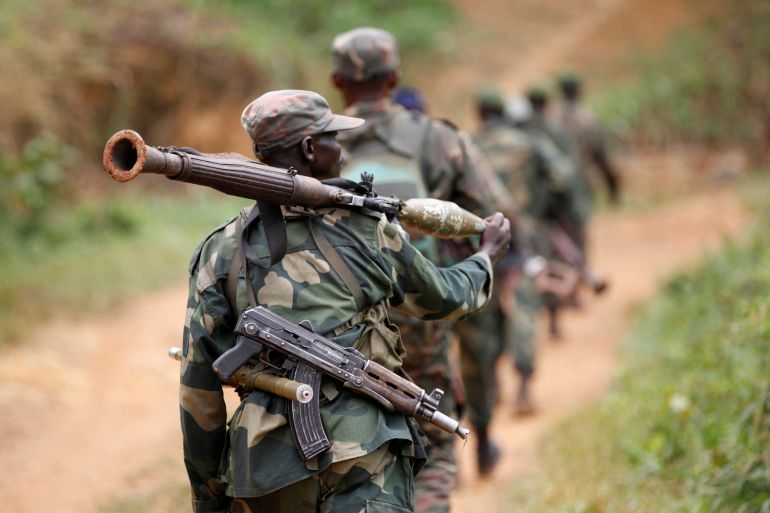
At least 15 people, including two soldiers, were killed in an attack by the so-called “Allied Democratic Forces” (ADF) on three villages in eastern Democratic Republic of Congo, according to local officials and military sources.
The armed group, originally formed from former Ugandan rebels and which has pledged allegiance to the Islamic State, launched its attack on the villages of Katanga, Mayindelo, and Kilong in the Lubero area of northwestern North Kivu province.
The villages, located within a 7-kilometer radius, were subjected to a simultaneous attack during an “incursion by the Allied Democratic Forces.”
Gunfire was heard from 8 p.m. to 10 p.m. local time, causing panic among residents. The attack resulted in “15 dead and 13 houses burned.”
“Units from the Armed Forces of the Democratic Republic of Congo and the Ugandan army are pursuing this enemy,” which “spread terror among peaceful residents who were celebrating” the New Year.
The Allied Democratic Forces was founded in the northeast of the Democratic Republic of Congo in the mid-1990s, has killed thousands of civilians, and continues to carry out numerous looting and killing operations despite the deployment of the Ugandan army alongside Congolese armed forces.
Democratic Republic of Congo
The Democratic Republic of Congo (DRC) is a vast country in Central Africa, not a single site, with a complex history marked by the pre-colonial Kingdom of Kongo, the brutal colonial rule under King Leopold II of Belgium as the Congo Free State, and a tumultuous post-independence period since 1960. It is renowned for its immense natural resources and biodiversity, including the Congo Basin rainforest, but has struggled with prolonged conflict and political instability. Culturally, it is a vibrant mosaic of hundreds of ethnic groups and is globally influential, particularly through its music genres like soukous and rumba congolaise.
Allied Democratic Forces (ADF)
The Allied Democratic Forces (ADF) is not a cultural site or place, but rather an Islamist militant group. It was founded in the mid-1990s in Uganda and is now primarily based in the eastern Democratic Republic of the Congo, where it has been responsible for prolonged conflict and numerous attacks against civilians.
National Army for the Liberation of Uganda (NALU)
The National Army for the Liberation of Uganda (NALU) was a rebel group active in the early 1990s, primarily operating in western Uganda near the Rwenzori Mountains. It was composed mainly of remnants of earlier insurgent movements and aimed to overthrow the government of President Yoweri Museveni. The group was largely defeated by the mid-1990s and is not a cultural site but a historical militant organization.
Beni
“Beni” most likely refers to the Beni Department in northeastern Bolivia, a region within the vast Amazonian lowlands. Historically, it was the heart of a sophisticated network of pre-Columbian societies, known for constructing thousands of artificial forested mounds and canals for agriculture and settlement. Today, it is a sparsely populated area known for its rich biodiversity, cattle ranching, and archaeological significance.
North-Kivu province
North Kivu is a province in the eastern Democratic Republic of the Congo, bordering Rwanda and Uganda. It is historically significant as part of the ancient Kingdom of Rwanda and later the Congo Free State, but it is now tragically known for its rich mineral resources and decades of devastating conflict involving armed groups, which has caused a profound humanitarian crisis. The region is also home to Virunga National Park, a UNESCO World Heritage site and Africa’s oldest national park.
United Nations peacekeeping mission (MONUSCO)
MONUSCO is the United Nations Organization Stabilization Mission in the Democratic Republic of the Congo, established in 2010 to succeed an earlier UN mission. Its mandate is to protect civilians, support the stabilization of the country, and help strengthen state authority amid ongoing conflict in the eastern regions. It is one of the UN’s largest and most complex peacekeeping operations, with a history of confronting numerous armed groups.
Lubero
Lubero is a town located in the North Kivu province of the Democratic Republic of the Congo, situated in the fertile foothills of the Rwenzori Mountains. Historically, it was part of the Kingdom of Rwenzururu and later became a significant colonial and post-colonial administrative center within the region, known for its agricultural production, particularly coffee. The area has also been deeply affected by the conflicts and instability that have characterized eastern Congo in recent decades.
North Kivu province
North Kivu is a province in the eastern Democratic Republic of the Congo, bordering Rwanda and Uganda. It is historically significant for its rich natural resources and tragic history of conflict, including the Rwandan Genocide’s aftermath and ongoing violence involving numerous armed groups. The region is also home to Virunga National Park, Africa’s oldest national park and a UNESCO World Heritage site.