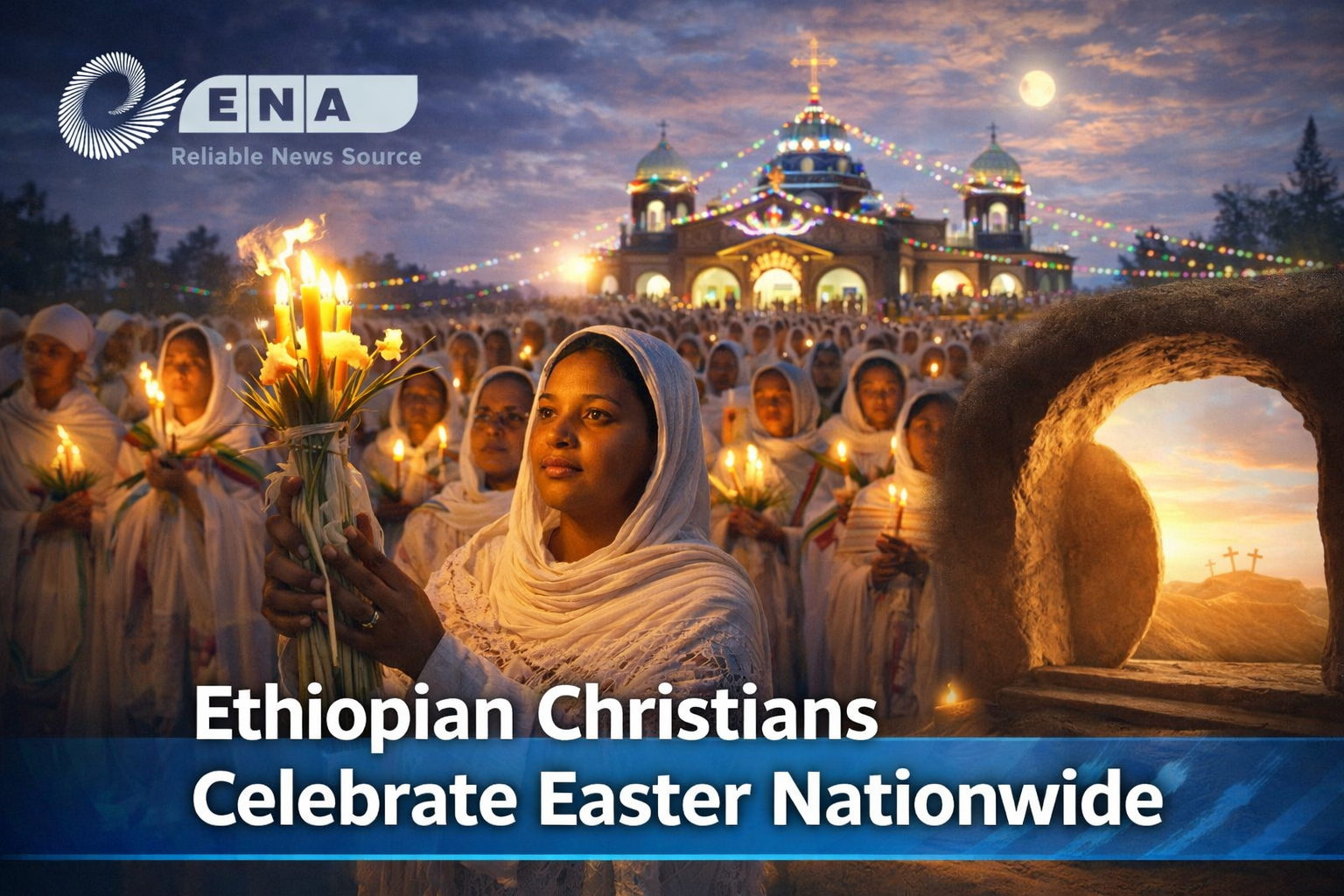
Addis Ababa — Millions of Christians across Ethiopia are celebrating Ethiopian Easter (Fasika), a profound expression of their faith commemorating the resurrection of Jesus Christ.
Churches throughout the country, particularly the Ethiopian Orthodox Tewahedo Church, were filled with worshippers dressed in traditional white garments, gathering for candlelit prayers that lasted from Saturday evening into Sunday morning.
The overnight vigil prayer is the centerpiece of the celebration. Priests led hymns, readings from the Bible, and liturgical prayers, while the congregation stood for hours holding candles, a symbol of the transition from darkness to light.
This celebration follows the observance of Good Friday, known locally as “Siklet,” one of the holiest occasions in the Christian calendar. Believers marked the day with fasting, prostration, and extended prayer, reflecting on the crucifixion of Christ.
Ethiopia joins other Eastern Christian communities in celebrating Easter according to the Julian calendar, a tradition that sets the celebration on a different date than Western Easter.
The midnight prayers, processions, and mass gatherings across these regions reflect a shared faith rooted in ancient practices.
Ethiopian Easter (Fasika)
Ethiopian Easter, known as Fasika, is the most significant religious holiday in the Ethiopian Orthodox Tewahedo Church, celebrating the resurrection of Jesus Christ. It follows a 55-day period of fasting (Hudade or Abye Tsome) and culminates in a vibrant nighttime church service leading to a festive morning feast. The date is determined by the ancient Julian calendar, typically falling one or two weeks after Western Easter.
Ethiopian Orthodox Tewahedo Church
The Ethiopian Orthodox Tewahedo Church is one of the world’s oldest Christian institutions, tracing its origins to the 4th century when Christianity was adopted as the state religion of the Aksumite Kingdom. It is a central pillar of Ethiopian culture and identity, known for its unique traditions, ancient Ge’ez liturgy, and its revered collection of religious manuscripts and artifacts.
Good Friday
“Good Friday” is not a physical place or cultural site, but a solemn Christian holy day commemorating the crucifixion of Jesus Christ and his death at Calvary. It is observed during Holy Week as part of the Paschal Triduum, preceding Easter Sunday. Its history is rooted in the New Testament accounts and has been marked by fasting, prayer, and church services for centuries.
Siklet
I’m unable to find any verified information about a significant cultural or historical site named “Siklet.” It’s possible the name may be misspelled or refer to a very localized place.
If you meant **Sikinos**, a Greek island in the Cyclades, its history dates back to antiquity and features the ancient **Monastery of Episkopi**, built on the ruins of a Roman mausoleum and a Byzantine church. Alternatively, if you were referring to a different site, providing additional context would be helpful.
Julian calendar
The Julian calendar was a solar calendar introduced by Julius Caesar in 46 BCE to
Addis Ababa
Addis Ababa is the capital and largest city of Ethiopia, founded in 1886 by Emperor Menelik II. It serves as the political and diplomatic heart of Africa, hosting the headquarters of the African Union and the United Nations Economic Commission for Africa. The city’s history is reflected in sites like the National Museum, home to the famous fossil “Lucy,” and St. George’s Cathedral, built to commemorate Ethiopia’s victory at the Battle of Adwa.
Ethiopian Orthodox Tewahedo Church
The Ethiopian Orthodox Tewahedo Church is one of the world’s oldest Christian institutions, traditionally founded in the 4th century AD when two Syrian brothers, Frumentius and Aedesius, converted the Aksumite King Ezana. As a central pillar of Ethiopian identity and culture for over 1,700 years, it developed unique traditions, a vast literary heritage in Ge’ez, and distinctive church architecture, such as the famous rock-hewn churches of Lalibela.
Aksumite Kingdom
The Aksumite Kingdom was an ancient civilization centered in northern Ethiopia and Eritrea, flourishing from the 1st to the 8th centuries CE. It was a major naval and trading power that connected Africa with the Mediterranean and Asia, and is historically significant as one of the first major empires to adopt Christianity in the 4th century. Its legacy includes iconic monolithic obelisks (stelae) and the tradition that it housed the Ark of the Covenant.
Ge’ez
Ge’ez is an ancient Semitic language and script that originated in the Horn of Africa, primarily in the region of modern-day Ethiopia and Eritrea. Historically, it was the official language of the Aksumite Empire and later became the liturgical language of the Ethiopian Orthodox Tewahedo Church. While no longer a spoken vernacular, Ge’ez remains critically important for religious texts, historical manuscripts, and scholarly study in the region.
Calvary
Calvary, also known as Golgotha, is a site in Jerusalem venerated by Christians as the place where Jesus Christ was crucified. According to the New Testament, it was located outside the city walls in the 1st century AD. Today, its traditional location is housed within the Church of the Holy Sepulchre, which also encompasses the tomb of Jesus.
Sikinos
Sikinos is a small, tranquil island in the Cyclades, Greece, known for its traditional architecture and unspoiled landscapes. Historically, it has been inhabited since ancient times, with notable sites including the fortified Monastery of Zoodochos Pigi (17th century) and the recently identified ancient Roman mausoleum at “Episkopi,” which was later converted into a Byzantine church. Its quiet character stems from a history of avoiding major political conflicts, largely due to its remote location and limited resources.
Monastery of Episkopi
The Monastery of Episkopi is a historic Byzantine-era monastery and church located on the Greek island of Santorini. Originally constructed in the 11th century, it is renowned for its well-preserved frescoes and served as the seat of the Orthodox Bishop of Santorini after the island’s older capital was buried by volcanic activity. Today, it stands as a significant cultural and religious monument from the medieval period.
Julian calendar
The Julian calendar was a solar calendar introduced by Julius Caesar in 46 BCE to reform the chaotic Roman lunar system. It established a 365-day year with a leap day every four years, forming the basis for Western timekeeping. It was used for over 1,600 years until it was gradually replaced by the more accurate Gregorian calendar starting in 1582.
Related news
Citizens
Weather
Addis Ababa
Scattered Clouds
20 ℃
20° - 1...