Prime Minister Abiy Ahmed’s December Leadership Accelerates Development Pace in Ethiopia and Its Global Impact
In December 2025, Prime Minister Abiy Ahmed spearheaded a series of high-level national and international initiatives, advancing Ethiopia’s development agenda and bolstering its growing regional and global influence.
A prominent initiative was the official visit of Indian Prime Minister Narendra Modi. During their meetings, the two leaders explored ways to enhance strategic cooperation in trade, investment, digital transformation, and tourism.
The visit culminated in several historic agreements, including mutual administrative assistance in customs, the establishment of a data center within the Ethiopian Ministry of Foreign Affairs, and a memorandum of understanding on cooperation with the United Nations in peacekeeping.
Prime Ministers Abiy and Modi also addressed a joint session of the Ethiopian Parliament, reflecting the increasing importance of Ethiopian-Indian relations on both bilateral and multilateral fronts.
On the continental level, Prime Minister Abiy Ahmed maintained close contact with African and regional partners. He met with the Executive Secretary of the United Nations Economic Commission for Africa, Claver Gatete, and the Chairperson of the African Union Commission, Moussa Faki Mahamat, to discuss cooperative efforts for the 32nd Conference of the Parties (COP32) in 2027, with a focus on African-led solutions and regional leadership.
Regionally, Prime Minister Abiy Ahmed hosted Somali President Hassan Sheikh Mohamud and Kenyan President William Ruto on working visits, holding productive talks on enhancing bilateral cooperation, supporting regional peace, and advancing sustainable development in the Horn of Africa.
On the domestic front, Prime Minister Abiy Ahmed achieved a significant milestone with the official launch of the “Digital Ethiopia 2030” initiative, building on the successes of the “Digital Ethiopia 2025” initiative. This strategy aims to expand digital access, ensure equal opportunities for all citizens, and foster trust between the public and government institutions.
Under this initiative, Ethiopia plans to significantly increase mobile service subscribers, expand 5G network coverage to 100 cities, broaden the scope of digital payments, modernize trade systems, and develop a robust artificial intelligence ecosystem alongside resilient cybersecurity infrastructure. The Prime Minister emphasized that electricity and the internet are fundamental elements, committing to providing them nationwide to support inclusive, citizen-centric digital growth.
He further affirmed that the “Digital Ethiopia 2030” initiative aligns with the vision of a Medemer state, which focuses on effective, seamless, and citizen-oriented governance.
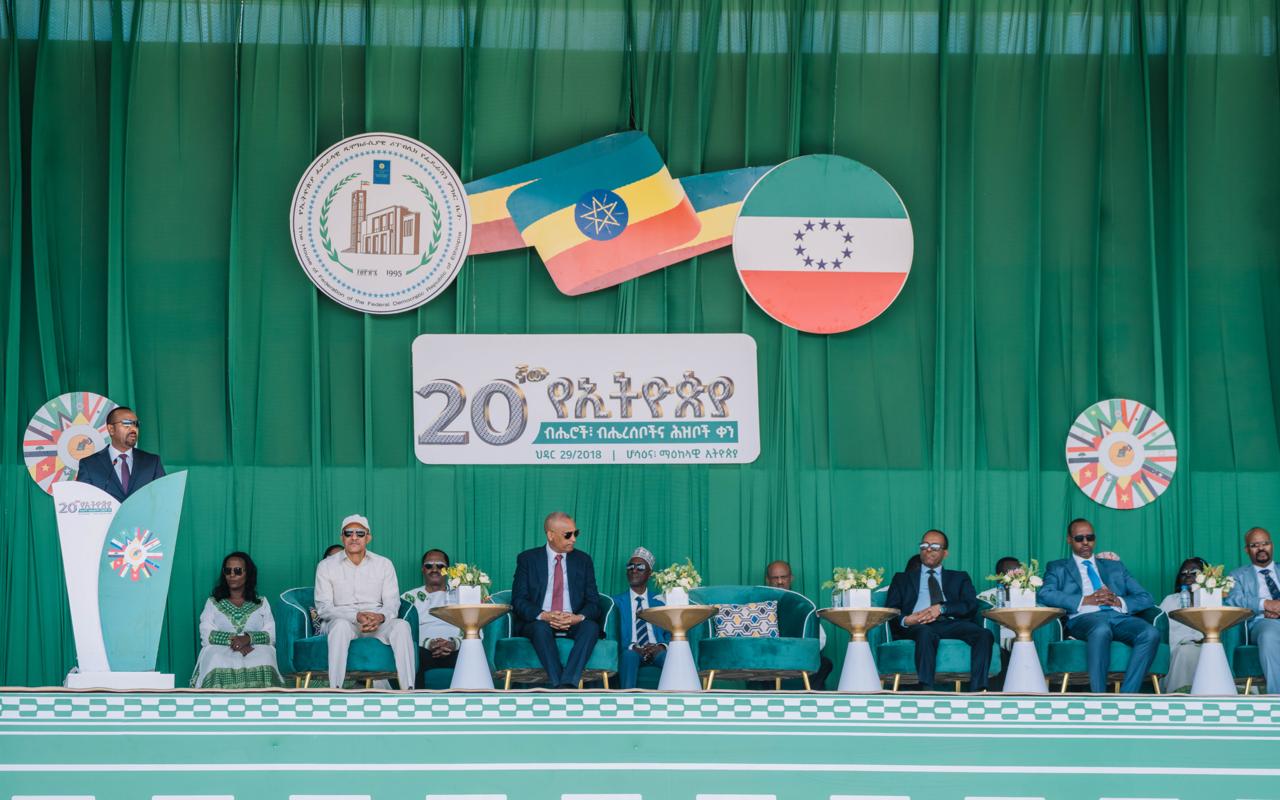
The celebrations for the 20th Nations, Nationalities, and Peoples’ Day in Hosanna provided another platform for Prime Minister Abiy Ahmed to promote national unity.
He reminded citizens of Ethiopia’s potential alongside its challenges, stating, “A single thread is fragile, but many threads woven together form an unbreakable rope.” The Prime Minister called for continued cooperation, solidarity, and the protection of national interests, announcing that the city of Jimma will host next year’s celebrations.
Throughout December, Prime Minister Abiy Ahmed’s leadership highlighted Ethiopia’s dual focus on internal modernization and strategic foreign diplomacy.
By promoting digital inclusion, consolidating regional partnerships, and deepening international cooperation, Ethiopia reinforced its national development path and elevated its regional and global standing.
Ethiopian Parliament
The Ethiopian Parliament, officially known as the Federal Parliamentary Assembly, is the supreme legislative body of Ethiopia, established under the 1995 constitution. It is a bicameral institution consisting of the House of Peoples’ Representatives and the House of the Federation, which represents the nation’s ethnic constituencies. Its modern form emerged following the end of the Derg military regime, replacing the historical imperial and single-party legislatures that governed the country in previous eras.
United Nations Economic Commission for Africa
The United Nations Economic Commission for Africa (UNECA) is one of the UN’s five regional commissions, established in 1958 to promote the economic and social development of its 54 member states on the continent. Headquartered in Addis Ababa, Ethiopia, it was founded to foster intra-regional integration and provide technical advisory support to African governments, playing a key role in shaping continental policy frameworks like the African Union’s Agenda 2063.
African Union Commission
The African Union Commission is the executive and administrative body of the African Union (AU), headquartered in Addis Ababa, Ethiopia. It was officially launched in 2002 as the successor to the Organization of African Unity (OAU), founded in 1963, to promote greater continental integration, peace, and development. The Commission implements the decisions of the AU and coordinates the Union’s activities and programs across its member states.
Horn of Africa
The Horn of Africa is a major peninsula in Northeast Africa, comprising the countries of Somalia, Ethiopia, Eritrea, and Djibouti. It is one of the world’s oldest known inhabited regions, with ancient civilizations like the Land of Punt and the Aksumite Empire shaping its early history. The region has long been a critical crossroads for trade and culture, but in recent decades it has been challenged by political instability, conflict, and recurring droughts.
Digital Ethiopia 2030
“Digital Ethiopia 2030” is a national strategic initiative launched by the Ethiopian government, not a physical place, aiming to drive the country’s socio-economic transformation through widespread digital technology adoption. Its history is rooted in the 2020 launch of the “Digital Ethiopia 2025” strategy, which was later extended and evolved into the “Digital Ethiopia 2030” vision to align with the United Nations Sustainable Development Goals. The program focuses on building digital infrastructure, fostering innovation, and digitizing key sectors like agriculture, healthcare, and education to create a more inclusive and prosperous digital economy.
Medemer state
“Medemer” is not a specific historical state or cultural site, but a political and social philosophy introduced by Ethiopian Prime Minister Abiy Ahmed. The term, which means “coming together” or “synergy” in Amharic, was popularized around 2018 and serves as a framework for national unity, inclusivity, and integrated development in Ethiopia. It is therefore a modern ideological concept rather than a physical place with a historical record.
Nations, Nationalities, and Peoples’ Day
“Nations, Nationalities, and Peoples’ Day” is an annual public holiday in Ethiopia, celebrated on December 8th. It commemorates the formal recognition of Ethiopia’s diverse ethnic identities and their right to self-determination, which was enshrined in the 1995 constitution following the fall of the Derg regime. The day features cultural displays, traditional attire, and performances highlighting the country’s rich mosaic of over 80 ethnic groups.
Jimma
Jimma is a city in southwestern Ethiopia historically known as the capital of the Kingdom of Jimma, a major 19th-century Oromo kingdom that prospered through coffee and trade. Today, it remains a key commercial and cultural hub in the Oromia Region, recognized for its vibrant market and as a center of Ethiopia’s coffee production.