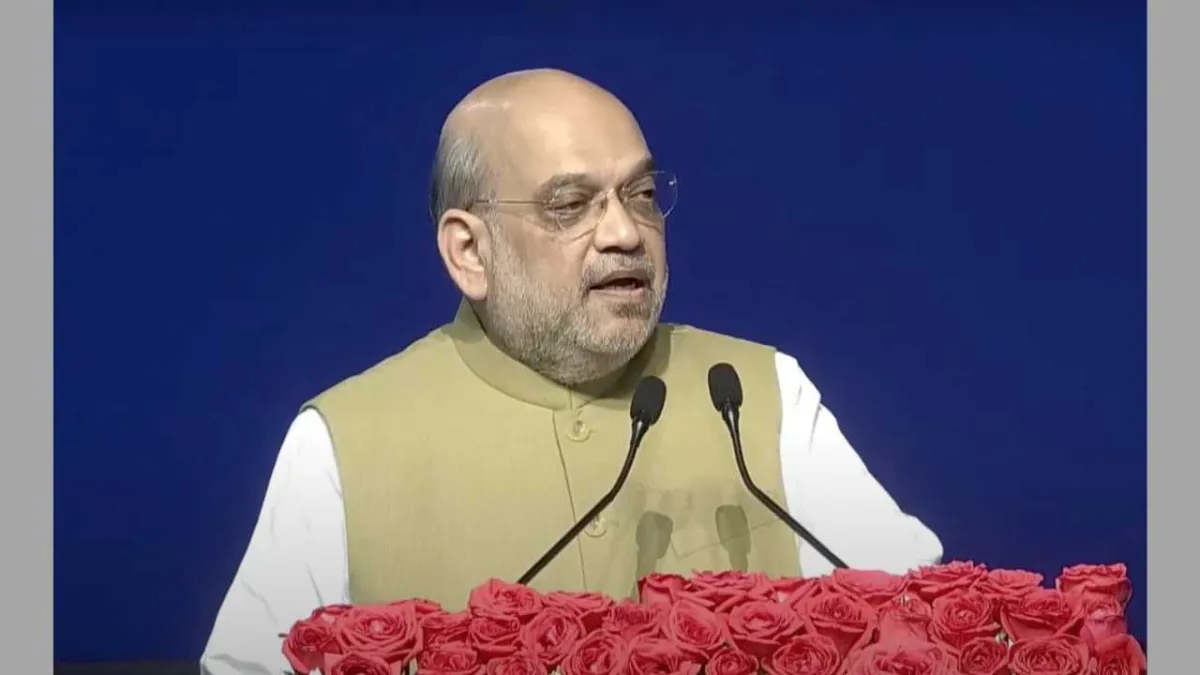
Union Home Minister Amit Shah responded to the discussion in the Lok Sabha on the ‘Nari Shakti Vandan Act’ and ‘Delimitation’.
During this, he said that in Karnataka, Tamil Nadu, Andhra Pradesh, Telangana, and Kerala… out of the 543 seats from these five states, the current number is 129, which is 23.76 percent. After the increase, when the allocation for these five states is made, the number of seats will rise from 129 to 195. Calculating this percentage out of 816 will give 23.87.
Previously it was 23.76 percent, and now it will be 23.87. No one will face any loss.
He said that I want to tell the mothers of this nation that the proposal put forth by the Congress party in Rahul Gandhi’s absence is a calculated trap, so that women’s reservation is not implemented again before 2029. Therefore, I agree with those who say that our states should have equal weight.
The Women’s Reservation Bill will be implemented before 2029. We will not let their conspiracy to push it beyond 2029 succeed. I understand that if they do not vote for it, the Women’s Reservation Bill will fail, but the women of the country are watching who is the obstacle in their path.
Amit Shah said that I want to make it clear to the women of this country that the proposal presented by the Congress party in Rahul Gandhi’s absence is a deliberate conspiracy to postpone reservation for women until after 2029, therefore I support all those who advocate for equal representation in our states.
Reservation for women should be implemented before 2029. We will not let their conspiracy to delay this crucial reform until after 2029 succeed. Some members here have spread the misconception that Muslim women should get reservation.
He said that I want to clarify the constitutional principles here. The Indian Constitution does not accept reservation based on religion. Those from the India Alliance want to raise the demand for Muslim reservation due to the politics of appeasement, and they talk about the Constitution. Can someone tell me which article of the Constitution provides for reservation based on religion.
The Indian Constitution does not recognize reservation based on religion. Despite this, driven by the politics of appeasement, the India Alliance is demanding reservation for Muslims, while they also cite the Constitution in support of this stance.
The Home Minister said that I tell the Congress that merely chanting slogans in speeches will not make the backward classes of the country consider you a well-wisher. From 1947 to 2014, you kept opposing OBCs. When you realized that power cannot be attained without OBCs, only then are you now chanting the name of OBCs.
This is superficial love, the backward classes of this country know it, the entire public of the country knows it, and from today, the women of the country will also know that the Congress party snatched away their rights.
He said that during the Modi government’s tenure, 27 ministers are from the OBC community, which is 40 percent of the total. During the Modi government’s tenure, the OBC Commission was given constitutional status. Our government empowered states by giving them the right to amend the OBC list.
Lok Sabha
The Lok Sabha is the lower house of India’s bicameral Parliament, located in New Delhi. Established by the Constitution of India in 1952, it is the primary legislative body where members are directly elected by the people. Its history is tied to India’s independence, succeeding the Constituent Assembly and operating from the iconic Sansad Bhavan (Parliament House), a heritage building from the British colonial era.
Nari Shakti Vandan Act
Lok Sabha
The Lok Sabha is the lower house of India’s bicameral Parliament, located in New Delhi. Established by the Constitution of India in 1952, it is the primary legislative body where members are directly elected by the people. Its history is tied to India’s independence, succeeding the Constituent Assembly and operating from the iconic Sansad Bhavan (Parliament House), a heritage building from the British colonial era.
Nari Shakti Vandan Act
The “Nari Shakti Vandan Act” is not a physical place or cultural site, but a landmark Indian legislation. Officially the Constitution (One Hundred and Sixth Amendment) Act, 2023, it mandates reserving one-third of seats for women in the Lok Sabha (India’s lower house of Parliament) and state legislative assemblies. This act culminated a decades-long struggle for greater gender parity in Indian political representation.
Indian Constitution
The Constitution of India is the supreme legal document of the Republic of India, adopted by the Constituent Assembly on November 26, 1949, and coming into effect on January 26, 1950. It established India as a sovereign, democratic republic and is renowned as the world’s longest written constitution, drawing from various global sources while enshrining fundamental rights and duties. Its drafting, led by Dr. B.R. Ambedkar, was a foundational act in India’s post-independence history, creating the framework for its parliamentary democracy and secular state.
OBC Commission
The “OBC Commission” refers to the National Commission for Backward Classes (NCBC), a constitutional body in India established in 1993 to investigate and monitor issues related to the social and economic development of Other Backward Classes (OBCs). It was initially created by an act of Parliament and given constitutional status through the 102nd Amendment Act in 2018, empowering it to examine complaints and protect the interests of OBC communities. The commission plays a key role in advising the government on inclusion and exclusion from the lists of communities eligible for affirmative action policies.
Sansad Bhavan
Sansad Bhavan, commonly known as the Parliament House of India, is the central legislative building in New Delhi where the two houses of the Indian Parliament—the Lok Sabha and the Rajya Sabha—conduct their sessions. It was designed by British architects Sir Edwin Lutyens and Sir Herbert Baker and opened in 1927 as the seat of the Imperial Legislative Council during British rule, before becoming the Parliament of independent India after 1947. The iconic circular structure, built in the colonial-era architectural style, remains a powerful symbol of the world’s largest democracy.
Parliament House
Parliament House is the meeting place of the Australian Parliament in Canberra, opened in 1988 to replace the provisional Parliament House. Its design, chosen through an international competition, symbolizes democracy with its distinctive boomerang-shaped plan and a massive flagpole atop a grass-covered roof, allowing public access. The site reflects a long history of federal governance since Australia’s federation in 1901.
Constituent Assembly
The Constituent Assembly refers to a legislative body convened to draft or adopt a new constitution for a nation. Historically, notable examples include the French National Assembly of 1789, which was central to the French Revolution, and the Russian Constituent Assembly of 1918, which was dissolved by the Bolsheviks after a single session. Such assemblies are pivotal moments in a country’s political development, often emerging during transitions from monarchy, colonial rule, or authoritarian regimes.
Constitution of India
The Constitution of India is the supreme legal document that established the country as a sovereign, democratic republic after gaining independence from British rule. It was adopted by the Constituent Assembly on November 26, 1949, and came into effect on January 26, 1950, a date now celebrated as Republic Day. Drafted under the chairmanship of Dr. B.R. Ambedkar, it is one of the world’s longest and most detailed constitutions, enshrining fundamental rights, duties, and the framework of governance.