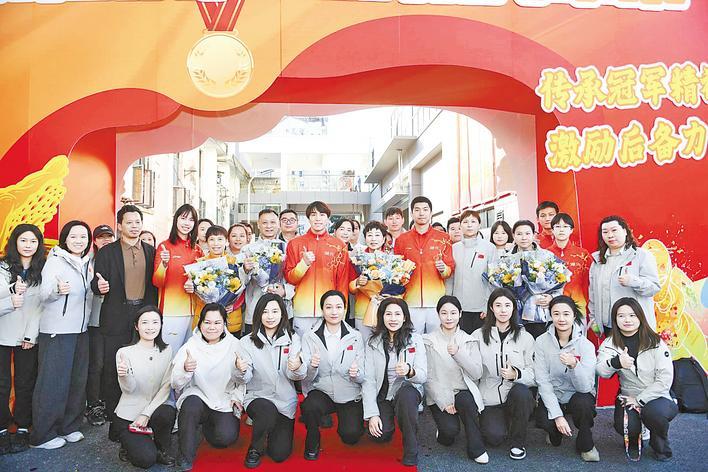
“Chongren native” National Games champion presents flowers to his former coach.
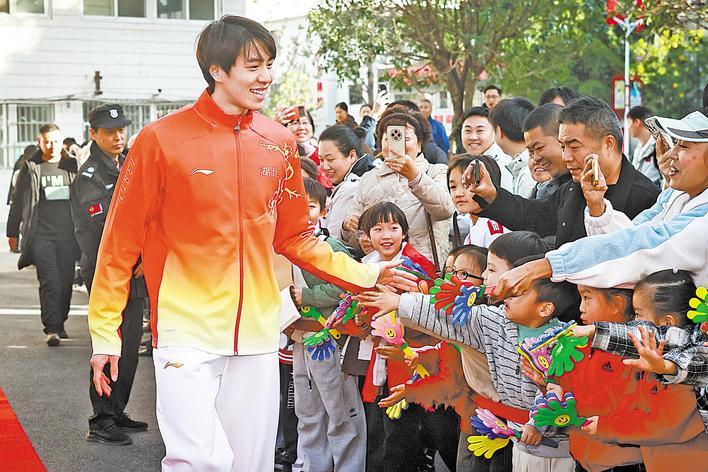
Young athletes at Chongren Center welcome Sun Jiajun “home”.
“No matter how far you swim or how heavy the gold medal is, you never forget where you came from.” On November 26th, a veteran swimming coach brought Yan Zibei, Sun Jiajun, Peng Xuwei, Huang Zichun, Ke Wenxi and other “Chongren native” National Games champions and athletes back to where their dreams began – the Hubei Chongren Sports Training Center.
Since its establishment in 1956, Chongren Center has trained 12 Olympic champions who have won 20 Olympic gold medals, along with numerous world champions from various competitions. In the recently concluded 15th National Games, Chongren swimming achieved another outstanding result of 4 gold, 1 silver, and 4 bronze medals. As a traditional activity at Chongren Center, this year’s “Champions Return Home” event was specially held after the National Games. The center director stated: “Standing at the starting point of a new cycle, we hope to bring surprises to young athletes through this event and pass on the glorious baton. This is not just a ‘triumphant return journey’ but also a ‘spiritual relay.'”
On the familiar Champions Avenue, Coach Zheng Shan held flowers in her left hand while holding Yan Zibei’s hand with her right. Mentor and student walked side by side, retracing the training path they had walked countless times.
“Twenty years have passed both quickly and slowly,” Zheng Shan reflected. “What’s fast is that the little boy who was less than ten years old has now become a coach like me; what’s slow is that every memory at Chongren remains as clear as yesterday.” In 2005, Zheng Shan selected Yan Zibei in Xiangyang and brought him to Chongren. Now, 30-year-old Yan Zibei led his team to win the most significant gold medal in the men’s 4×100m medley relay at the 15th National Games. While bringing his athletic career to a perfect conclusion, he has transitioned to become a youth team coach for Hubei swimming. “I hope to share my path and experience with more young athletes. I want to tell them that dreams start from here, and they should pursue a better future with passion,” Yan Zibei said.
Yan Zibei practiced what he preached. Together with the Chongren athletes who returned with honors from the 15th National Games, he entered the swimming pool to provide technical guidance and interact warmly with the young athletes in the elite training group. Meanwhile, Zheng Shan exchanged coaching insights and passed on experience with all the swimming coaches.
Ke Wenxi, who won the bronze medal in the women’s 400m individual medley at the 15th National Games, is only 14 years old this year. Pointing at her childhood idol Yan Zibei, she said: “When training at Chongren, we often watched his competitions. When we got tired, we would think about how hard he worked, and then we could keep going.” Now that her idol has become her senior, Ke Wenxi will never forget what Yan Zibei told her before her final – just one word: “Charge!”
The baton has quietly been passed to the new generation. In the swimming lanes, water splashes everywhere as young athletes sprint with all their might.
Zhang Yuqiao, a fifth-grade student at Stadium Elementary School, trains under the coach who originally discovered Sun Jiajun. Her coach said that Zhang Yuqiao is a “stubborn kid” who repeats exercises over and over until they’re perfect if she doesn’t get them right. Every day on her way to training, she looks at the photos of Yan Zibei and Sun Jiajun on the Champions Wall. “When my explosive power isn’t enough,