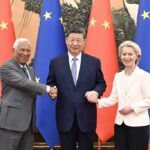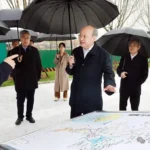
On March 23, during an inspection of the Xiong’an New Area in Hebei Province, the General Secretary emphasized: “The undertaking of functions must adhere to high standards and high quality, organically linking the relocation of Beijing’s non-capital functions with the coordinated development of the Beijing-Tianjin-Hebei region.”
More than a month earlier, during an inspection in Beijing, the General Secretary stressed: “Beijing should base its efforts on the city’s strategic positioning and the coordinated development of the Beijing-Tianjin-Hebei region, further establish a high-quality development orientation, and promote effective qualitative improvement and reasonable quantitative growth in the economy through a mix of increases and decreases, protections and pressures.”
In the first year of a new phase, from Beijing to Xiong’an, two consecutive local inspections have focused on the coordinated development of the Beijing-Tianjin-Hebei region, the first national strategy for coordinated regional development in the new era.
Today, the “city of the future” is growing rapidly, and the Jing-Jin-Ji region is undergoing daily changes. The consistent theme is relentless effort and practical action, underpinned by profound consideration for planning economic and social development with dialectical thinking.
The solution to coordinated development began with a question of “reduction and increase” concerning the capital’s development.
The timeline goes back to February 2014.
The General Secretary presided over a symposium, specifically listening to reports on the coordinated development of the Beijing-Tianjin-Hebei region, emphasizing that “the coordinated development of Beijing, Tianjin, and Hebei is of great significance, and understanding of this issue must be elevated to the level of national strategy.”
At that time, Beijing was experiencing “growing pains.” Overpopulation, traffic congestion, and significant ecological environmental pressure… Solving Beijing’s “big city problems” required “surgical intervention.”
“To properly address Beijing’s development issues, they must be considered within the strategic space of the Beijing-Tianjin-Hebei region and the Bohai Rim economic zone.”
How to solve the “Beijing-Tianjin-Hebei integration” puzzle?
The General Secretary pointed out that the coordinated development of Beijing-Tianjin-Hebei must “grasp the relocation of Beijing’s non-capital functions as the ‘key link’,” and that “relocation is not simply moving house; it should also be an opportunity for renewal and upgrading.”
With retreat for advance, with relinquishment for gain, a change in perspective opens up new horizons.
Beijing persists with reduction-based development, creating new space for high-quality development and enhancing overall urban functions; Tianjin leverages its advantages in advanced manufacturing, closely connecting with Beijing’s scientific and technological innovation resources; the Xiong’an New Area in Hebei and Beijing’s municipal administrative center strengthen differentiated and interconnected development, reinforcing the supporting role of node cities like Tangshan, Baoding, Zhangjiakou, and Langfang.
“The Beijing-Tianjin-Hebei integration is mutually beneficial; ultimately, no one loses out, and everyone gains what they seek.” Through reduction and increase, dispersal and reception, the three provincial-level regions have moved beyond the confines of “a single city or locality,” finding their strategic positioning within the national context for differentiated development, each playing to its strengths.
How to advance the coordinated development of Beijing-Tianjin-Hebei?
The dialectic of “breaking and establishing” runs through the tackling of hard challenges in coordinated development.
“Focus on increasing efforts to promote coordinated development, consciously break the mindset of sticking to one’s own ‘one-third of an acre,’ and work together as a team towards the goals set by the top-level design,” the General Secretary pointed out the key.
What is being broken is the old pattern of compartmentalization and fragmented efforts. In the past, the three regions of Beijing, Tianjin, and Hebei were geographically connected but insufficiently linked, with administrative boundaries acting as “invisible walls” to development.
Transportation barriers must be dismantled, with a basic 1 to 1.5-hour transportation circle taking shape among major cities in the region; ecological barriers must be dismantled, deepening joint construction, prevention, and control; and, crucially, barriers to people’s livelihoods must be dismantled, promoting cross-provincial handling of education, healthcare, and social security matters. One stubborn problem after another is being solved, allowing for smoother flow of various resource elements.
What is being established is a new system of integrated planning and coordinated advancement. “Seize the opportunity of the expansion of the Beijing (Jing-Jin-Ji) International Science and Technology Innovation Center, strengthen collaborative