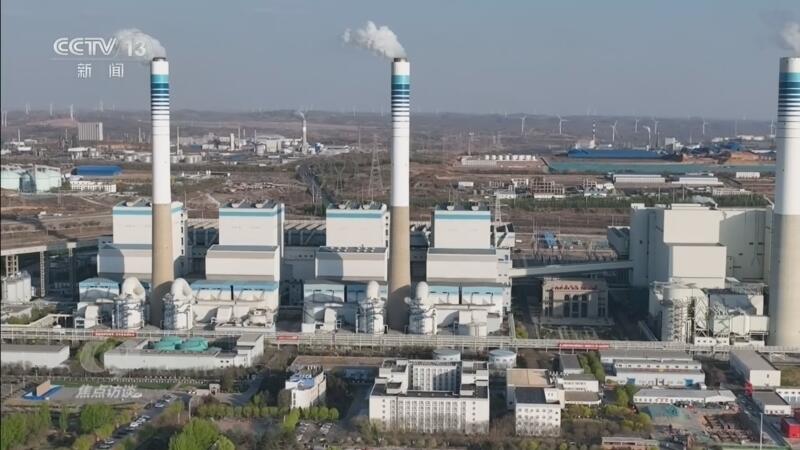
Energy is the lifeblood of a nation’s economic circulation and a key driver of high-quality development. As the world’s largest energy producer and consumer, the transformation of China’s energy structure is a core force reshaping the economic framework and cultivating new growth points. The outline for the 15th Five-Year Plan proposes: accelerate the construction of a new energy system that is clean, low-carbon, safe, and efficient, and build China into an energy powerhouse. In the inaugural year of the plan, we visited major energy bases across the country to observe the ongoing changes in the energy industry firsthand.
As special coal trains from Shendong Coal depart for distant destinations, a “Great Wall of Photovoltaics,” nearly 400 kilometers long and averaging about 5 kilometers wide, is under construction over 160 kilometers away on the northern edge of the Kubuqi Desert in Inner Mongolia.
From Yulin in Shaanxi to Ordos in Inner Mongolia, from traditional fossil fuels to new energy sources like wind and solar power, from the northwestern Gobi Desert to the eastern coast, a diversified supply and network of energy channels ensures the energy consumption needs of over 1.4 billion people.
The inaugural year of the 15th Five-Year Plan sees a surge of activity in the energy sector. At the Energy Storage International Summit in Beijing, we met with an energy expert conducting research.
“Every Five-Year Plan prioritizes energy security. The defining features of the 15th Five-Year Plan are a shift towards ‘green’ and ‘smart’ energy. ‘Smart’ refers to leadership by artificial intelligence, while ‘green’ focuses on low-carbon development.”
From a binding 17% carbon reduction target to a supply security baseline of 5.8 billion tons of standard coal, and from laboratory technological breakthroughs to large-scale implementation, China’s energy sector is poised for comprehensive transformation and upgrading during the 15th Five-Year Plan period, moving towards a cleaner, low-carbon, safe, and efficient future.
In China, most wind and solar power capacity is located in the western regions, while electricity consumption is concentrated in the east. To resolve this imbalance, high-speed electricity transmission corridors are being built to achieve ultra-long-distance, ultra-high-capacity, and ultra-low-loss power transfer. The Mengxi–Beijing–Tianjin–Hebei ±800 kV ultra-high-voltage direct current transmission project under construction is one such “electricity superhighway.” Once operational, it will transmit over 36 billion kilowatt-hours of electricity annually to the load centers of the Beijing-Tianjin-Hebei region.
Inner Mongolia is a crucial national energy base. Looking ahead to the 15th Five-Year Plan period, an increasingly dense network of “electricity superhighways” will deliver more of Inner Mongolia’s clean power to regions like Beijing-Tianjin-Hebei, South China, and Central China.
The outline for the 15th Five-Year Plan proposes implementing a tenfold increase in non-fossil energy over a decade, balancing local consumption and external transmission. This means that in addition to building more “West-to-East Electricity Transmission” corridors, effective pathways for utilizing green electricity must be found in the future.
At a wind-solar-storage power station, each rotation of a wind turbine blade generates 12 kilowatt-hours of electricity. This green power is transmitted via a dedicated 41-kilometer line directly to a computing power center in the Hohhot Helinge’er New District. Inside an intelligent computing facility, 2,390 servers operate at high speed, supported by liquid cooling technology for real-time heat dissipation. When you edit photos on your phone in Beijing, utilize a large AI model, or play games, these servers may be contributing to the task.
“Currently, 95% of the computing power from the Hohhot Data Center Park is supplied to the Beijing-Tianjin-Hebei region, with a network latency of about 3 milliseconds. A blink of an eye is 300 milliseconds, meaning data can travel between Beijing and Hohhot ten times in the blink of an eye.”
Behind this stable and powerful computing capability lies electricity consumption levels that are hard for the average person to imagine.
“A single server rack consumes 40 kilowatts, which is 40 kilowatt-hours per hour. The annual electricity consumption is close to 300 million kilowatt-hours, costing about 100 million yuan.”
Thanks to Inner Mongolia’s abundant solar and wind resources, the comprehensive electricity price here is more than half that of regions like the Yangtze River Delta and Beijing-Tianjin-Hebei. Where electric current meets servers, watts are continuously being converted into bits. It is this cost-effective computing power supply model that is attracting more and more technology companies.
As a