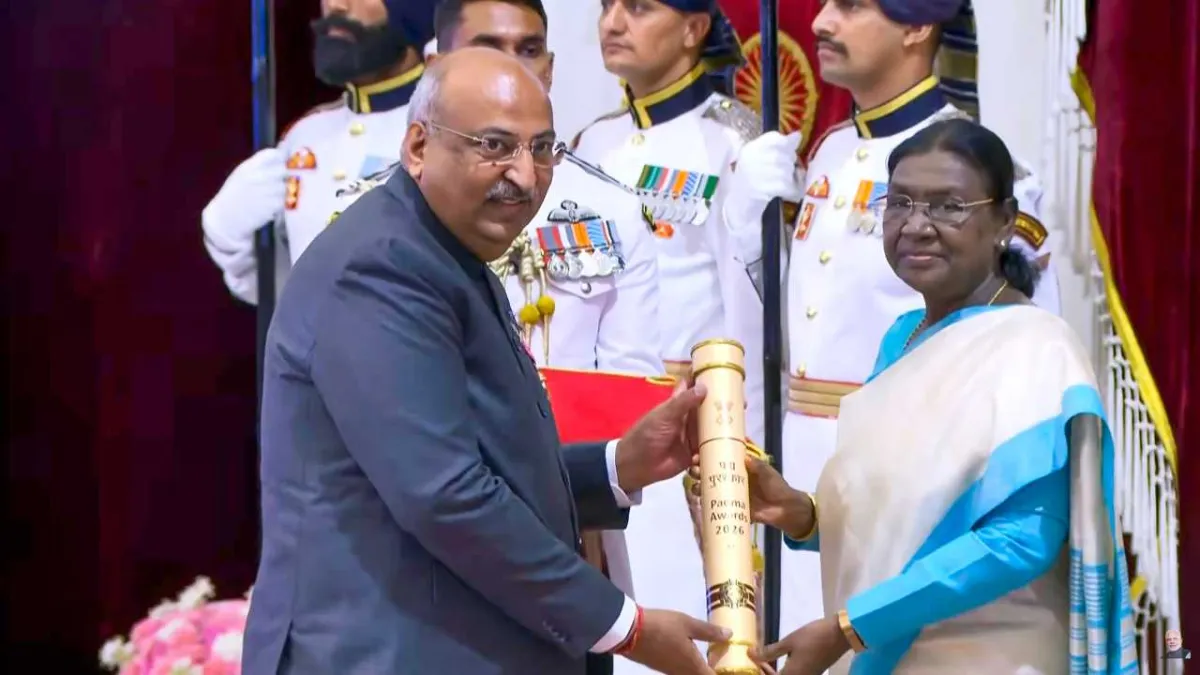
New Delhi, May 25. In a grand ceremony held at the Rashtrapati Bhavan, President Draupadi Murmu conferred Padma awards on 66 personalities who made remarkable contributions in various fields. This year, a total of 131 people have been selected for the Padma honors, with the remaining awardees to be honored in the next phase.
At the ceremony, the first award was the posthumous Padma Vibhushan to the late actor Dharmendra Singh Deol. His wife and actress Hema Malini received the honor. Dr. N. Rajam was also awarded the Padma Vibhushan for her special contributions to Indian classical music. Other personalities selected for the Padma Vibhushan will be honored in the upcoming phase.
Among those who received the Padma Bhushan were former Chief Minister of Uttarakhand Bhagat Singh Koshyari, Uday Kotak from the industry, the late Piyush Pandey from the advertising world, V.K. Malhotra, Shatavadhani R. Ganesh, and from the medical field, Kallipatti Ramasamy Palaniswamy. Their contributions in various fields were recognized at the national level during the ceremony.
In the Padma Shri awards, many luminaries from sports, arts, literature, social service, medicine, and science were honored. Indian women’s cricket team captain Harmanpreet Kaur was awarded the Padma Shri in the field of sports. Under her leadership, the Indian team achieved a notable feat by winning the ODI World Cup this year.
Several renowned personalities were also honored in the field of arts and culture. Actors R. Madhavan and Prosenjit Chatterjee, dancer Deepika Reddy, and other artists were conferred with the Padma Shri. Meanwhile, many experts and social workers contributing to medicine, education, and social service were also given national honors.
For contributions to the defense manufacturing sector, Chairman of the Solar Group, Satyanarayan Nuval, was awarded the Padma Shri. K. Pazhanivel of Puducherry, who brought global recognition to the traditional martial art ‘Silambam’, was also presented with the Padma Shri. His act of bowing to Prime Minister Narendra Modi during the ceremony also became a topic of discussion.
The ceremony was attended by Vice President C.P. Radhakrishnan, Prime Minister Narendra Modi, Union Home Minister Amit Shah, and many other dignitaries. The Padma awards are considered among the highest civilian honors in the country, awarded for exceptional contributions in arts, social service, public life, science, literature, and other fields.
Who are the personalities included in the list of Padma honors?
Two couples will also receive the Padma award. This will be counted as a single award.
19 women will also be honored by President Draupadi Murmu.
Six foreign/NRI or OCI card holders will also receive Padma honors.
16 personalities will be honored posthumously.
Why are Padma awards given every year?
The Padma awards are conferred every year on personalities who achieve extraordinary accomplishments in various fields, including remarkable contributions in arts, social service, and the public sector. The Padma Vibhushan is for exceptional service, the Padma Bhushan for distinguished service of a high order, and the Padma Shri is awarded for distinguished service in any field. These awards are announced every year on Republic Day.
Padma Vibhushan
Serial Number Name Field State / Country
1 Dharmendra Singh Deol (Posthumous) Arts Maharashtra
2 K.T. Thomas Public Service Kerala
3 N. Rajam Arts Uttar Pradesh
4 P. Narayanan Literature and Education Kerala
5 V.S. Achuthanandan (Posthumous) Public Service Kerala
Padma Bhushan
Serial Number Name Field State / Country
1 Alka Yagnik Arts Maharashtra
2 Bhagat Singh Koshyari Public Service Uttarakhand
3 Kallipatti Ramasamy Pal