How young people are redefining the “experience piece” of Vietnam.
For decades, the souvenir market seemed stuck in a safe “loop”: postcards printed with familiar landscapes, notebooks with little variation, and products mainly serving functional display needs.
A Market Gap
This model once worked efficiently thanks to a steady flow of tourists. However, a new wave is rising, completely redefining the concept of “gifts from afar” through the lens of creativity and emotional connection.
This shift originates from the needs of young urban consumers—those no longer interested in items that merely “represent a location.” They crave products with their own design language, carrying stories and reflecting modern life.
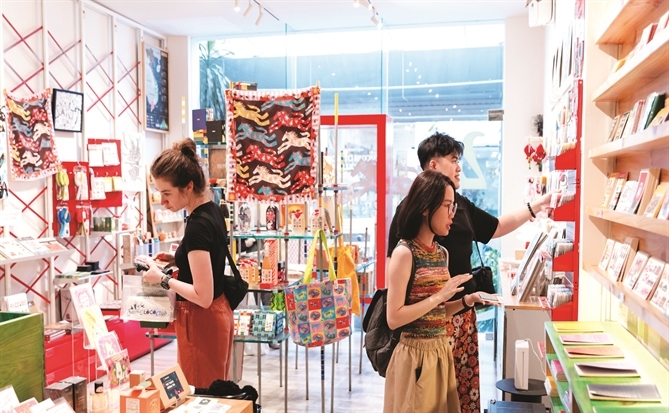
OHQUAO, a typical concept store in Ho Chi Minh City, was born from this very gap. This brand not only sells souvenirs but also promotes an image of a “young and dynamic” Vietnam. “We believe our products can thrive in that niche. Therefore, sustainable development has been a goal we aimed for from the start,” a founder shared.
 |
Instead of following the path of mass commercialization, OHQUAO chooses the role of a curator. Today, it connects over 100 local brands and artists. Its product range spans from designer stationery to lifestyle accessories like fabric bags and textiles with cultural elements. The products feature contemporary illustration language, using materials from Vietnamese life but expressed through fresh and original graphic styles. This model not only generates income for artists but also turns each item into an “experience piece” about Vietnam.
Travel gifts contribute to enhancing a destination’s appeal, encouraging spending, and promoting local imagery. In recent years, the tourism industry has also launched programs encouraging key tourist destinations to select gifts and souvenirs that carry local characteristics and cultural imprints.
The Return of Emotional Value
This market shift is also changing dramatically. If before the “beauty” factor was enough to drive purchase decisions, now customers are more selective, caring more about product stories, cultural value, and experience. This creates a paradox: spending tends to increase, but the “acceptance threshold” is also higher. Products with clear concepts can still sell at high prices, while those lacking positioning increasingly struggle to survive. OHQUAO’s revenue structure clearly reflects this stratification. Highly practical and accessible products drive revenue, while experiential or unique items help build brand image. Prices range from about 50,000-100,000 VND for basic items, but focus mainly on the 200,000-500,000 VND segment, suitable for young urban customers with distinct aesthetic tastes.
During peak periods, common invoice values range from 1-3 million VND. In some notable cases, international customers—especially orders from Japan and the US—may spend 7-12 million VND per purchase, almost without haggling. The common thread is that customers find aesthetic alignment and clearly feel the cultural value the products convey.
“When customers feel they are not just buying individual items but bringing home a part of the Vietnam experience, spending tends to increase naturally, and in some cases, opens up long-term collaboration opportunities beyond a typical retail transaction,” observed a COO of OHQUAO.
In an era dominated by digital technology and artificial intelligence, OHQUAO bucks the trend by focusing nearly 100% of its revenue on offline channels. With three spaces in prime locations like Thao Dien or near the City Post Office, each store is designed as a unique storytelling tool.
This trend aligns with global data from Mintel: nearly three-quarters of adults engaged in at least one handicraft activity in 2025, showing that the need for physical interaction with products is stronger than ever. “If we become increasingly digital… the reverse trend is to seek things you can touch. Nostalgia is the biggest retail trend right now,” noted a co-founder of The Retail Tracker.
In Vietnam, models like OHQUAO are proving that when creativity is properly organized, it is not just a sideline to tourism, but a sustainable economic value, carrying pride in the contemporary Vietnamese spirit to the world.
Ho Chi Minh City
<div class="text-gray