Do you know which municipality among cities with a population of 500,000 or more has the smallest amount of waste per person per day? When we spoke with municipal officials, they said that behind the low waste output lies over 20 years of continuous effort.
That city in Tokyo
According to the 2024 survey results published in March, among cities with a population of 500,000 or more, the city with the smallest waste output per person per day is Hachioji City.
Hachioji City recorded 690.9 grams of waste per person per day. This was 14.2 grams less than the second smallest (705.1 grams).
This marks the fourth consecutive year that Hachioji City has ranked first in this category.
Why does Hachioji City produce so little waste?
When we interviewed the city’s Resource Recycling Division, an official emphasized, “We believe this is the result of citizens and businesses working with a high awareness of waste reduction and resource recovery.”
The major turning point for waste reduction was the introduction of a fee for waste collection.
Triggered by fee introduction
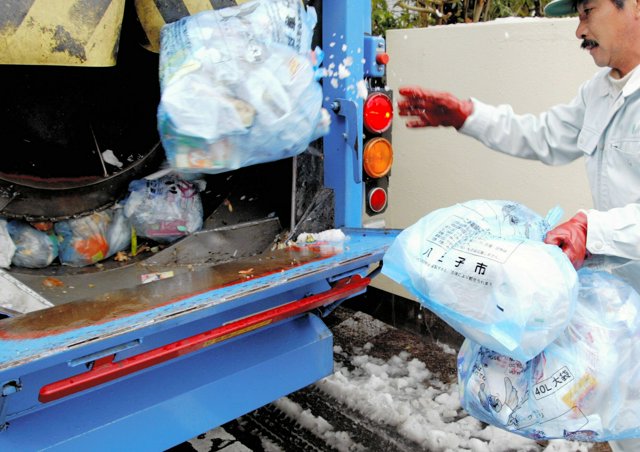
Hachioji City introduced fees for waste collection in 2004. A large waste bag (40 liters) was set at 75 yen each.
One of the backgrounds for implementing the fee was the issue of disposal sites.
Waste from 25 cities and one town in the Tama region, including Hachioji City, was being landfilled at the Futatsuzuka disposal site.
However, the available landfill capacity was becoming strained, and securing a new disposal site was difficult. Extending the life of the disposal site became an urgent issue, making waste reduction a pressing necessity.
To effectively utilize resources, the city began collecting plastics and also implemented door-to-door collection.
Door-to-door collection is said to have the advantage of making residents more responsible for the waste they put out in front of their homes, leading to more thorough sorting.
Waste volume decreases, resource recovery increases
The effects of these efforts were reflected in the numbers.
Before the fee introduction in fiscal year 2003, the total waste collection volume (combustible and non-combustible waste combined) was 129,150 tons, but after the fee introduction, it dropped to 92,832 tons.
Additionally, the amount of recovered resources increased sharply. The recovery volume, which was 16,510 tons in fiscal year 2003, rose to 30,249 tons in fiscal year 2005.
An official from Hachioji City reflected that through waste reduction initiatives, a shift in awareness occurred among citizens.
“Awareness of waste reduction and resource recovery increased, leading to progress in sorting and resource recovery. Furthermore, we began receiving opinions calling for measures not only to improve sorting and recovery but also to curb waste generation itself,” the official said.
In the Tama region, waste reduction is also progressing in municipalities other than Hachioji City.
An emeritus professor at a university who is knowledgeable about waste issues pointed out regarding Hachioji City’s case, “I think the biggest factor is that the waste fee made citizens interested in reducing waste.”
“And when data shows that waste has actually decreased, it energizes both citizens and municipal waste staff, boosting their motivation to reduce waste. I think we can say a positive cycle is happening,” he said.
Aiming for further reduction, Hachioji City is challenging itself with various initiatives.
For example, an attempt to reduce waste by cutting down on food loss.
Through a project called “Tabesuke HACHIOJI,” it offers a system where food products nearing their expiration dates or ingredients that might otherwise be discarded can be purchased at reasonable prices from local stores.
Users can search for products of interest on an app or website, make a purchase reservation, and then pick them up at the reserved store at a discounted price.
To reduce bulky waste, the city is also focusing on reusing items like furniture.
This fiscal year, the city signed agreements with two companies, including one that operates a service for finding new owners for unwanted items through posts on an online bulletin board.
The city
<div class="my-