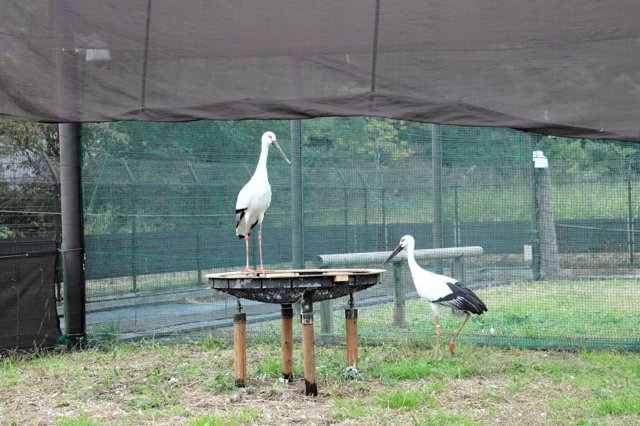
Stork “Mirai” returns to her hometown from Tokyo with a male partner, whose name will be chosen through a public contest.
A Japanese crested ibis named “Mirai” (female, 11 years old), born at the “Kounotori no Sato” facility, has returned to the facility together with her male partner (12 years old) from Tokyo. Breeding and egg-laying are anticipated. The facility has also begun public viewing.
Japanese crested ibises are managed under the Inter-institutional Panel on Population Management of Oriental White Storks (IPPM-OWS) plan, which focuses on maintaining genetic diversity and appropriate population levels. This involves transferring eggs between facilities nationwide for hatching and pairing birds. Mirai and the male are part of this pairing program.
Mirai was born in May 2014 to parents Kou-kun (male, 20 years old) and Kou-chan (female, 30 years old) at the Noda facility. She was sent to Tama Zoo to form a new pair, and this spring she successfully paired with the male. To avoid the summer heat, they returned to Noda at the end of October.
How are the two birds doing?
Returning home with her partner…
Kounotori no Sato
Kounotori no Sato, or “Stork Village,” is a conservation area in Toyooka City, Japan, dedicated to the reintroduction and protection of the Oriental White Stork. This species became extinct in the wild in Japan in 1971, but through a successful captive breeding program initiated here, the storks were re-released starting in 2005. The site now serves as an educational and research center, symbolizing a successful model of wildlife restoration and human coexistence with nature.
Tokyo
Tokyo, originally a small fishing village called Edo, became Japan’s political center in 1603 when Tokugawa Ieyasu established his shogunate there. It was renamed Tokyo (“Eastern Capital”) in 1868 when the Emperor moved from Kyoto, beginning the Meiji Restoration. Today, it is a global metropolis renowned for its towering skyscrapers, historic temples, and vibrant pop culture.
Inter-institutional Panel on Population Management of Oriental White Storks
This is not a physical place or cultural site, but a collaborative committee formed by Japanese institutions. It was established to manage the conservation and reintroduction of the endangered Oriental White Stork, a bird of great cultural significance in Japan. The panel’s work involves coordinating breeding programs and managing the wild population that was successfully re-established in the Toyooka Basin after the species went extinct in the wild in 1971.
Noda facility
The Noda facility is a soy sauce production plant located in Chiba, Japan, established by the Kikkoman Corporation in 1917. It was a key site in consolidating several family breweries and played a central role in industrializing traditional soy sauce brewing methods. Today, it remains a major production center and a symbol of Kikkoman’s global presence in the food industry.
Tama Zoo
Tama Zoo is a modern, open-range zoo located in Tokyo, Japan, which opened in 1958. It is renowned for its innovative, cage-less exhibits that allow animals to roam in spacious, naturalistic enclosures. A key feature is the “Lion Bus,” where visitors can observe the zoo’s famous lions up close from the safety of a specially designed vehicle.